

Someone praises your work, your outfit, or a kind thing you did, and what comes out of your mouth is “aiya, nothing lah” or “no, no, it was luck.” Sound familiar? For many of us, accepting compliments in Singapore feels genuinely uncomfortable, so we deflect, downplay, or wave the kind words away. Yet learning to receive praise gracefully is a small skill with a big payoff, both for how you feel about yourself and for the person who took the trouble to say something nice. This guide explains why it feels awkward and how to get better at simply saying thank you.
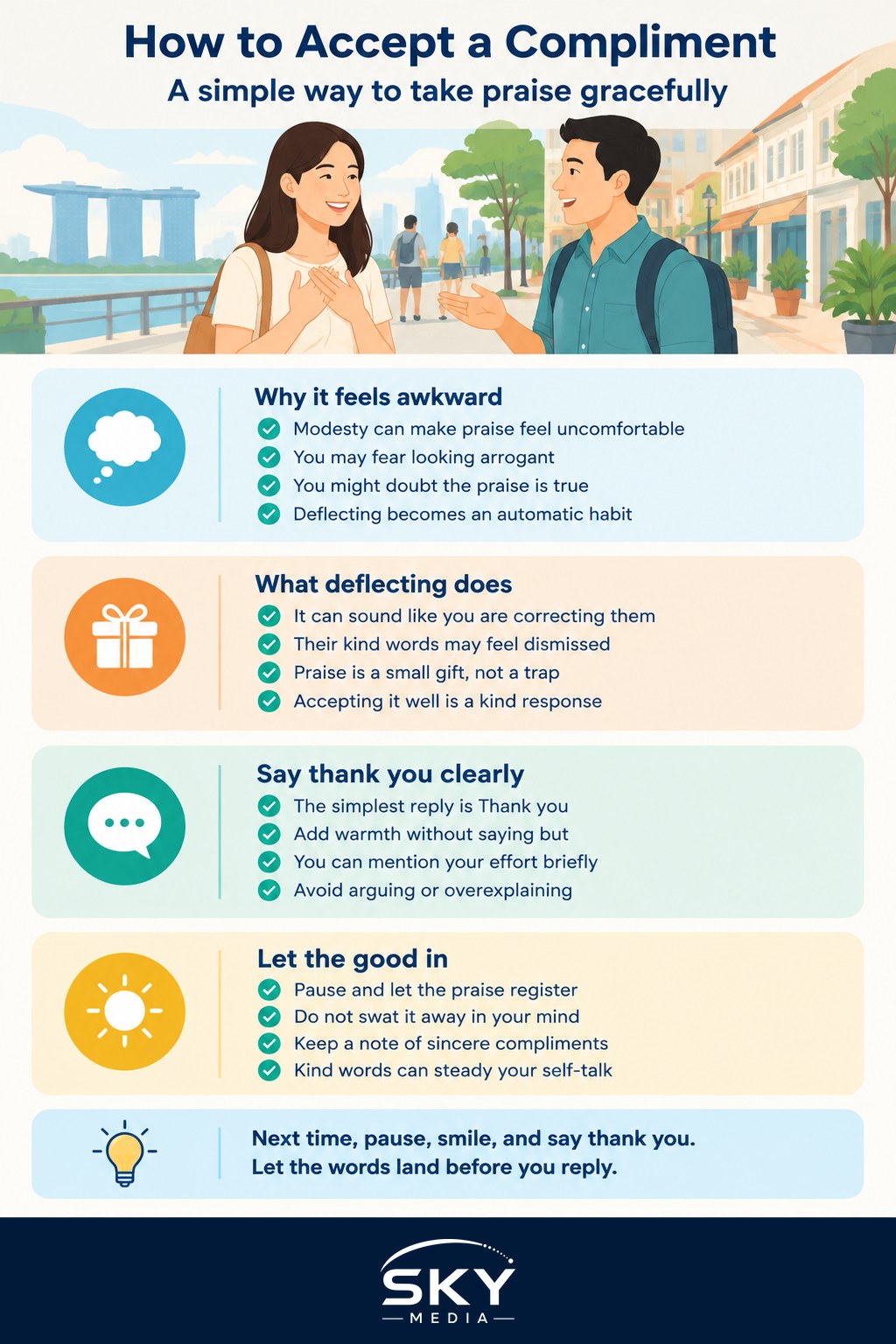
Why Compliments Make Us Squirm
Deflecting praise is so common that it can feel like the polite thing to do. But where does the discomfort actually come from? Usually a mix of a few things.
There is modesty, which many of us are raised to value. Accepting a compliment can feel like showing off, so we shrink it to seem humble. There is also the fear that if we agree with the praise, we will look arrogant or, worse, be found out later as undeserving. And underneath it all, for a lot of people, is a quiet difficulty believing the good thing is true. If part of you does not feel worthy of the compliment, brushing it off is a way to resolve the mismatch.
None of this makes you vain or broken. It is a very human habit. But it is worth noticing, because deflecting has costs. It can sound like you are correcting the other person, and over time, batting away kind words trains your mind to discount the good and hold on to the bad.
What Deflecting Does to the Other Person
Here is an angle that changes things. When someone compliments you, they are giving you a small gift. When you deflect, you are, in effect, handing it back and saying “you’re wrong.”
Imagine telling a friend “I love your presentation, it was so clear,” and they reply “no, it was terrible, I rushed the whole thing.” You would feel a little deflated, maybe even as if your judgement had been dismissed. Deflection does the same to the person praising you, even when you mean it modestly.
Accepting a compliment graciously is actually a kindness. It lets the other person feel that their words landed and were appreciated. Seen this way, receiving praise well is not about ego at all. It is a small act of generosity, and it fits neatly with wanting to develop empathy for the people around you.
The Simple Art of Saying Thank You
The good news is that the fix is short and easy to remember. In most cases, the best response to a compliment is two words. Thank you.
You can add a little warmth without deflecting:
- “Thank you, that really means a lot.”
- “Thank you, I worked hard on it, so I appreciate you noticing.”
- “Thank you, that’s kind of you to say.”
Notice what these have in common. They accept the compliment fully, without a “but” or a downgrade. You are allowed to add a genuine detail, like the effort you put in, as long as you are not shrinking the praise.
A few things to avoid:
- Do not immediately return a forced compliment just to escape the moment. A sincere one later is lovely, but a reflex “you too” can feel like changing the subject.
- Do not argue with the person’s judgement. “No lah, so-so only” corrects them and dismisses your own effort.
- Do not overexplain or list reasons you do not deserve it. Let the kind words stand.
If saying a plain thank you feels strangely hard, that is useful information. It may point to a shaky relationship with your own worth, and gently strengthening how to build self-confidence will make receiving praise feel far more natural over time.
Let the Good Words In
Accepting a compliment is not only about your outward reply. It is also about what you do with the words on the inside. Many of us hear ten kind remarks and one criticism, then spend the evening chewing on the criticism.
Try to actually take in the good. When someone praises you, pause for a second and let it register rather than swatting it away in your mind. You might even keep a small note of genuine compliments you have received, so that on a low day you have real evidence to counter the harsh inner voice. This works hand in hand with learning how to improve your self-talk, because how you speak to yourself shapes whether kind words can find a place to land.
You do not need to become someone who fishes for praise or believes their own hype. This is simply about letting true, kind observations in, the same way you would let in a warm bit of sunshine.
A Warm Wrap-Up
Accepting a compliment well is a tiny skill that quietly improves your relationships and your relationship with yourself. The next time someone says something nice, resist the urge to deflect. Take a breath, meet their eyes, and say thank you. That is all it takes.
It may feel unnatural at first, and that is fine. Practise it in low-stakes moments, notice how the other person warms to it, and let the kind words actually reach you. You are allowed to be seen doing something well. Receiving that gracefully is not arrogance. It is grace.
Frequently Asked Questions
What should I say when someone compliments my appearance? A simple thank you is enough, perhaps with a smile, such as ‘Thank you, that’s kind of you.’ You do not need to explain your outfit or return the compliment straight away. If you feel awkward, keep it short and let the moment pass naturally.
How do I take compliments at work without sounding arrogant? Say thank you and, if you like, credit others who helped, as long as you are not brushing off your own effort. Something like ‘Thank you, the team worked hard on this’ sounds gracious rather than boastful. Avoid hedging with ‘it was luck’.
Why do I feel uncomfortable or suspicious when people praise me? Many people feel uneasy because they were raised to value modesty, or because they quietly doubt that the praise is true. Some also wonder if the speaker wants something. This is common, and practising a calm thank you can make it feel less strange over time.
Is it rude to say ‘no lah’ or ‘aiya, not really’ to a compliment? It is not rude in intent, since it often comes from modesty, but it can sound as if you are correcting the other person. A warm thank you respects both their kindness and your own effort. You can save the modest banter for close friends who know your style.
How do I give a good compliment so others receive it well? Be specific and genuine, such as naming what you noticed and why it mattered, rather than offering a vague ‘good job’. Keep it about the effort or result, not comparisons with others. Saying it kindly and without expecting anything back helps it land.
Further reading: How to Give a Genuine Compliment