

If you want to know how to be a better listener, the honest answer is that it has less to do with your ears and more to do with your attention. Good listening means giving someone your full focus, holding back your own reply, and making them feel understood before you respond. It is a skill you can practise, and it changes almost every relationship you have.
Why most of us listen poorly
We are not bad people. We are just busy, and our brains are quick. While someone speaks, we are often rehearsing our answer, checking our phone, or waiting for a gap to jump in with our own story. The other person can feel this. They sense that we are managing the conversation rather than being in it.
In Singapore, where meetings run back to back and family dinners compete with group chats, the pressure to half-listen is real. The good news is that a few deliberate habits can pull you back into the room.
Give your full attention first
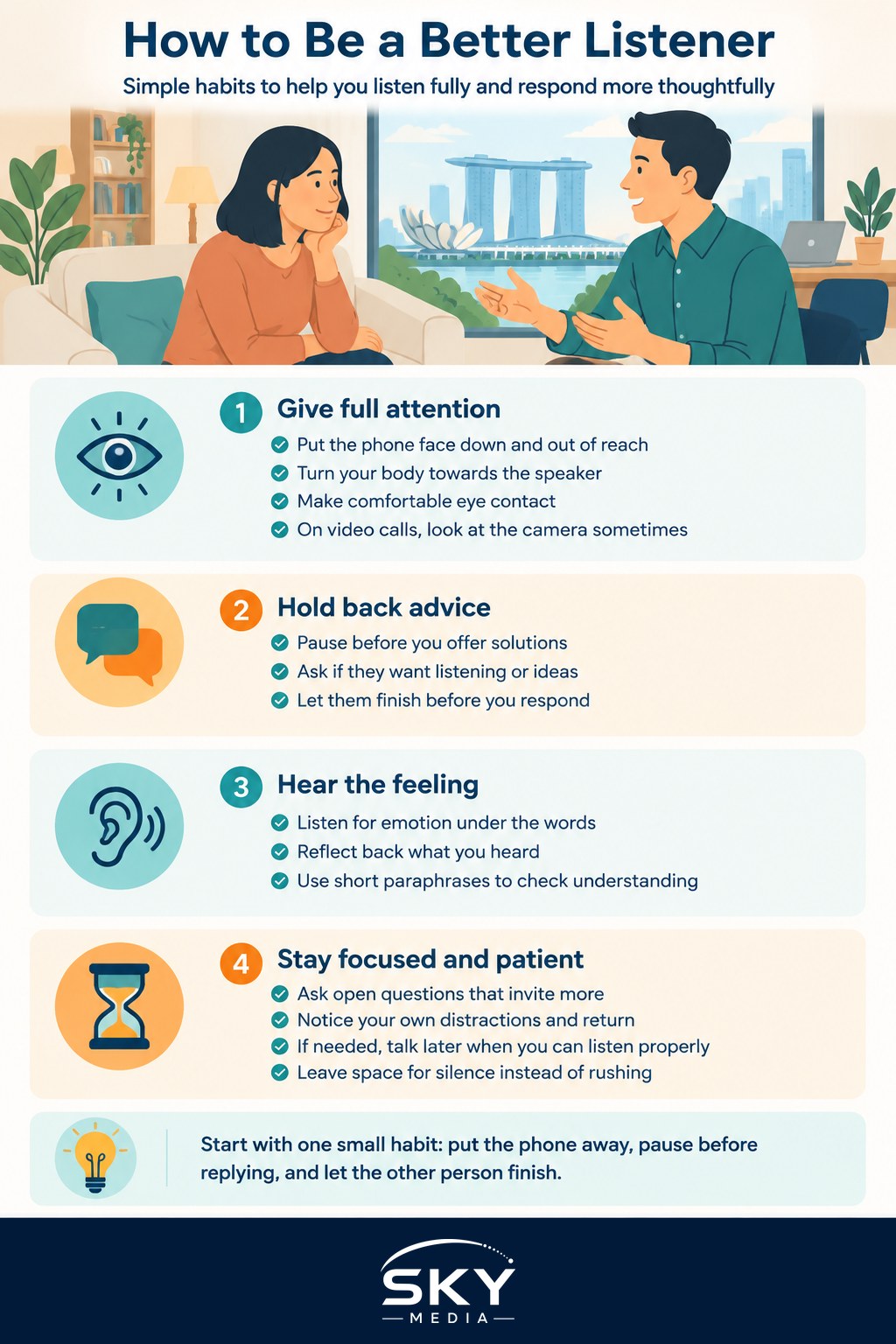
Before anything clever, do the basics. Put the phone face down and out of reach. Turn your body towards the person. Make comfortable eye contact, not a stare. If you are on a video call, look at the camera now and then instead of your own face.
These signals do two things. They tell the speaker you are present, and they force your own brain to commit. It is hard to drift when your posture says you are engaged.
Silence the urge to fix
When a friend shares a problem, the instinct is to leap in with solutions. Often they do not want a fix. They want to be heard. Try holding your advice until they ask for it. A simple line works well: “Do you want me to just listen, or would some ideas help?” That one question saves many conversations.
Listen for the feeling, not just the facts
People rarely say exactly what they mean on the first pass. A colleague who says “the timeline is fine” while sighing is telling you two things. Good listeners track both the words and the emotion underneath.
You can reflect this back gently. “It sounds like the deadline is doable, but you are stretched.” When you name the feeling accurately, the other person relaxes. They feel seen, and they open up further.
Ask questions that go deeper
Weak questions can be answered with yes or no. Strong questions invite the person to keep going. Instead of “Did the meeting go well?”, try “What happened in the meeting?” Instead of “Are you okay?”, try “What has been on your mind lately?”
Follow their lead rather than steering to your own topic. If they mention their mother is unwell, do not pivot to your own family news. Stay with them: “How are you coping with that?”
Do versus don’t at a glance
Here is a quick reference you can keep in mind during your next conversation.
| Do this | Not this |
|---|---|
| Put the phone away and face the speaker | Glance at notifications while they talk |
| Pause before you reply | Jump in the moment they breathe |
| Reflect back what you heard | Change the subject to yourself |
| Ask open questions | Fire yes or no questions |
| Sit with silence | Rush to fill every gap |
| Listen for emotion | Focus only on the facts |
Use short reflections to check understanding
One of the most powerful tools is paraphrasing. After someone finishes a thought, briefly summarise it in your own words. “So the client changed the brief twice, and now you are worried about the launch date.” This does three jobs at once. It proves you were listening, it lets them correct any misunderstanding, and it slows the conversation down enough for real thinking.
Keep reflections short. A long summary can feel like you are performing. One clear sentence is usually enough.
Manage your inner distractions
External distractions are easy to spot. The harder ones are internal. Your mind wanders to your to do list, your reply, or a judgement about what the person just said. When you notice this, gently bring your attention back to their face and voice, the same way you might in a quiet moment of reflection.
If you keep losing focus because you are tired or hungry, be honest. It is kinder to say “I really want to hear this properly, can we talk after lunch?” than to nod through a conversation you are not absorbing.
Handle disagreement without switching off
Listening is hardest when you disagree. The moment someone says something you find wrong, your brain starts building a rebuttal and stops taking in their words. Try to notice that reflex.
You can listen fully and still disagree later. Hearing someone out is not the same as agreeing with them. In fact, when you understand their position properly, your eventual response is far more persuasive because it speaks to what they actually said. This is closely tied to how you handle conflict calmly and how you handle criticism well, where the first move is always to understand before you argue.
Small practices that build the habit
You do not need a course to improve. Try these over the next week.
- In one conversation a day, count to two before you reply.
- Once a day, ask a follow up question instead of sharing your own story.
- At the end of a chat, silently recall one thing the person told you.
- Notice when you are about to interrupt, and let them finish instead.
These are tiny. That is the point. Big change in listening comes from many small moments of restraint, repeated until they feel natural.
When listening is emotional labour
Sometimes people bring you heavy things: grief, stress, a hard decision. Listening well here is a gift, but it can drain you. Give what you can, then protect your own energy. You are allowed to say, “I care about this, and I need a short break so I can keep giving you my full attention.” Being a generous listener does not mean having no limits.
The quiet reward
When you become a better listener, people start to seek you out. They trust you with more. Conversations feel less like a contest and more like a shared space. You will also learn far more about the people around you, which makes you wiser in return.
Start small, stay patient, and let your attention do the work. The next time someone speaks to you, give them the rare gift of being truly heard.
Explore more: How to Develop Emotional Intelligence in Singapore · How to Handle Conflict Calmly · How to Become More Self-Aware
Frequently Asked Questions
How do I listen to someone who talks too much? Start by accepting that you do not have to absorb every detail. Listen for the main point or feeling, reflect it back in one short sentence, and then gently steer or close the chat. Being honest about your time is kinder than nodding while you switch off.
How can I listen better to my teenage child? Pick a calm moment, put your phone away and let them finish before offering opinions. Teens often share more when they do not feel they are being lectured. Ask open questions, reflect what you heard and ask whether they want advice or just someone to listen.
How do I listen well on video calls or chat? Close other tabs, silence notifications and look towards the camera now and then. On chat, reply to what the person actually wrote rather than skimming, and check you understood before responding to anything sensitive. A quick call can be better than a long message thread for emotional topics.
Is staying quiet the same as listening well? Not quite. Silence helps, but listening also means showing you are following, through eye contact, a nod or a short reflection of what you heard. Someone who says nothing and looks distracted does not feel heard. The aim is attention that the speaker can feel.
How long does it take to become a better listener? There is no fixed timeline, but small changes can be noticed fairly quickly. Practising a pause before replying or asking one follow-up question a day builds the habit steadily. Expect progress to come from repeated everyday moments rather than one big effort.