

Kindness is easy to admire and easy to forget. We mean to check in on a friend, thank the person who helped us, or give someone the benefit of the doubt, and then the day gets busy and the moment passes. Building a kindness habit in Singapore is about closing that gap between good intentions and small actions, so that being thoughtful becomes something you do by default rather than only when you happen to remember. The good news is that kindness responds well to habit-building. Made small and regular, it quietly reshapes your days and your relationships.
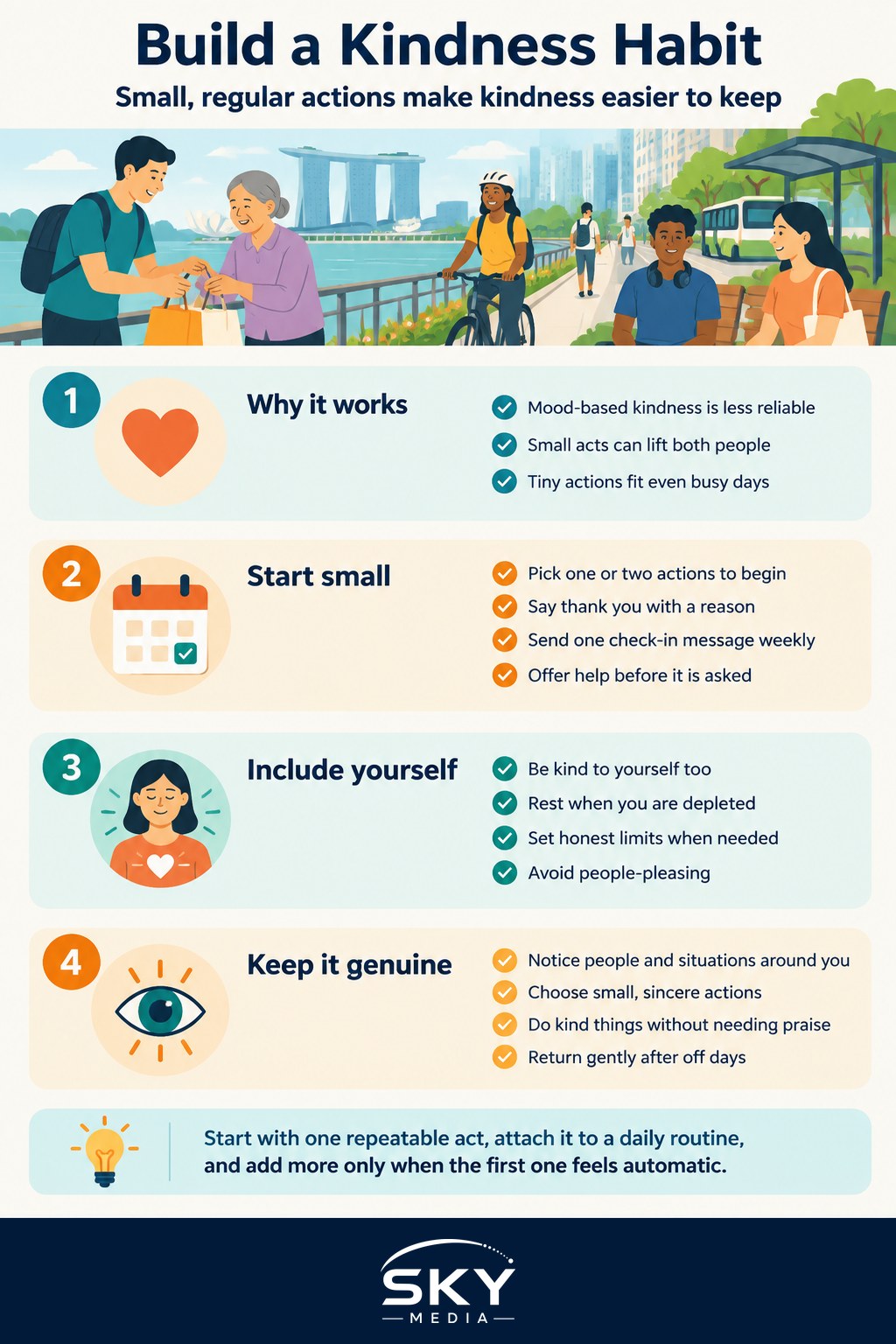
Why Kindness Works Better as a Habit
When kindness depends on mood, it is unreliable. On a good day you are warm and generous. On a stressed, rushing, running-for-the-MRT day, it disappears exactly when it would matter most. Turning kindness into a habit means it no longer needs perfect conditions.
There is a quiet benefit for you too. Small acts of kindness tend to lift the person doing them, not just the person receiving them. Holding a lift, letting a car merge, or sending a genuine thank you gives a small sense of connection and meaning, which is no small thing in a fast, sometimes impersonal city.
It helps to drop the idea that kindness has to be grand. You do not need to volunteer every weekend or give money you do not have. A habit is built from things so small you can do them even when tired: one warm word, one patient pause, one bit of help offered without being asked.
Start Small and Specific
Vague goals like “be kinder” rarely stick because they do not tell you what to actually do. Specific, small actions do. Pick one or two to begin with and let them become automatic before adding more.
Some easy starting points:
- Say thank you properly to one person a day, naming what they did.
- Send one message a week to check in on someone, with no agenda.
- Give a sincere compliment when you notice something good.
- Let small annoyances go instead of reacting, and assume the other person is having a hard day.
- Offer help before it is requested: a seat, directions, a hand with bags.
The strongest way to make these stick is to attach them to things you already do. This is the core idea behind habit stacking: pair a new action with an existing routine. For example, “while my kettle boils, I send one kind message,” or “when I reach my desk, I thank one colleague.” The old habit becomes the reminder for the new one.
If you want kindness to hold up over months rather than fizzle out in a week, it is worth understanding how habits actually stick in general. Cues, small size, and consistency matter far more than motivation or good intentions.
Include Yourself in the Kindness
A kindness habit that is only pointed outward tends to run dry. If you are harsh with yourself, constantly self-critical, or never allowed to rest, you will eventually have less warmth to give anyone else. Being kind to yourself is not indulgent. It is what keeps the whole thing sustainable.
This means talking to yourself the way you would talk to a good friend who is struggling: with patience rather than contempt. It means letting yourself off the hook for small mistakes, resting when you are depleted, and not treating your own needs as less important than everyone else’s. Practising self-compassion is genuinely part of a kindness habit, not a separate project.
Watch out, too, for kindness that quietly turns into people-pleasing. Real kindness comes from care and choice. People-pleasing comes from fear of disappointing others, and it often leaves you drained and resentful. You can be warm and still say no. In fact, honest limits are a form of respect, for the other person and for yourself.
Make It Genuine, Not Performative
Kindness lands differently when it is real. People can usually tell the difference between someone being nice to look good and someone actually paying attention to them. So aim for small and sincere over big and showy.
A large part of genuine kindness is simply noticing. Slowing down enough to see that a colleague looks tired, that a friend went quiet, that a stranger is struggling with a pram on the stairs. In a busy environment it is easy to move through the day without really seeing anyone. The habit of looking up and paying attention is where most kindness begins.
You also do not need thanks for it to count. Some of the best kindness is quiet: the credit you do not take, the help nobody sees, the patience you extend when it would be easier to be sharp. Letting go of the need to be noticed keeps the habit honest.
Keep It Going Gently
You will have off days when you are short-tempered, distracted, or simply out of energy. That does not undo the habit. Kindness is not a scorecard, and one snappy morning does not cancel out weeks of warmth. Just return to it the next chance you get.
Start this week with one small, repeatable act. Choose it, attach it to something you already do, and let it run until it feels automatic. Then, if you like, add another. Over time these tiny choices add up to something that shapes how people experience you and how you feel about your own days. A kinder life is built the same way any good habit is: one small, ordinary action at a time.