
There is no single “best” card, and anyone who tells you otherwise is usually selling one. The truth about credit cards in Singapore is simpler and more useful: the right card is the one that matches how you actually spend, that you can qualify for, and that you can pay off in full every month. Get those three things right and the rewards take care of themselves.
This is a framework, not a ranking. Products, rates and promotions change constantly, so instead of naming winners we will teach you how to weigh the choices yourself. Think of it as general information to help you decide, not financial advice.

Start with how you actually spend
Before you compare a single card, look backwards. Pull up two or three months of bank statements and sort your spending into rough buckets: groceries and dining, transport and fuel, online shopping, overseas travel, bills and subscriptions. Most people are surprised by where their money really goes.
Your spending pattern points to the type of card that suits you:
- Cashback cards give you a small percentage back as a statement credit or rebate. Simple, flexible, and easy to value because a dollar back is just a dollar.
- Rewards points cards earn points you redeem for vouchers, products or bill offsets. Value varies a lot depending on how you redeem.
- Air miles cards earn miles for flights and upgrades. An air miles card shines if you fly often or travel overseas, and looks poor if you never leave the ground.
Cashback vs miles: the honest comparison
The classic decision is cashback vs miles, and it comes down to how you live rather than which sounds more glamorous.
Cashback is predictable. You spend, you get a fixed rebate, you see it on your statement. It rewards everyday spenders who want no fuss and no expiry dates to track.
Miles are aspirational and can be worth more per dollar, but only if you redeem them well, usually on flights rather than cashing them out. If you rarely fly, miles can quietly expire before you use them. As a rough guide, ask yourself: will I realistically book flights with these, or am I chasing a reward I will never claim?
A quick rule of thumb: if you cannot clearly explain how you will redeem your miles, you probably want cashback instead.
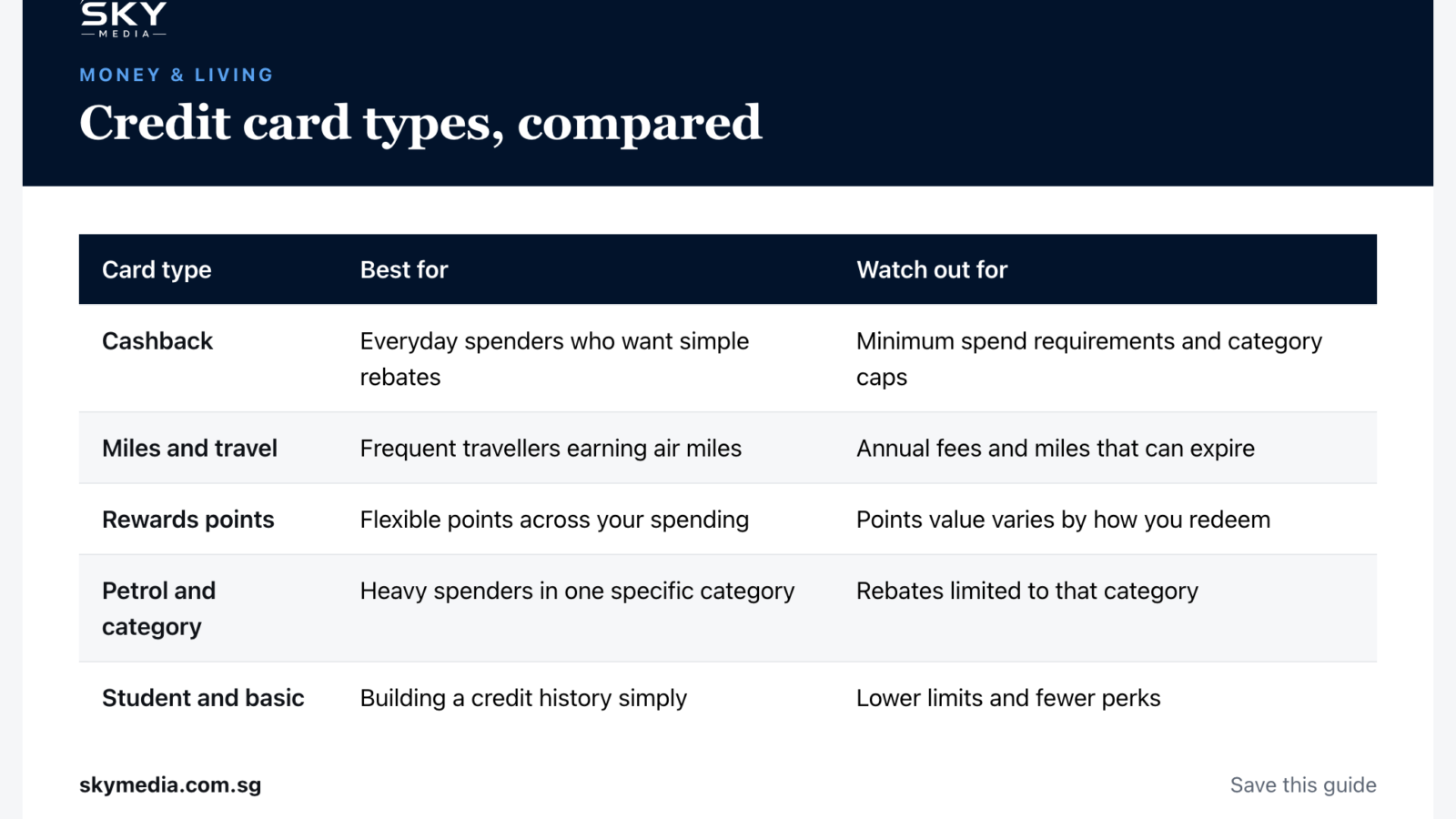
Here is how the main card types compare:
| Card type | Best for | Watch out for |
|---|---|---|
| Cashback | Everyday spenders who want simple rebates | Minimum spend requirements and category caps |
| Miles and travel | Frequent travellers earning air miles | Annual fees and miles that can expire |
| Rewards points | Flexible points across your spending | Points value varies by how you redeem |
| Petrol and category | Heavy spenders in one specific category | Rebates limited to that category |
| Student and basic | Building a credit history simply | Lower limits and fewer perks |
Check your eligibility before you apply
Nothing stings like choosing the perfect card and then being declined. Credit card eligibility in Singapore is set by the issuing bank within guidelines from the Monetary Authority of Singapore, and the headline number is annual income.
- Residents (citizens and permanent residents): most cards ask for a minimum annual income, commonly in the region of S$30,000 for entry-level cards, with premium cards asking considerably more.
- Foreigners and newcomers: the income bar is usually set higher, and you may be asked for additional documents such as your employment pass, proof of income and sometimes a fixed deposit as security.
You will typically need to show identity documents, proof of income such as recent payslips or tax statements, and in some cases a minimum period of employment. Applicants under 21 face tighter rules. These thresholds move over time, so confirm the current requirements directly with the bank before you apply. Applying for several cards at once and getting rejected can also work against you, so choose deliberately rather than scattering applications.
Understand annual fees and waivers
Many cards carry an annual fee, sometimes waived for the first year or two as a sign-up sweetener. After that, you are expected to pay it, unless you ask.
Here is the part banks do not advertise: an annual fee is often waivable. If your card charges one, a quick call or app request to waive it frequently succeeds, especially if you use the card regularly. Some cards waive the fee automatically once you spend above a threshold in a year.
When weighing a fee, do the maths honestly. A card with a S$150 annual fee only makes sense if the rewards you will genuinely earn and use comfortably exceed that. A “free” card you actually use often beats a premium card whose perks you never touch.
Quick checklist before you commit:
- Does my main spending category earn a good rate on this card?
- Can I meet the eligibility and income requirements today?
- Is there an annual fee, and can it be waived or offset by my spending?
- Are the rewards easy for me to redeem in real life?
- Can I pay the full balance every month without strain?
Interest, and why paying in full is everything
This is the single most important idea in this whole guide. Credit card interest in Singapore is high, often around 26 to 28 percent per year as a rough guide, and it is charged when you do not pay your statement in full.
The mechanics are unforgiving. Pay the full amount by the due date and you generally pay zero interest, effectively borrowing for free while you keep your cash a little longer. Pay only the minimum and interest compounds on the rest, plus new purchases may start accruing interest immediately. A rewarding card used carelessly becomes an expensive loan.
So the golden rule: treat your credit card like a debit card with benefits. Only charge what you already have the money to cover, and set up a full-balance payment, ideally by GIRO or automatic transfer, so you never miss a due date. If you ever cannot pay in full, that card is costing you far more than any cashback or miles it earns.
Foreign currency and overseas spending
If you travel or shop online from overseas merchants, look closely at foreign-currency charges. Cards typically add a fee of roughly 3 to 3.5 percent on overseas and foreign-currency transactions, combining a network fee and the bank’s own markup. That quietly eats into the miles or cashback you earn abroad.
A few things worth knowing:
- Watch for dynamic currency conversion, where an overseas terminal offers to charge you in Singapore dollars. It sounds convenient but usually gives you a worse rate. Choose to be charged in the local currency instead.
- If you travel often, an air miles card or a card designed for overseas spend may offset these fees. If you rarely travel, do not pay for travel perks you will not use.
- For sending money abroad regularly, a credit card is rarely the cheapest route. Dedicated remittance services usually cost less.
Using credit responsibly
A credit card is a tool, and like any tool it rewards good habits and punishes careless ones. Used well, it offers convenience, security, a short interest-free window and rewards on money you were going to spend anyway.
Keep a few principles in mind. Charge only what you can repay in full. Keep your total credit use well below your limit rather than maxing it out. Review your statement each month for anything unfamiliar. And resist collecting cards you do not need just for a sign-up bonus, since more cards mean more fees and more due dates to manage.
Choosing among credit cards in Singapore is really about self-knowledge. Match the card to your spending, clear the eligibility bar, keep fees in check, and pay in full without fail. Do that, and the card works for you instead of the other way around.
Explore more: Budgeting in Singapore and Sending money home from Singapore