

If you are working, studying, or newly settled here, sooner or later you will want to send money home. The good news is that remittance in Singapore is well established, competitive, and closely watched by the authorities. Whether you are supporting family, paying tuition, or moving savings back to an account overseas, you have several safe ways to remit money from Singapore. This guide walks through your options, how to compare the true cost, and how to keep every transfer secure.
A quick note first: this is general information, not financial advice. Fees and exchange rates change constantly, so always confirm the current numbers with the provider before you send.
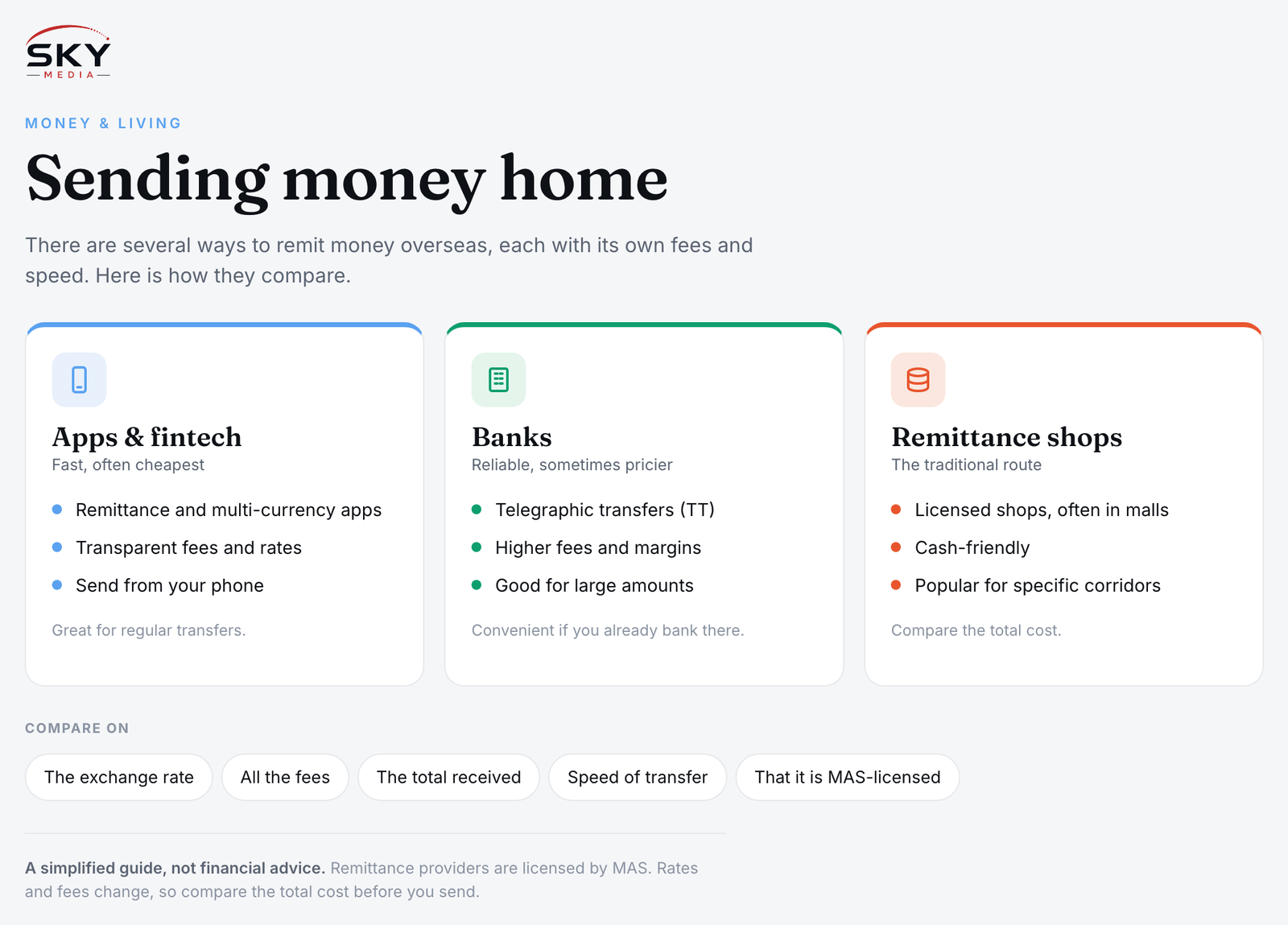
Your options for sending money abroad
There is no single “best” way to send money home. The right choice depends on how much you are sending, how fast it needs to arrive, and where it is going. Broadly, you have three routes.
Bank telegraphic transfer
Your bank can send an international wire, often called a telegraphic transfer or TT, straight from your account to a bank account overseas. It is convenient if you already do everything through your bank app, and it suits larger amounts where you value the paper trail. The trade-offs are that banks often charge a fixed fee plus intermediary bank charges, and their exchange rates can carry a wider margin than specialist services. Transfers can take a few working days to land.
Licensed remittance agents and money changers
Singapore has many licensed remittance shops, including counters you will spot in malls and neighbourhood centres such as those around Lucky Plaza, City Plaza, and other well-known spots. Staff often speak the languages of the communities they serve, which makes them popular with migrant workers and families sending regular amounts. Rates can be sharp, especially for popular corridors, and cash payment is usually accepted. Always check that the shop is properly licensed before handing over money.
Digital and app-based services
A growing number of digital services let you remit money from Singapore entirely through an app or website. Providers such as Wise are one example of this category, along with various bank-linked and app-based transfer options. You fund the transfer from your bank account or card, and the money is delivered to an overseas bank account, mobile wallet, or cash pick-up point. These services often show the fee and exchange rate upfront, which makes them easy to compare. Speed varies from minutes to a couple of days depending on the destination and payment method.
How to compare the true cost
The headline fee is only half the story. To know what a money transfer really costs you, look at two things together.
- The transfer fee. This is the flat or percentage charge shown at checkout. It is the obvious cost, but often the smaller one.
- The exchange rate margin. Providers usually add a markup on top of the “real” mid-market rate. That hidden margin can quietly cost more than the visible fee, especially on larger amounts.
A simple way to compare remittance fees fairly is to ask one question: how much money will actually land in the recipient’s account? Enter the same amount across two or three providers and compare the final figure the recipient receives after all fees and the exchange rate. The one that delivers the most is usually the cheapest, no matter how the fee is labelled.
Look up the mid-market rate for your currency pair online first. If a provider’s rate is far from it, the difference is the margin you are paying.
Speed, limits, and documents
Speed. Cash pick-up and mobile wallet transfers can be near instant on some corridors, while bank-to-bank transfers usually take one to a few working days. Weekends, public holidays, and time zones in the destination country can add delays.
Limits. Providers and regulations set limits on how much you can send per transaction, per day, or per month. Larger sums may need extra verification or supporting documents. If you are moving a big amount, ask about limits before you start.
Documents you will typically need. Have these ready to make your first transfer smooth:
- A valid photo ID, such as your passport, and often your work pass, student pass, or FIN.
- Proof of address in Singapore, in some cases.
- The recipient’s full name exactly as it appears on their account, plus their account number or IBAN and the bank’s code.
- For larger transfers, proof of the source of funds, such as a payslip.
Safety: use MAS-licensed providers
This is the most important part. In Singapore, remittance and money-transfer businesses must be licensed and are regulated by the Monetary Authority of Singapore (MAS). Using a licensed provider means your transfer is handled by a business that meets the country’s standards for security and conduct.
Before you send, protect yourself with a few simple checks:
- Confirm the provider is MAS-licensed. You can check the Financial Institutions Directory on the MAS website. Reputable shops and apps will state their licence clearly.
- Never send money through unlicensed individuals offering “better rates” on social media or messaging apps. If something goes wrong, you may have no protection.
- Always ask for a receipt and keep it until the money is confirmed as received.
- Double-check the recipient’s details yourself. Most failed or delayed transfers come from a wrong account number or misspelled name.
- Be alert to scams. No legitimate provider will ask you to move money to “release” a transfer or to help a stranger.
Tips for regular transfers
If you send money home every month, small habits add up to real savings over a year.
- Compare a few providers now and then. Rates and fees change, and the best option for your corridor can shift over time.
- Watch the exchange rate. If your currency pair swings a lot, sending when the rate is in your favour can stretch each transfer further.
- Consider timing and frequency. Sometimes one larger transfer costs less in total fees than several small ones. Weigh that against when your family actually needs the money.
- Keep your details saved. Most apps let you store a recipient so repeat transfers take seconds.
- Set a budget. Knowing your typical monthly costs here makes it easier to plan how much you can comfortably send.
Quick checklist before you hit send
- Provider is MAS-licensed.
- You compared the final amount the recipient receives, not just the fee.
- Recipient’s name and account details are correct.
- You understand the fee and the exchange rate margin.
- You have your receipt and reference number.
Sending money home should feel routine and reassuring, not stressful. Once you have found a licensed provider you trust and learned to compare the real cost, remittance from Singapore becomes just another simple monthly task. Take a little care the first time, and every transfer after that gets easier.
Explore more: Cost of living in Singapore · Using WeChat Pay and Alipay in Singapore · How to open a bank account in Singapore