

Some goals cannot be reached in a weekend. Finishing a qualification, building a skill, saving steadily, healing from a setback, or growing something meaningful all take time, and time tests us. This staying power, the ability to keep going through the slow, unglamorous middle, is what people mean by grit. Developing grit and perseverance in Singapore does not require punishing yourself or grinding non-stop. In fact, the most durable perseverance is built on rest, self-kindness, and a pace you can actually sustain.
Let us set the record straight from the start. Grit is not about hustling until you burn out, ignoring your limits, or treating every rest as a weakness. That version of “never give up” tends to break people. Real perseverance is quieter and gentler than the motivational posters suggest. It is the ability to keep returning to something you care about, unhurriedly, even after slow days and setbacks. That is a skill anyone can grow.
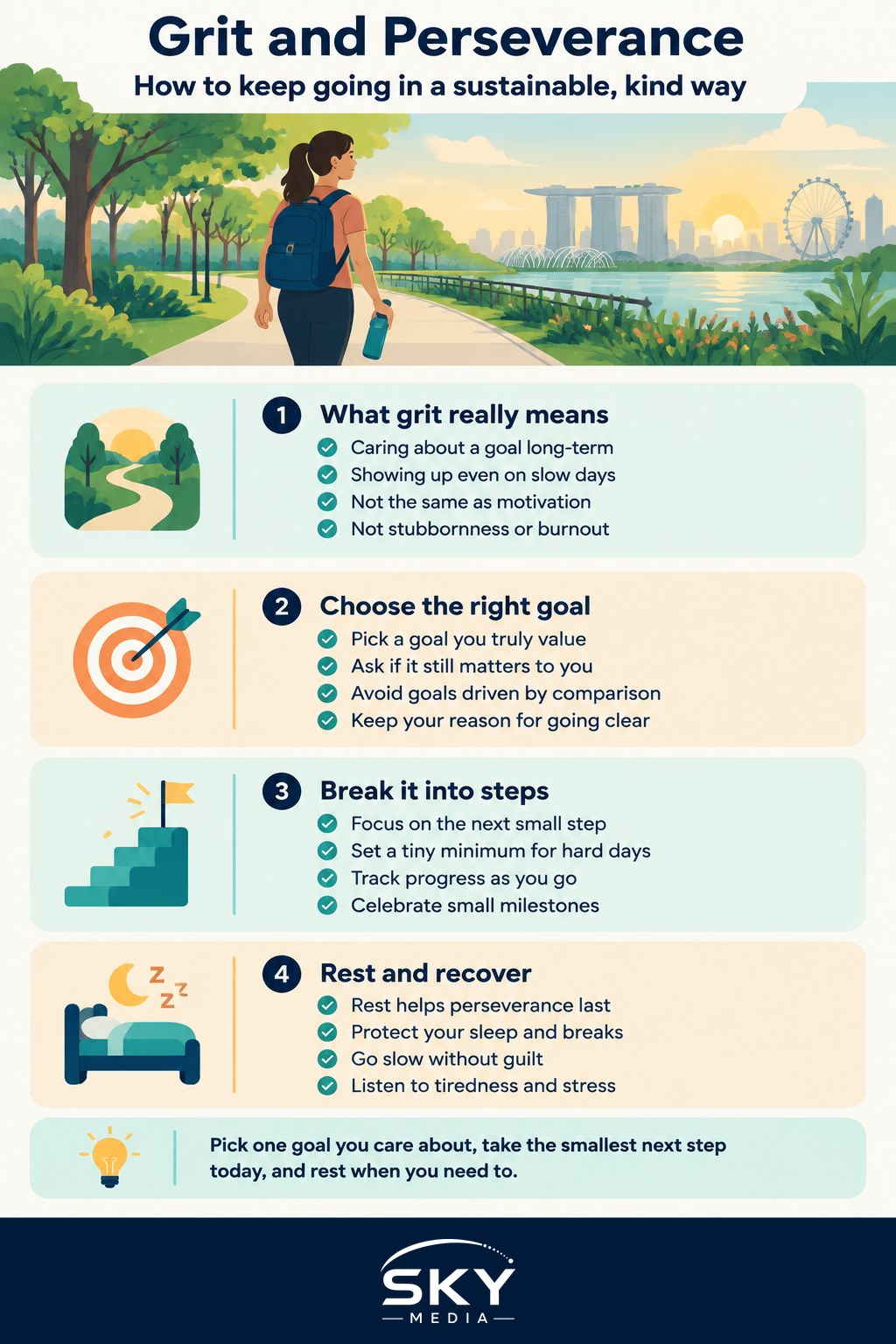
What Grit Actually Is
Grit is a blend of two things: caring about a goal over the long haul, and being willing to keep showing up for it. Notice that neither of those requires being intense every single day. A person walking a long road does not sprint. They keep a steady, comfortable pace, and they stop to rest when they need to. That is exactly how sustainable perseverance works.
It helps to separate grit from motivation. Motivation is the burst of energy you feel at the start, and it naturally fades. Perseverance is what carries you when that feeling is gone. This is why relying on feeling motivated is a shaky plan; the article on discipline vs motivation, what works unpacks this well. The gritty person is not someone who always feels like it. It is someone who has built gentle systems so they can keep going even when they do not.
Importantly, grit is not stubbornness. Sometimes the wise, gritty choice is to change your method, ask for help, or even let go of a goal that no longer fits. Perseverance serves you; you do not serve it.
Choose Goals Worth the Long Road
Perseverance is far easier when you genuinely care about where you are heading. It is very hard to keep at something for its own sake if it means little to you, or if you only picked it because everyone else seemed to be chasing it. Comparison pressure is strong in Singapore, and plenty of people persevere for years towards goals that were never really theirs.
So before you push for staying power, get honest about the destination. Does this goal connect to something you actually value? Would you still want it if nobody was watching? Spending time on finding your personal values can save you years of grinding towards the wrong thing. Grit aimed at a goal you love feels completely different from grit forced onto one you do not.
Once you know it matters, remind yourself of the “why” when things get hard. A clear reason is fuel that lasts far longer than a fleeting mood.
Break the Long Road Into Small Steps
Big goals can feel overwhelming when you stare at the whole thing at once. The distance is so vast that stopping feels reasonable. The fix is to shrink your focus to the next small step, and only that step.
- Set a tiny minimum for hard days. On a good day you might do a lot; on a low day, doing the smallest version still counts and keeps the chain unbroken.
- Track your progress so you can see how far you have come, not just how far is left. Looking back is quietly motivating.
- Celebrate small milestones. You do not have to wait until the finish line to feel good about the journey.
This is really the practice of how to break big goals into steps, and it is one of the kindest things you can do for your own perseverance. A long road walked one manageable step at a time is far less likely to defeat you than one you keep viewing as a single, impossible leap.
Rest Is Part of Perseverance, Not the Opposite
This is the part that hustle culture gets badly wrong. Rest is not the enemy of grit; it is what makes grit possible over the long term. Muscles grow during recovery, not only during effort, and the same is true of your energy, focus, and resolve. Push with no rest and you do not become tougher, you break down.
So build rest in on purpose. Take proper breaks. Protect your sleep. Have days where you do the bare minimum, or nothing at all, without guilt. Going slowly through a hard season is not giving up; it is pacing yourself so you can still be going next month and next year. Anyone who has kept at something for a long time will tell you they slowed down many times along the way. If you are running low, how to avoid burnout is essential reading, because burnout ends far more journeys than a lack of effort ever does.
Listen to your body and mind. Tiredness, dread, and constant irritation are signals worth heeding, not weaknesses to override. Honouring them is what lets you keep going for the distance.
Keep Going After Setbacks
No long journey runs in a straight line. You will hit obstacles, plateaus where nothing seems to improve, and days you fall off entirely. Perseverance is not about never falling; it is about how gently and reliably you return.
When a setback hits, resist the urge to read it as proof that you are not cut out for this. It is simply part of the terrain everyone crosses. Treat a missed week as a pause, not a failure, and step back in without drama or self-punishment. The story you tell yourself here matters enormously; if you tend towards harsh self-talk, a kinder, sturdier inner voice will help you recover far better than criticism ever will.
Above all, drop the “no excuses, just try harder” script. It is not true and it does not help. The people who go the distance are not the hardest on themselves. They are the ones who keep coming back, gently, again and again.
The Quiet Power of Showing Up
Grit, in the end, is unremarkable up close. It is a person returning to something they care about, day after day, at a pace they can sustain, resting when they need to, forgiving themselves when they slip, and starting again. There is nothing flashy about it, and that is exactly why it works.
You do not need to become intense or relentless. You need a goal that matters, small steps, real rest, and the willingness to come back after setbacks. Choose one goal you care about and take the smallest next step today. Then rest if you need to, and take another step tomorrow. That, quietly repeated over time, is how perseverance is built, and you are more capable of it than you think.
Frequently Asked Questions
Can grit be taught to children? Yes, children can build perseverance through small, achievable challenges and encouragement. Praise their effort and strategies rather than only results, and let them try again after mistakes. Adults who model patience and rest also show that persistence need not mean pressure.
How do I know when to quit and when to keep going? Ask whether the goal still matches your values and whether you are making progress, even slowly. If the cost to your health or wellbeing outweighs the benefit, or the goal no longer fits, changing course is wise. Quitting a goal is not the same as giving up on yourself.
How do I stay committed to long-term study or a career change? Break the journey into small milestones, set a manageable weekly routine and keep your reason in sight. Tracking progress helps on low days. For the cost and support available for courses, check the latest information from SkillsFuture or SWDA.
Is perseverance the same as stubbornness? No. Stubbornness sticks to one method regardless of results, while perseverance stays committed to the goal and adjusts the approach. A gritty person asks for help, changes tactics or lets go when something no longer serves them.
What can help me restart after a long break or major failure? Start with the smallest possible step, such as ten minutes, rather than trying to catch up. Be kind about the gap and focus on rebuilding a routine. If low mood is stopping you, speak to a doctor or counsellor.
Further reading: How to Develop Courage