

Talent gets a lot of attention, but ask anyone who has genuinely mastered a subject and they will usually talk less about being gifted and more about not giving up. The ability to keep going when work is hard, boring, or discouraging is often what separates those who make it from those who quietly drift away. Grit in learning singapore students can build over time, and it matters just as much for a struggling secondary schooler as for an adult returning to study after years away.
This guide looks at what grit really is, why it beats raw talent over the long run, and how to build it without slipping into unhealthy grind.
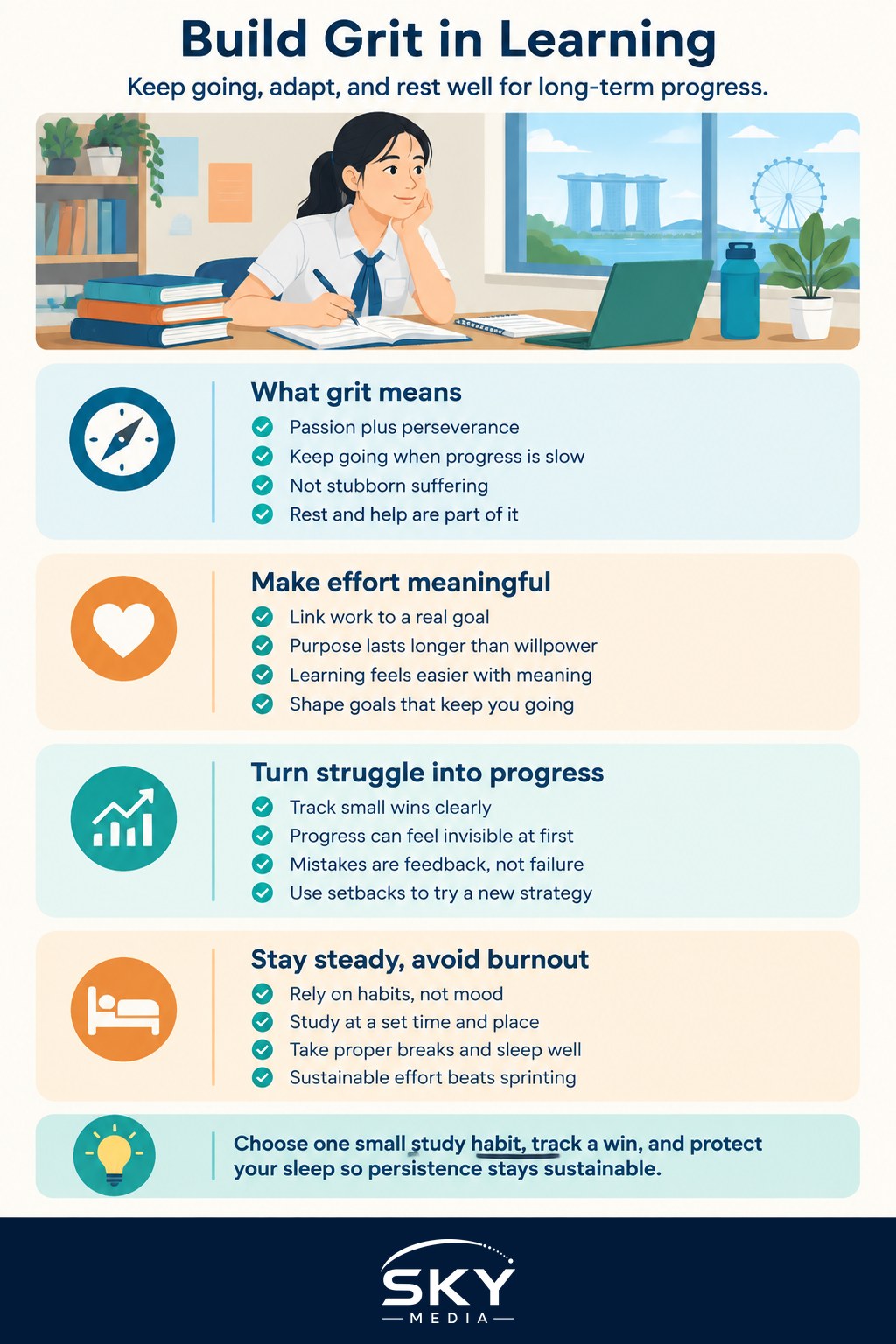
What Grit Actually Means
Grit is often described as a mix of passion and perseverance for long term goals. In plain terms, it is the willingness to keep working towards something that matters to you, even when progress is slow and the initial excitement has worn off.
It helps to clear up what grit is not. It is not stubbornly pushing through at all costs while ignoring your health. It is not refusing to ever change course. And it is certainly not about proving you can suffer. Real perseverance is sustainable. It includes rest, adjustment, and asking for help, because those are what let you keep going for the long haul rather than burning out in a month.
There is a strong link between grit and the belief that ability can grow. If you see intelligence as fixed, a setback feels like proof you are simply not cut out for the subject, so you stop. If you see ability as something you build through effort and good strategy, a setback becomes a signal to try differently, and you carry on. That second mindset is the soil grit grows in.
How to Build Perseverance in Practice
Grit is not a fixed trait you either have or lack. It is more like a muscle, strengthened by how you handle difficulty over time.
Connect the hard work to something you care about
Perseverance is far easier when the effort has meaning. Pure willpower runs out fast, but purpose lasts. Remind yourself why the subject or skill matters to you, whether it is a course you want, a career you are aiming for, or simply the satisfaction of getting good at something. When the goal feels real, tedious work becomes more bearable. Giving your goals this kind of shape links closely to setting learning goals that stick.
Make progress visible
One reason people quit is that progress in learning is often invisible day to day. You study for a week and feel no cleverer, so you assume you are getting nowhere. Counter this by tracking small wins, such as topics covered, questions you can now do, or a skill that felt impossible last month. Seeing the trail behind you makes the road ahead feel worth walking.
Reframe struggle as the work, not a warning
Perhaps the most important shift is to expect difficulty rather than being discouraged by it. Confusion and struggle are not signs that something is wrong. They are what learning actually feels like when it is happening. Treating mistakes as feedback rather than failure keeps you moving, and the mindset in learning from your mistakes is a key part of gritty learning. When you hit a wall, the answer is usually a different strategy, and knowing something about learning how to learn gives you more tools to try before you conclude you cannot do it.
Build habits so you do not rely on motivation
Motivation comes and goes, and grit that depends on feeling inspired is fragile. Habits carry you through the flat days. If studying happens at a set time in a set place, you do it without needing to feel like it, and consistency over months is where real progress lives. Strengthening this side of things through building self-discipline for studying makes perseverance far less exhausting, because it stops being a daily battle of the will.
Perseverance Without Burnout
Here is the crucial balance. Grit is about endurance, and you cannot endure if you run yourself into the ground. Sustainable perseverance includes rest, sleep, and stepping back when you need to. Pushing through exhaustion is not grit. It is a fast route to burnout, which ends progress entirely.
So build in recovery on purpose. Take proper breaks, protect your sleep, and treat rest as part of the work rather than a reward you have not earned. The goal is to still be going strong in six months, not to sprint until you collapse.
A Steadying Word
Every capable person you admire has wanted to quit at some point. What set them apart was not that learning came easily, but that they kept turning up, adjusting, and trying again. You can do the same. Pick something that matters, expect the hard days, protect your rest, and keep taking the next small step. Over time, that quiet persistence adds up to more than talent ever could on its own.
Frequently Asked Questions
Is grit more important than talent for exam results? Neither works alone, but sustained effort and good strategy often matter more over the long run than raw talent. Believing ability can grow helps you treat setbacks as signals to try differently. Grit should be sustainable though, with rest and help included, not endless pushing.
How do I keep going when a subject feels boring or hopeless? Reconnect the work to something you care about, such as a course you want or the satisfaction of improving. Shrink the task to something small, track wins like topics covered, and expect difficulty rather than being discouraged by it. Try a different strategy before concluding you cannot do it.
What is the difference between grit and burning myself out? Grit is endurance over the long haul, which depends on rest, sleep and stepping back when needed. Pushing through exhaustion is a fast route to burnout, which ends progress. Build recovery in on purpose, so you are still going strong months from now.
Can adults returning to study build grit too? Yes. Grit is closer to a muscle than a fixed trait, strengthened by how you handle difficulty over time. Adults often have a clear purpose, which helps. Use habits rather than motivation to carry you, and ask for help from tutors or course mates when stuck.
How can parents encourage perseverance without adding pressure? Praise effort, strategy and improvement rather than only marks, and treat mistakes as part of learning. Help your child see progress, such as questions they can now do. Make sure rest and sleep are protected, and speak to a teacher or counsellor if stress seems heavy.
Further reading: Building Resilience in Children