

Somewhere on the way from junior to senior, the nature of the work changes. Early on, you succeed by executing tasks well. Later, you are expected to see the bigger picture, connect the dots, and make choices that shape where things go, not just how they get done. That shift is what people mean by strategic thinking, and it is one of the most valued and least taught skills in any career. The encouraging truth is that developing strategic thinking is not about being born clever or getting a fancy title. It is a set of habits you can build deliberately, whatever your role or level, starting today.
Understand What Strategic Thinking Really Means
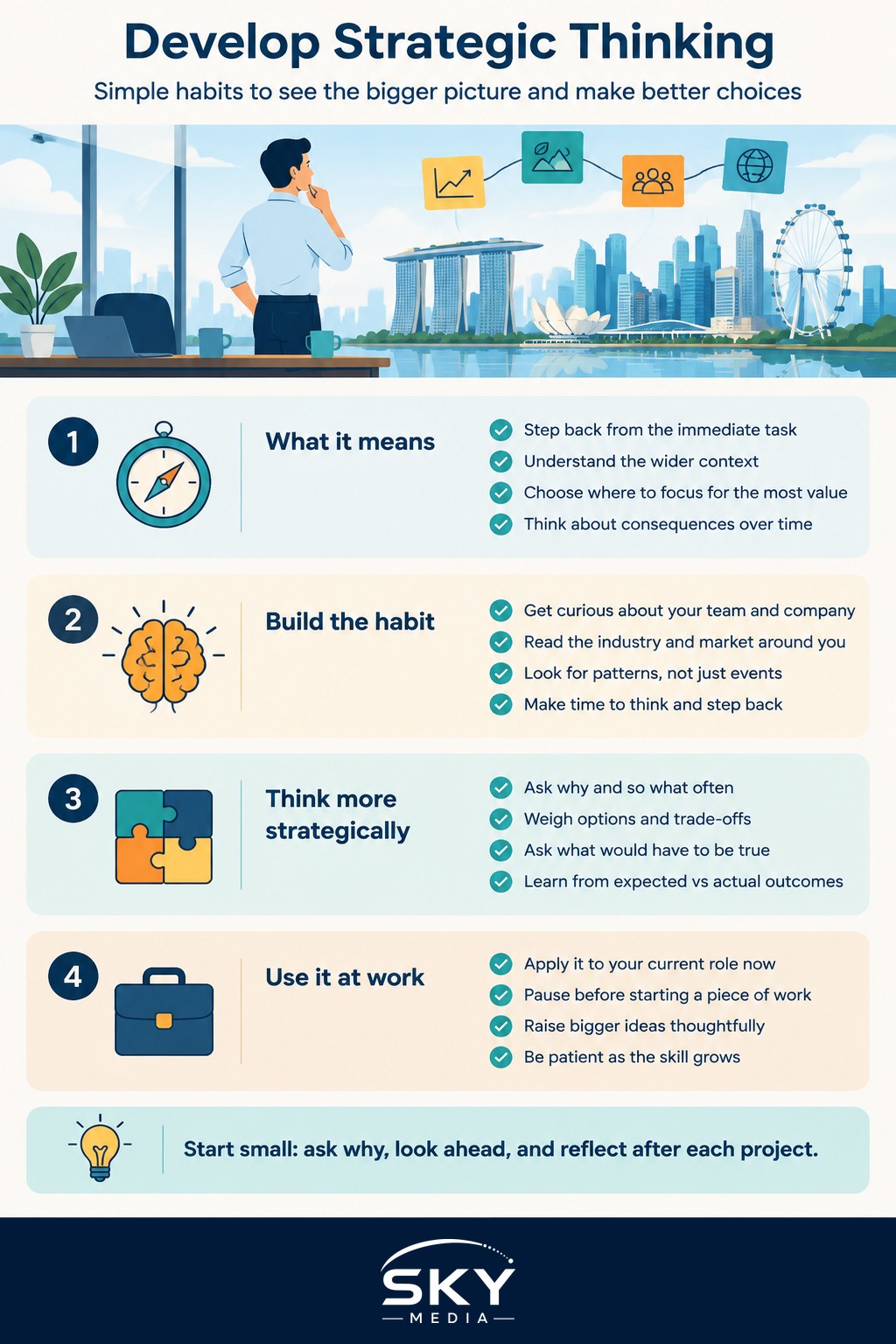
Strategic thinking is often talked about in vague, impressive-sounding terms, which makes it feel out of reach. At its core it is simpler than that. It means being able to step back from the immediate task, understand the wider context, and choose where to focus so your effort creates the most value.
Three habits sit at the heart of it. The first is seeing the bigger picture, understanding how your work connects to your team’s goals, your company’s direction, and the market around it. The second is thinking ahead, considering the likely consequences of choices and how things might unfold over time rather than only reacting to what is in front of you. The third is prioritising, deciding what matters most and having the discipline to say no to things that do not.
Notice that none of this requires seniority. A junior analyst who asks why a report matters and who will use it is thinking more strategically than a manager who just keeps busy. Strategic thinking is a way of paying attention, and you can start practising it in your current role.
Get Curious About the Bigger Picture
You cannot think strategically about a world you do not understand. So the first practical step is to get genuinely curious about the context around your work.
Start close to home. Understand your team’s goals, how success is measured, and why. Then widen out. Learn how your team fits into the company, where the company makes its money, who its customers are, and what pressures it faces. This wider understanding, sometimes called commercial awareness, feeds strategic thinking directly, because strategy only makes sense against real constraints and real goals.
Read beyond your own function. Follow what is happening in your industry, in the Singapore economy, and in the trends shaping your sector. Talk to people in other departments to understand their world, since strategy usually lives at the intersections. Learning to collaborate across departments is not just a soft skill, it is how you gather the information strategic thinking needs.
The habit to build is asking why and so what. Why does this project exist, why now, so what if it succeeds or fails. These small questions, asked often, gradually assemble the mental map that strategic thinkers navigate by.
Build the Thinking Habits
Strategic thinking grows through deliberate practice. A few habits make the biggest difference, and none of them require permission from anyone.
- Make time to think. Strategy needs slack. If every hour is packed with tasks, there is no room to lift your head. Block short periods to step back and ask where things are heading and whether you are working on the right things. Guarding this space is part of managing your energy and not just your time.
- Look for patterns, not just events. When something happens, ask whether it is a one-off or part of a trend. Connecting dots across time and across situations is the essence of strategic insight.
- Think in options and trade-offs. For any decision, force yourself to name at least two or three paths and weigh their pros, cons, and second-order effects. Strategy is choosing, and choosing well means seeing what you give up.
- Ask “what would have to be true?” Before betting on a plan, ask what conditions would need to hold for it to work. It is a simple test that exposes shaky assumptions early.
- Learn from outcomes. After a project, reflect on what you expected versus what happened. This feedback loop sharpens your judgment over time far more than any framework.
Practise Strategy in Your Current Role
You do not need to wait for a strategy job to think strategically. The best way to develop the skill is to apply it to whatever you are doing now.
Before starting a piece of work, pause and ask what outcome it is really meant to achieve and whether there is a smarter way to get there. When you spot a problem or an opportunity that sits above your immediate task, think it through and raise it thoughtfully with your manager. Contributing an idea about where the team could focus, backed by a little reasoning, is how people start to be seen as strategic long before it is in their title. If this is part of a bigger goal, it fits naturally into creating a career development plan.
Be patient with yourself. Strategic thinking deepens with experience, exposure, and reflection. Early attempts may feel clumsy, and some of your predictions will be wrong. That is part of the learning. What matters is the habit of stepping back, asking better questions, and choosing where to aim.
Growing Into a Strategic Thinker
Developing strategic thinking is a gradual, doable process, not a gift reserved for the few. When you understand what it really means, stay curious about the bigger picture, build the thinking habits, and practise on the work in front of you, you slowly change how you see your job and your career. Over time, that shift is exactly what turns a reliable doer into someone whose judgment people seek out, and it is well within your reach.