

Whether you are a parent helping with homework, a student teaching a friend before the O levels, or a working adult briefing a colleague, being able to make a hard idea click is a genuine skill. Explaining concepts simply in Singapore is not about dumbing things down or leaving out the important parts. It is about clearing away the clutter so the core idea shines through, and it is one of the most reliable ways to prove that you truly understand something yourself.
The good news is that this is a skill you can practise and improve. You do not need to be naturally gifted or endlessly patient. You just need a few dependable habits, a bit of empathy for the person in front of you, and the willingness to slow down when something is not landing.
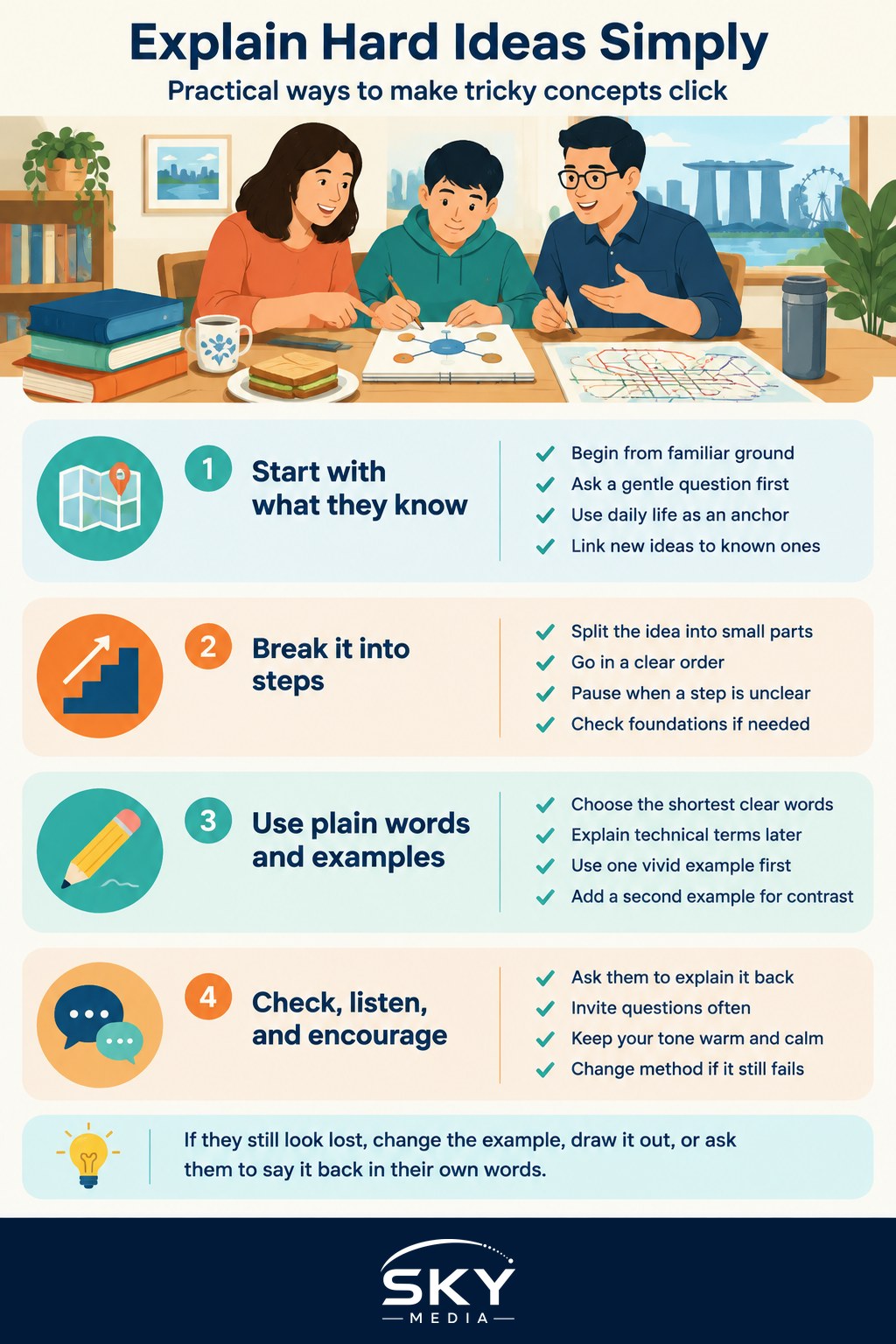
Start With What the Listener Already Knows
The single biggest reason explanations fail is that they begin too far along. The person explaining forgets what it felt like not to know, and jumps straight into jargon and shortcuts. To explain something simply, first find the shelf in the listener’s mind where the new idea can sit.
Ask a gentle question or two to gauge where they are. If you are helping a Primary school child understand fractions, you might start with sharing a pizza or a plate of kaya toast slices, because that is something already familiar. If you are explaining compound interest to a teenager, you might start with the idea of a snowball rolling downhill and growing. The trick is to anchor the unfamiliar to the familiar, then build outward.
This is why analogies drawn from daily Singapore life work so well. An MRT map explains a network. Topping up an EZ-Link card explains the idea of a balance. Queueing at a hawker centre explains a first-in, first-out order. When the starting point is something the listener has already lived, the new concept feels less frightening.
Break it into small, ordered steps
Difficult ideas are usually not one big lump. They are several smaller ideas stacked together, and the difficulty comes from trying to swallow them all at once. Break the concept into a short sequence of steps, and make sure each step is understood before moving to the next.
If a step causes a blank stare, that is your signal to pause, not to speak faster or louder. Sometimes the missing piece is a much earlier idea that was never solid in the first place. This is common in subjects that build on themselves, so it is worth checking foundations. The same layered approach helps in technical subjects, which is why a structured method matters so much when you study maths or tackle science subjects.
Use Plain Words, Examples, and a Quick Check
Once you know where to begin and how to sequence the idea, focus on the language itself. Choose the shortest words that still carry the meaning. Replace textbook phrasing with how you would say it to a friend over coffee. If a technical term is genuinely necessary, introduce it after the idea is clear, not before, so the word becomes a label for something already understood rather than a barrier.
Concrete examples do a lot of heavy lifting. One vivid, specific example almost always beats a general definition. After you give the example, offer a second one that is slightly different, so the listener can see what stays the same and what changes. This helps them separate the essential idea from the surface details.
A powerful way to sharpen your own explanations is to teach as if the listener were much younger or completely new to the topic. This is the heart of a well-known learning method, and it is worth reading up on the Feynman technique for understanding, which asks you to explain an idea in plain language and then notice exactly where you get stuck. The gaps you find are the parts you did not really understand, and fixing them makes both your knowledge and your explanation stronger.
Here are a few habits that keep explanations simple and kind:
- Say one idea per sentence, then pause.
- Use everyday nouns before technical ones.
- Draw a quick sketch or diagram when words alone are not enough.
- Invite questions often, and treat every question as useful rather than annoying.
- Check understanding by asking the listener to explain it back in their own words.
That last point matters most. If they can restate the idea correctly, it has landed. If they stumble, you now know precisely which part to revisit. This back-and-forth is far more useful than asking “Do you understand?”, because most people will nod out of politeness even when they are lost.
Be Patient and Keep It Encouraging
Explaining well is also emotional work. When someone struggles, they may feel embarrassed, especially a child or a student who is used to being told to just try harder. Keep your tone warm. Normalise confusion by saying things like “this part trips up almost everyone” so the person does not feel alone. A calm, encouraging manner makes people more willing to admit what they do not follow, which is exactly what you need to help them.
Remember that clarity is a two-way effort. If an explanation is not working after a couple of tries, change the approach rather than repeating the same words. Switch to a drawing, a physical object, a different analogy, or a real example from the person’s own life. Flexibility, not force, is what gets you there. These same patient habits help enormously when you are helping with homework without doing it, where the goal is understanding rather than a finished answer.
In the end, explaining concepts simply is a gift you give twice. The listener gains understanding, and you deepen your own. Every time you turn something tangled into something clear, you build a skill that will serve you in school, at work, and at home for the rest of your life.
Frequently Asked Questions
How do I explain a hard idea to a young child? Start from something the child already knows from daily life, then build in small steps. For fractions, sharing slices of toast is a familiar starting point. Use short sentences, one idea at a time, and a quick drawing if words are not enough. Ask them to explain it back.
How can I tell whether the person actually understood my explanation? Ask them to restate the idea in their own words or apply it to a new example. Asking whether they understand usually gets a polite nod even when they are lost. If they stumble, you can see exactly which step to revisit.
What if my explanation still does not work after a few tries? Change the method rather than repeating the same words. Try a drawing, a physical object, a different analogy or an example from the person’s own life. Sometimes the real gap is an earlier idea that was never solid, so check the foundations before going on.
Is it a good idea to use technical terms when explaining? Use them, but introduce them after the idea is clear, so the term becomes a label for something already understood rather than a barrier. Start with everyday words and a concrete example, then add the correct term. This works for students and colleagues alike.
Does explaining things to others help me learn better? Yes, teaching is a good test of your own understanding. When you try to explain in plain words, you quickly notice where you get stuck, and those gaps show what you need to relearn. Explaining to a friend or even to yourself out loud both work.