

Science asks something maths does not. As well as solving problems, you have to hold a web of facts, definitions and processes in your head, then explain them in precise language a marker will accept. A biology student memorises structures and functions, a chemistry student juggles reactions and rules, a physics student blends concepts with calculation. Working out how to study science in Singapore, across the O and A level sciences and into polytechnic and university modules, means combining the recall habits that keep facts fresh with the deeper understanding that lets you apply them to a question you have never seen. The methods below work for any of the three sciences and for adult learners returning to the subject.
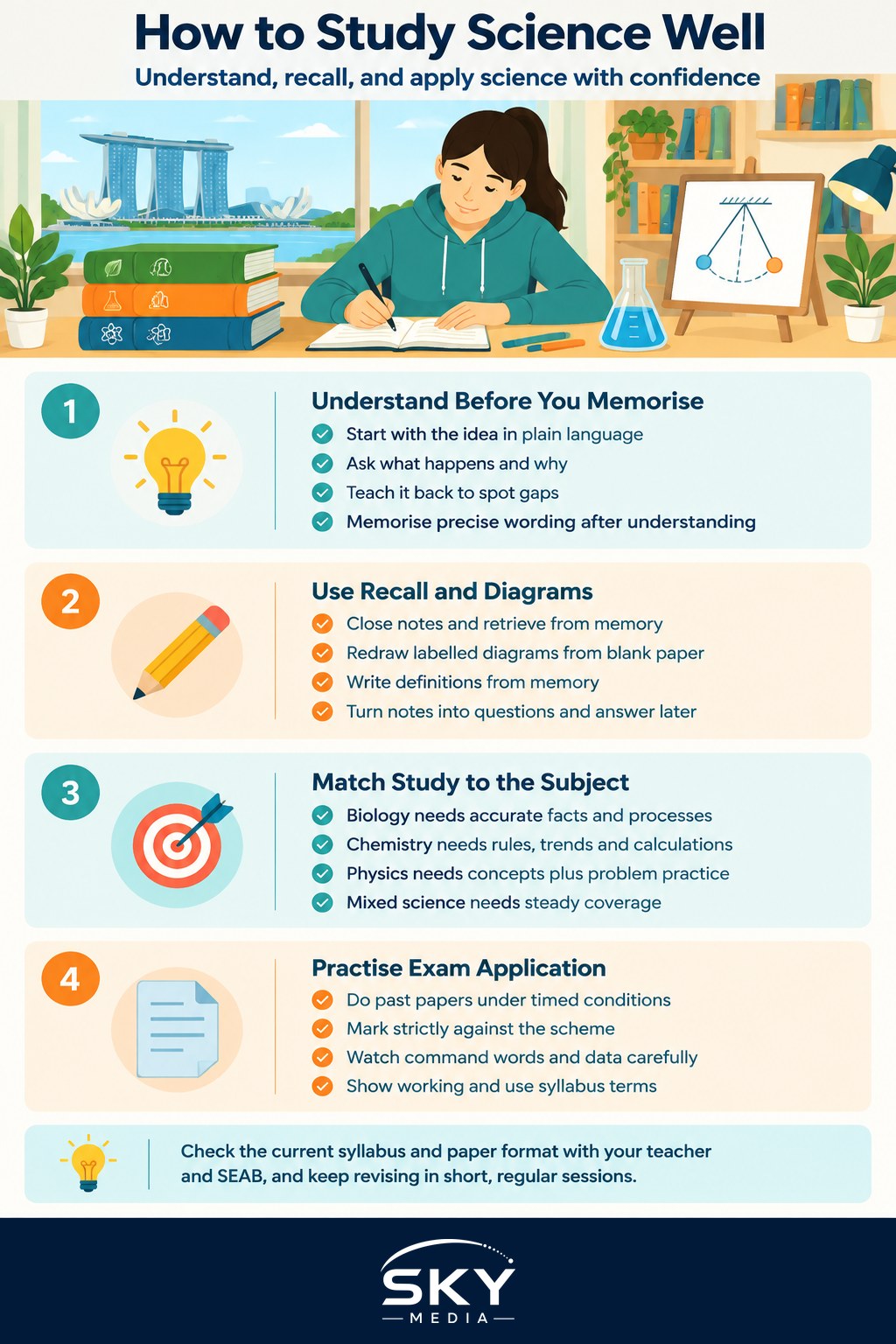
Understand the Concept Before You Memorise the Facts
The most common mistake in science is memorising terms without grasping the idea underneath. You can recite that diffusion moves particles from high to low concentration, but if you do not picture why, the exam question that hides the concept behind a new scenario will catch you out.
Start every topic by understanding the mechanism in plain language. Ask yourself what is happening, why it happens, and what would change if one condition were different. A strong test is whether you can explain the idea to someone with no science background using ordinary words. That teach-it-back habit is the Feynman technique, and in science it quickly reveals the difference between knowing a definition and understanding a process.
Only once the concept is clear should you drill the exact wording. Science exams often reward precise, syllabus-standard phrasing, so the sequence matters: understand first, then commit the accurate terms to memory, not the other way round.
Use Active Recall and Diagrams Together
Science rewards two habits especially well: testing yourself, and drawing.
Active recall means retrieving information from memory rather than rereading it. Close the notes and write out the process, label the diagram from a blank sheet, or list the steps of a reaction before checking. Every retrieval strengthens the memory far more than another pass of highlighting. Our guide to active recall explains the science of why this works, and it applies neatly to every topic you need to hold.
Diagrams deserve special attention because so much of science is spatial and connected. Drawing a labelled diagram from memory tests understanding and recall at once. A visual map of how ideas link, such as how the parts of a system feed into one another, helps you see the big picture rather than a pile of isolated facts. Building these connections is exactly what mind mapping is for, and it suits biology’s systems and chemistry’s reaction pathways particularly well.
Practical recall drills for science:
- Redraw a labelled diagram on blank paper, then check every label.
- Write a definition from memory and compare it word for word with the syllabus wording.
- Explain a full process out loud, from start to finish, without pausing to peek.
- Turn a paragraph of notes into a question, then answer it a day later.
Match the Method to the Subject
The three sciences share study principles but reward slightly different emphases. Knowing where to put your energy saves a lot of wasted time.
| Subject | Heaviest demand | Where to focus effort |
|---|---|---|
| Biology | Volume of accurate facts and processes | Recall drills, precise definitions, labelled diagrams |
| Chemistry | Rules, patterns and some calculation | Understanding trends, practising reactions, balancing and mole sums |
| Physics | Concepts applied through calculation | Grasping principles, then heavy problem practice with clear working |
| Combined and applied science | A broad mix across all three | Steady coverage, no neglected topic, regular self-testing |
Notice that physics leans towards problem practice much like maths, so showing clear working and checking that an answer is a sensible size both matter. Biology leans towards structured recall of accurate content. Chemistry sits between the two. Adjust your routine to the subject in front of you rather than studying all three the same way.
Practise Applying, Not Just Remembering
Knowing the content is only half the exam. The other half is applying it to unfamiliar situations, interpreting data, and answering the specific command word the question uses. “State”, “explain”, “describe” and “compare” each want a different response, and marks are lost when students write a lovely answer to a question that was not asked.
Past papers are the best training for this. Work them under timed, silent conditions, then mark strictly against the scheme to see exactly what the examiner rewards. Data-response and structured questions especially need practice, because reading a graph or table under pressure is a skill in itself. Our guide to past year papers covers how to review each one so it teaches you something. Keep a short log of what you got wrong and why, whether it was a missed keyword, a shaky concept, or a misread question, and revisit those weak spots deliberately.
A few science-specific exam habits:
- Underline the command word and any data before you write.
- Answer with syllabus terms, not casual paraphrases, where precision is expected.
- In calculation subjects, show every step and carry units through.
- For “explain” questions, give the reason, not just the observation.
Because syllabuses, practical requirements and paper formats are set by the exam bodies and do change, confirm the current structure with your teacher and the Singapore Examinations and Assessment Board (SEAB) rather than trusting an old set of notes or a senior’s memory.
A Steady Routine and a Healthy Head
Science content is large, so spacing your study across the term beats cramming near the exam. Short, frequent sessions with regular self-testing keep more topics warm at once and stop the panic of meeting a whole syllabus for the first time in the final week. If you also take maths, many of the same problem-solving habits carry across, and how to study maths shares the practice-first mindset that physics in particular demands.
A simple weekly shape works well: rotate through topics on weekdays with recall drills and a few questions, use one session to redo past mistakes, and keep a longer weekend slot for a mixed set of past-paper questions so you practise switching between topics the way a real paper forces you to.
Finally, look after yourself through the grind. If revision stress starts to feel heavy, that is worth taking seriously rather than pushing through in silence. Talk to a trusted adult, your teacher or your school counsellor, and remember that real help exists, including mindline at 1771 and the Samaritans of Singapore (SOS) at 1767. A disappointing result in any science is one step, not a final verdict, and there is almost always a route forward.
Studying science well comes down to a rhythm: understand the idea, drill the accurate facts and diagrams by recall, then practise applying them to unseen questions. Keep that loop turning through the term, ground it in real practice rather than passive reading, and each of the sciences becomes far more manageable than it first appears.
Further reading: Tackling PSLE Science Open-Ended Questions With Confidence · How to Revise Science Effectively for Singapore Exams · How to Study Computing and Computer Science in Singapore · How to Study Physics in Singapore · How to Study Chemistry in Singapore · How to Study Biology in Singapore