

Some weeks just blur together. You wake up, commute, work, scroll, sleep, repeat. Nothing is dramatically wrong, yet nothing feels fresh either. If that sounds familiar, you are not lazy and you are not broken. You are simply in a rut, and getting out of a rut in Singapore is very doable once you stop waiting for a burst of motivation and start with one small, honest change. This guide walks through gentle, realistic steps that help you feel a little more like yourself again.
What a Rut Actually Is
A rut is that flat, going-through-the-motions feeling. The days are full but not fulfilling. You might feel restless, a bit bored, low on energy, or strangely tired even after resting. Often it builds up quietly: too much routine, too little novelty, a run of stress, or a stretch of always being switched on in a fast, busy city.
It helps to know a rut is usually a signal, not a flaw. Your mind and body are telling you that something needs adjusting, whether that is rest, connection, challenge, or meaning. The good news is that a rut responds well to small nudges. You do not need to overhaul your whole life. You just need to shift one or two things and let a little momentum build.
One important note before we go on. This article is about everyday flatness and being stuck, which is common and normal. If your low mood has lasted for weeks, if you feel hopeless, or if it is clearly affecting your sleep, appetite, work, or relationships, please treat that as a sign to reach out. Talk to people you trust, and consider speaking with your GP, a counsellor, or a Singapore support body such as the Institute of Mental Health or the Samaritans of Singapore. Asking for help is a strong, sensible move, not a weakness.
Start Absurdly Small
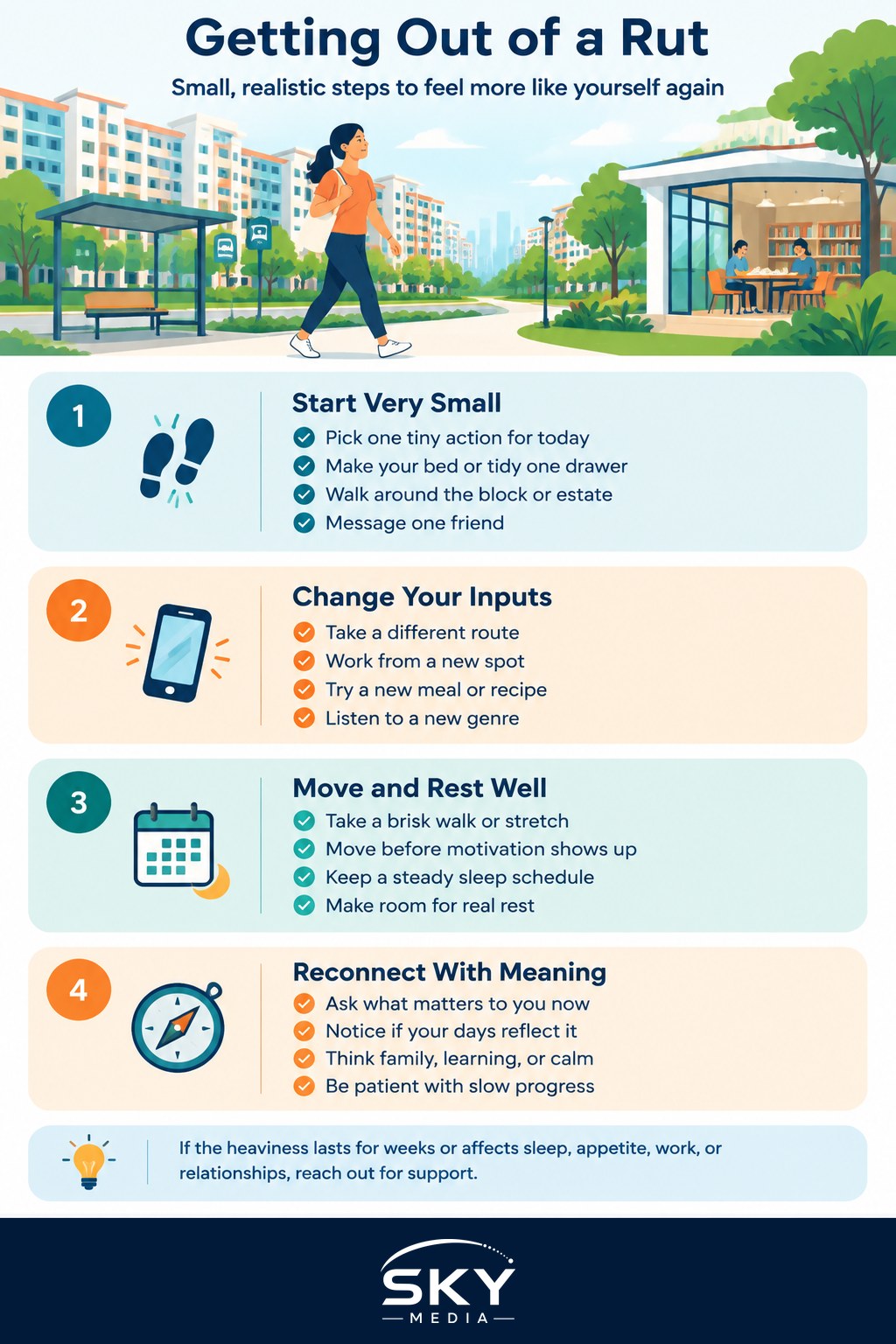
When you are stuck, big plans tend to backfire. Telling yourself to completely change your habits by Monday only adds pressure. Instead, pick one tiny action you can do today. Make your bed. Take a ten-minute walk around the block or your HDB estate. Message one friend. Tidy a single drawer. These sound too small to matter, but their real job is to break the flat feeling and prove that you can move.
Small wins create a quiet sense of progress, and progress is what a rut is missing. If you want a structured way to keep this going, our guide on how to build momentum on your goals shows how one small step naturally leads to the next. The idea is not to force yourself, but to lower the bar so far that starting feels easy.
Change Your Inputs
Ruts thrive on sameness. The same route, the same lunch, the same feed, the same view. So change your inputs on purpose. Take a different bus, work from a library or a hawker centre corner for an afternoon, cook something you have never made, or listen to a genre you usually skip. Novelty gives your brain something new to chew on, and it often shakes loose the stuck feeling.
Your phone deserves a special mention here. Endless scrolling can deepen a rut by filling your time without refreshing you. Trying how to do a digital detox for even a weekend can free up surprising amounts of attention and energy. You do not have to give up your phone forever. You just want to notice whether it is feeding you or draining you.
Move Your Body and Rest Properly
Energy and mood are closely linked to how you treat your body. A rut often comes with poor sleep, little movement, and skipped meals, which then makes the rut worse. Gentle exercise, even a brisk walk or some stretching, can lift your mood more reliably than waiting to feel motivated first. Movement tends to come before motivation, not after it.
Rest matters just as much. Being busy is not the same as being well. If you are running on empty, real recovery helps more than pushing harder. Our guide on how to rest properly explains why genuine rest is active, not just collapsing in front of a screen. Aim for a consistent sleep schedule, a little daylight each day, and moments of quiet where nothing is demanded of you.
Reconnect With Why It Matters
Sometimes a rut is really a meaning gap. You are doing the tasks but you have lost sight of the point. It can help to zoom out and ask what actually matters to you right now, and whether your days reflect that. This is not about grand life goals. It might be as simple as wanting more time with family, more learning, or more calm.
A short reflection can reset your direction. Working through how to find your why gives you prompts to reconnect with what you care about, so your ordinary days feel a bit more chosen and less like autopilot.
Be Patient and Kind With Yourself
Getting out of a rut is rarely a single dramatic moment. It is more like a slow turning, one small change at a time, with some ordinary days in between. You will have flat days again, and that is normal. What matters is the overall direction, not a perfect streak.
So go easy on yourself. Celebrate the walk you took, the message you sent, the drawer you cleared. Those small acts are you finding your feet again. Keep the steps tiny, keep changing your inputs, look after your body, and reach out if the heaviness lingers. Bit by bit, the days start to feel like yours once more.
Frequently Asked Questions
How do I tell if I am in a rut or actually depressed? A rut is usually flat, bored or restless but eases with small changes, while depression tends to last weeks and affect sleep, appetite, concentration and interest in everything. Only a professional can diagnose it. If low mood persists or you feel hopeless, see a doctor or counsellor.
Is a career rut a sign I should change jobs? Not necessarily. First work out whether the problem is the role, the workplace or something outside work. Try a new project, a conversation with your manager or learning a skill before a big move. For training options, check SkillsFuture or SWDA.
How long does a rut usually last? It varies, from a few days to a few months, and tends to shift sooner when you introduce small changes in routine, movement and connection. If it drags on and starts affecting daily life, seek support rather than wait it out.
Why do I feel stuck even though nothing is wrong? Sameness, lack of challenge or a gap in meaning can leave you flat without any obvious problem. Your mind may simply need novelty, rest or purpose. Try changing one input, such as a new route or hobby, and see how you feel.
Can a short holiday or staycation break a rut? It can offer a helpful reset through rest and novelty, but the flat feeling may return if daily routines stay the same. Pair a break with small lasting changes afterwards. A day trip or even a new neighbourhood walk can help.
Further reading: How to Stop Numbing Out With Constant Entertainment