

There is a common myth that progress starts with a burst of motivation. You wake up one morning, feel inspired, and finally get going. In real life, it rarely works like that. Momentum is not something you wait to feel. It is something you build, slowly, through small actions that gradually make the next action easier. For anyone chasing a goal, building momentum singapore style, around real jobs, commutes, and family, is less about a dramatic push and more about a gentle, repeatable start.
If you have stalled on a goal, please know that this does not mean you lack discipline or willpower. Starting from a standstill is genuinely hard for everyone. The trick is to make that first push small enough that you can actually manage it.
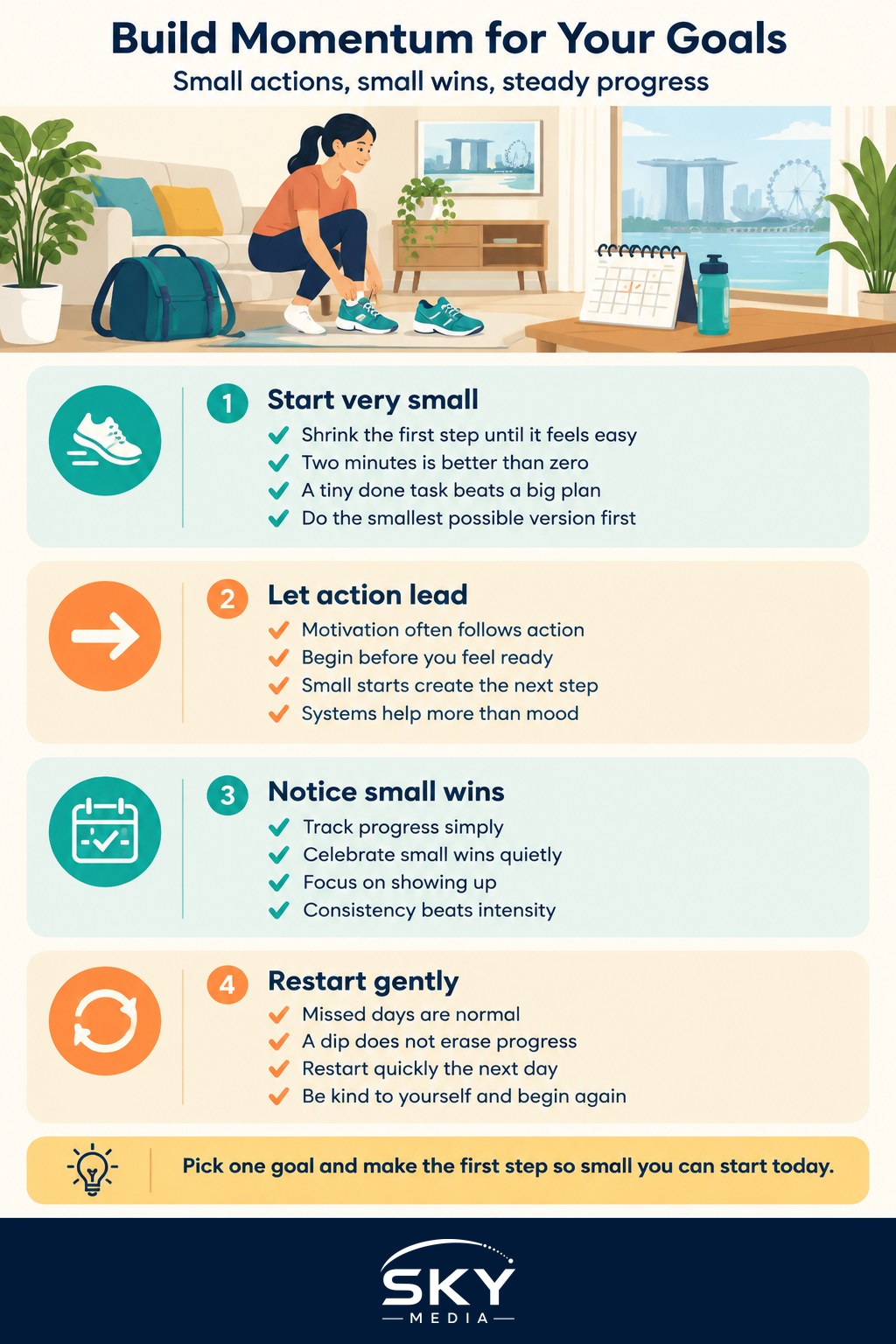
Momentum comes from action, not the other way round
We tend to think motivation must come first, then action follows. Often it is the reverse. You take a tiny action, you feel a flicker of progress, and that feeling makes the next step a little easier. Action creates the motivation, not the other way round.
This matters because waiting to “feel ready” can keep you stuck for months. You do not need to feel motivated to begin. You just need to begin, in the smallest possible way, and let a little momentum build from there. If motivation has felt unreliable, it helps to understand discipline versus motivation and what works, because leaning on systems rather than mood is what keeps most people going.
There is no overnight switch here. Nobody becomes unstoppable in a day. What actually happens is quieter: a small win today makes tomorrow’s start slightly easier, and that compounds over weeks.
Start absurdly small
The biggest enemy of momentum is a first step that is too big. If your goal is to get fit, “exercise for an hour” is daunting when you are starting cold. “Put on my shoes and walk for ten minutes” is not. The second one actually happens, and once it does, you are moving.
Shrink your first action until it feels almost too easy. Two minutes of writing. One page of reading. A single tidy drawer. The point is not the size of the task but the fact that you did it. A tiny completed action beats a huge planned one every time.
This connects to the broader skill of learning to break big goals into steps. A goal that feels overwhelming as a whole becomes doable when it is chopped into pieces small enough to actually start.
Use small wins as fuel
Once you start, protect your sense of progress, because progress is what keeps you going. Notice and count your small wins. Ticking off a tiny task, seeing a page fill up, feeling slightly fitter: these little signals tell your brain that effort is paying off, and that keeps you moving.
A few ways to keep progress visible:
- Track it simply, even just a tick on a calendar for each day you show up.
- Celebrate small, in proportion. A quiet nod of “good, I did it” is enough.
- Focus on showing up, not on being perfect. Consistency beats intensity.
The aim is a chain of small wins that gently pulls you forward. If you already track your habits, you will know how satisfying it is not to break the chain. If not, learning to track your habits gives momentum something concrete to feed on.
Expect dips, and plan to restart
Here is the honest part. You will miss days. Life in Singapore is busy and unpredictable, and no streak lasts forever. A missed day, or even a missed week, is completely normal and does not erase your progress.
The people who keep momentum are not the ones who never stumble. They are the ones who restart quickly, without a big drama about it. Missing once is a moment. Missing and then quitting is what actually stalls a goal. So decide in advance that when you slip, you will simply do the smallest version again the next day, no guilt required.
Be gentle with yourself in these moments. Shaming yourself for a missed day rarely gets you moving again. A kind, matter-of-fact “okay, back to it” works far better than “I’ve ruined everything”.
Keep the momentum going over the long haul
Early momentum is exciting, but goals worth having take time. To keep going, tie your daily actions to something that genuinely matters to you, not just a target on paper. When the effort connects to a real reason, it survives the boring middle stretch where the novelty has worn off.
It also helps to attach new actions to routines you already have, so they run more or less on autopilot rather than needing fresh willpower each day. Over time, these become habits, and habits carry momentum for you. If you want that staying power, it is worth learning how to build habits that actually stick, so your goal keeps moving even on the days you do not feel like it.
Be patient with the process
Momentum is quiet. It does not feel dramatic while it is happening. Most of the time it looks like small, slightly boring actions repeated on ordinary days. Then one day you look back and realise how far you have come, almost without noticing.
So set your expectations kindly. You are not going to transform overnight, and you do not need to. You just need to start small, keep the wins visible, restart gently after every dip, and let time do its patient work. Choose one goal, shrink the first step until it feels easy, and take it today. That single small action is how all momentum begins.
Frequently Asked Questions
How long does it take for momentum to build? It varies, but many people feel the first lift after a handful of days of small, consistent action, and a firmer rhythm after a few weeks. There is no set timeline. Keep the steps tiny and regular rather than waiting for a dramatic change.
How do I get started when I feel completely stuck or unmotivated? Choose a first step so small it feels almost silly, such as two minutes of the task, and do just that. Starting usually makes continuing easier. If you feel persistently flat for weeks, consider talking to a doctor or counsellor.
How do I restart a goal after a long break? Return to the smallest version of the habit, not where you left off. Drop the guilt and treat it as a fresh start. Rebuilding the first few days matters more than catching up.
Should I make my goals public to keep momentum? It works for some people because friends can encourage and check in, but others feel pressured. Tell one or two supportive people rather than everyone. Choose what keeps you moving, not what impresses.
How do I keep momentum going when work or family gets busy? Scale the habit down to a bare minimum on hectic days, such as five minutes, so the chain does not break. Plan the restart in advance. Slow weeks are normal and do not wipe out progress.
Further reading: How to Create a Personal Bucket List