
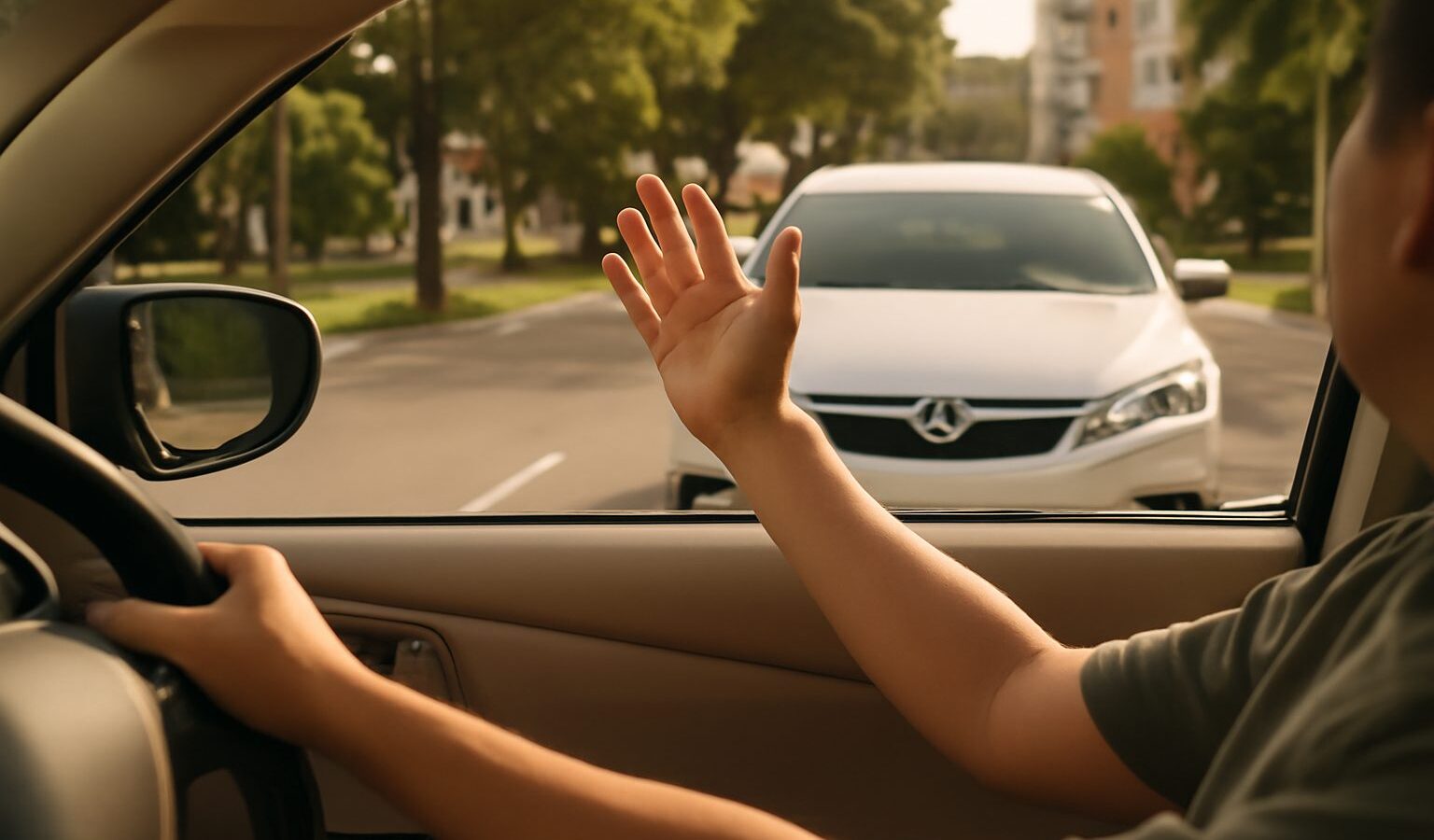
Handling road rage well is really about handling yourself. When another driver tailgates you, cuts in, flashes their lights or leans on the horn, the natural urge is to react, to match aggression with aggression or to teach them a lesson. That urge is exactly what turns a moment of annoyance into a dangerous confrontation. The single most effective thing you can do behind the wheel is to stay calm, keep your distance and let the situation defuse itself.
This guide covers how to deal with a tailgater safely, why retaliation and brake-checking are never the answer, how to de-escalate when a driver becomes aggressive, and when and how to report dangerous driving. It follows Traffic Police guidance and the Highway Code. For the official rules and any offence, defer to the Traffic Police and the law.
Staying Calm Is the Whole Game
Almost every road-rage incident escalates because at least one driver chooses to respond in kind. You cannot control how another person drives, but you can control your own reaction, and that is where your safety lies.
- Take a breath and drop your shoulders. A few slow breaths lower the flush of adrenaline that pushes you towards a rash move.
- Do not take it personally. A driver who is tailgating or gesturing is usually stressed, running late or simply a poor driver. Their behaviour is about them, not you.
- Keep your eyes forward and your hands steady. Avoid returning gestures, mouthing words or staring into your mirror. Eye contact and reactions are fuel.
- Remember your goal. You are trying to get home safely, not to win. Letting an aggressive driver go is a victory, not a defeat.
Calm is a skill you can practise. The more consistently you choose it, the less any single incident is able to rattle you.
Dealing With a Tailgater
A tailgater, the driver sitting far too close behind you, is one of the most common triggers on our roads. The instinct to tap the brakes to warn them off is understandable, but it is precisely the wrong move. Brake-checking, deliberately braking to scare or punish the driver behind, is dangerous and can make you legally responsible if it causes a collision. Never do it.
Instead, follow these steps:
- Increase your own following distance. Ease off gently and leave more space to the car in front of you. This gives you a bigger cushion so that if you do need to slow, you can do it gradually rather than sharply, protecting both you and the tailgater.
- Maintain a steady, legal speed. Do not speed up to escape them; that just draws you into a chase. Hold a safe, consistent pace.
- Let them pass. When it is safe, move to the left lane or ease over so the tailgater can overtake and be on their way. Removing yourself from in front of them solves the problem instantly.
- Stay predictable. Smooth, signalled, unsurprising driving gives the impatient driver every chance to get past without drama.
The paradox of the tailgater is that the calmest response, giving them room and letting them go, is also the safest and the fastest way to be rid of them.
What Never to Do
When emotions run high it is worth having a firm mental list of responses that are off the table, no matter how justified they feel in the moment.
| Provocation | Do not (aggressive or unsafe) | Do instead (calm and safe) |
|---|---|---|
| Tailgater behind you | Brake-check or slam the brakes | Leave more space and let them pass |
| Driver cuts in front | Speed up to block or chase | Ease off and keep your distance |
| Horn, lights or gestures | Return gestures or shout back | Ignore it, eyes forward |
| Being followed | Drive home or stop and confront | Drive to a safe public place |
| Rising anger in yourself | Push on while furious | Pull over safely and cool down |
Retaliation of any kind, blocking, chasing, brake-checking, cutting back in or getting out of the car, escalates risk for everyone and can leave you on the wrong side of the law. There is no version of it that ends well.
De-escalating an Aggressive Situation
If a driver becomes openly aggressive, your job shifts entirely to defusing and creating distance. Do not engage, and never let it draw you out of the car.
- Avoid eye contact and do not react. Denying the other driver a response often takes the heat out of the situation on its own.
- Give way and create space. Let them pass, change lanes or drop back. Physical distance is your best protection.
- Keep doors locked and windows up. If someone approaches your car on foot, stay inside and do not wind down the window.
- Do not drive home. If you believe you are being followed, drive to a busy, well-lit public place such as a petrol station or a manned carpark rather than leading anyone to your address.
- Call for help if you feel threatened. If there is a genuine danger to your safety, contact the Police. Where it is safe and legal, a passenger can note the other vehicle’s number plate.
Your dashcam, if you have one, quietly records what happens without you needing to say or do anything provocative. Let it do the work.
Managing Your Own Frustration
Road rage is not only something other people direct at you. Traffic jams, a long day, the heat and a monsoon downpour can all fray your patience, and recognising your own rising anger is part of driving responsibly.
- Give yourself time. Leaving a buffer for the journey removes the pressure that makes small hold-ups feel infuriating.
- Cool the cabin and the mood. Comfortable temperature, calm music and a steady breathing rhythm all help in our sticky climate.
- Pull over if you need to. If you feel too angry to drive safely, find a safe spot, stop and take a few minutes. There is no shame in it.
- Let go of small slights. A driver who did not thank you or who nudged into your gap is not worth your afternoon. Breathe and move on.
A calm driver is a safer driver, full stop. Managing your own state protects you as much as reading everyone else’s.
Reporting Dangerous Driving
Some behaviour goes beyond rudeness and becomes genuinely dangerous, and that is worth reporting so it can be dealt with properly rather than answered on the road.
If you witness or experience seriously dangerous driving, you can report it to the Traffic Police, and dashcam footage is often useful supporting evidence. Note what you safely can afterwards, such as the vehicle number, the time and the location, but never compromise your own safety or start filming or writing while you are driving. Let the authorities handle enforcement. For how and where to submit a report, and for what counts as an offence, defer to the Traffic Police.
Handling road rage comes down to a simple, disciplined choice repeated every time: stay calm, keep your distance, never retaliate, let the other driver go, and report anything truly dangerous through the proper channels. Do that consistently and you protect yourself, your passengers and everyone else sharing the road.