
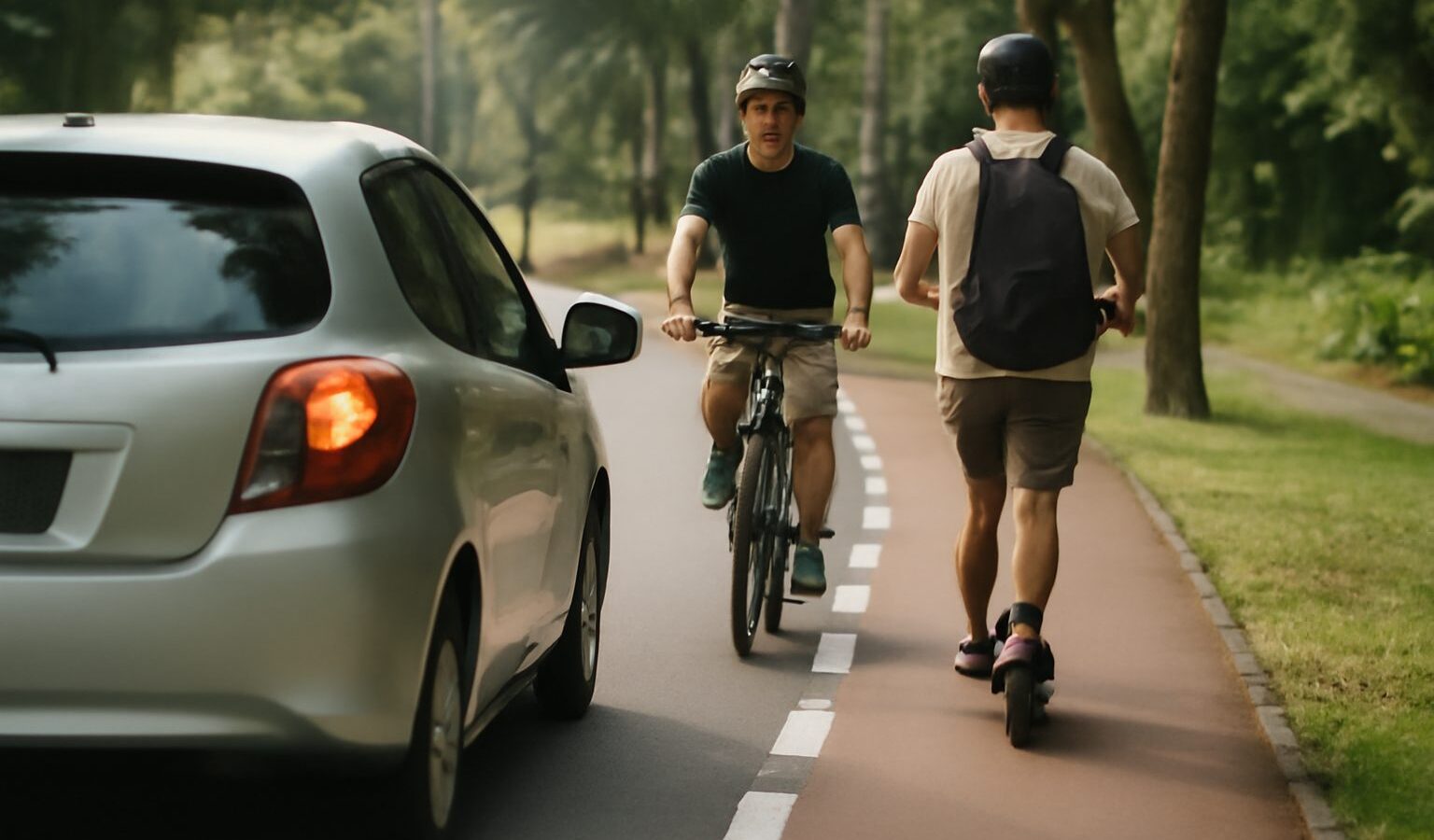
Singapore’s roads carry more than cars these days. Cyclists commute along the same lanes you drive, delivery riders weave between junctions, and personal mobility devices (PMDs) and other active-mobility users share paths and, in some cases, the road edge. Sharing the road well is partly a matter of rules and partly a matter of attitude. The people on those two wheels are far more exposed than you are inside a metal cabin, and a moment of impatience from a driver can end very badly for them. This guide sets out how to give cyclists and PMD riders the space and attention they need, and how to keep everyone, including yourself, out of trouble.
A quick but important note first: the rules for cyclists and for active-mobility devices change over time, and they differ by device type and by where the person is riding. This article gives general guidance only. For the current criteria, the paths and roads each device may use, speed limits and the UL2272 fire-safety standard for PMDs, always defer to the Land Transport Authority (LTA) and the Traffic Police, whose rules take precedence over anything here.
Why Vulnerable Road Users Deserve Extra Care
The physics are simple and unforgiving. A cyclist or rider has no crumple zone, no airbags and no metal shell. In any collision with a car, they come off far worse, even at low speed. That imbalance is exactly why the responsibility sits heavily on drivers to look out for them, rather than the other way around.
There is also a visibility gap. Cyclists are narrow, can sit in your blind spots, and are easy to overlook when your eyes are scanning for other cars. In our climate, a sudden downpour makes matters worse, cutting visibility and lengthening stopping distances for everyone. A rider in dark clothing on a wet evening is genuinely hard to see, so you have to actively look for them rather than assume the road is clear.
Sharing the road generously is not only courteous, it is practical. Anticipating a cyclist’s movements, giving them room and easing off the accelerator costs you a few seconds at most. Getting it wrong can cost someone their life and leave you facing serious consequences. Framed that way, patience is an easy trade.
Giving Cyclists Room on the Road
Most conflict between drivers and cyclists comes down to space and timing. A handful of habits prevent the majority of close calls.
- Leave a generous passing gap. When overtaking a cyclist, move well clear rather than squeezing past within the same lane. Treat them as you would a slow car: wait for a safe moment, then pass with plenty of room, and only when the oncoming lane is clear.
- Do not overtake and immediately turn or brake. Cutting back in front of a cyclist and slowing sharply, sometimes called a left hook at a junction, is a common cause of collisions. Complete your pass fully before you need to turn.
- Be patient behind them. If you cannot pass safely yet, hold back and wait. A few seconds behind a cyclist is not a reason to take a risk.
- Watch your car doors. If you are parked or dropping someone off, check over your shoulder for a passing cyclist before opening a door. A “dooring” can throw a rider straight into traffic.
- Signal early and clearly. Your indicators tell riders what you intend to do. Use them in good time so a cyclist can react.
The theme running through all of this is predictability. Cyclists can read a driver who signals early, holds a steady line and passes with room. It is the sudden, squeezed or aggressive move that catches them out.
Junctions, Turns and Blind Spots
Junctions are where most car-versus-bike incidents happen, so they deserve special attention. When you are turning, a cyclist may be travelling straight ahead alongside or just behind you, exactly where a quick glance can miss them.
- Turning left: check your left-hand mirror and blind spot for a cyclist coming up on your inside before you commit to the turn. They may be moving faster than you expect.
- Turning right across traffic: look for an oncoming cyclist just as carefully as you would for a motorcycle. Their narrow profile makes them easy to misjudge, and it is easy to think you have a bigger gap than you do.
- Pulling out from a side road or carpark: a cyclist on the road can appear quickly. Take a second, deliberate look rather than a rushed glance.
- At traffic lights: give cyclists room to move off, and do not creep into any marked space set aside for them.
Get into the habit of a proper shoulder check, not just a mirror glance, before any turn or lane change. Mirrors have blind spots that a narrow cyclist fits neatly inside. That extra half-second of looking is the single most valuable thing you can do at a junction.
PMDs, Active Mobility and the Rules That Change
Personal mobility devices and other active-mobility users occupy a shifting legal picture, and this is the area where deferring to current LTA rules matters most. Broadly, PMDs and bicycles are governed by where they are allowed to travel, whether that is a footpath, a shared path, a cycling path or the road, and each device type has its own permissions, speed limits and equipment requirements, including the UL2272 fire-safety certification for PMDs. These rules have been tightened and revised more than once, so do not rely on what was true a year or two ago.
The table below outlines the general mindset for different users, not the legal specifics. For those, check the LTA active-mobility rules directly.
| Road user | Where you commonly meet them | Your safest driving response |
|---|---|---|
| Cyclist on the road | Alongside traffic, at junctions, on expressway-adjacent roads where allowed | Pass wide, check blind spots, signal early |
| PMD or e-scooter rider | Crossing at junctions, near shared paths, at path-road boundaries | Slow down near crossings, expect sudden appearances |
| Power-assisted bicycle | On roads and paths depending on class | Treat like a faster cyclist, allow extra closing speed |
| Pedestrian near shared paths | Bus stops, crossings, path entrances | Yield early, watch for people stepping out |
Where a rider or device crosses in front of you at a junction or a crossing, slow down and let them clear rather than nudging forward. Whatever the letter of the rule, a driver who anticipates and yields prevents the accident. If you are ever unsure who has right of way, the safe default is to give way and avoid the conflict.
Building a Habit of Mutual Courtesy
Sharing the road is a two-way street, and most cyclists and riders are trying to get somewhere safely, just as you are. A few of them will ride in ways you find frustrating, just as some drivers behave badly. The answer is never to retaliate, teach a lesson or drive aggressively to make a point. That turns a minor annoyance into a real danger and can leave you liable.
Instead, drive as though every cyclist and rider might be a family member. Leave room, look twice, signal clearly, and let small frustrations go. Keep your own conduct calm even when someone else’s is not, and never use your car to intimidate a more vulnerable road user. If another driver’s behaviour towards a cyclist alarms you, keep your distance and stay out of it rather than joining in.
Sharing the road with cyclists and PMD riders comes down to space, attention and patience, backed by the current LTA and Traffic Police rules. Give people room, check your blind spots at every junction, and treat the most exposed users on the road with the care you would want in their place. Do that consistently and you protect them, yourself and everyone travelling alongside you.