

The talk you keep putting off is usually the one you most need to have. Difficult conversations, whether telling a colleague their work is slipping, raising a boundary with a family member, or ending something, feel daunting because the stakes and emotions are high. The good news is that with a little preparation and a calm approach, you can have these talks well and often come out stronger on the other side.
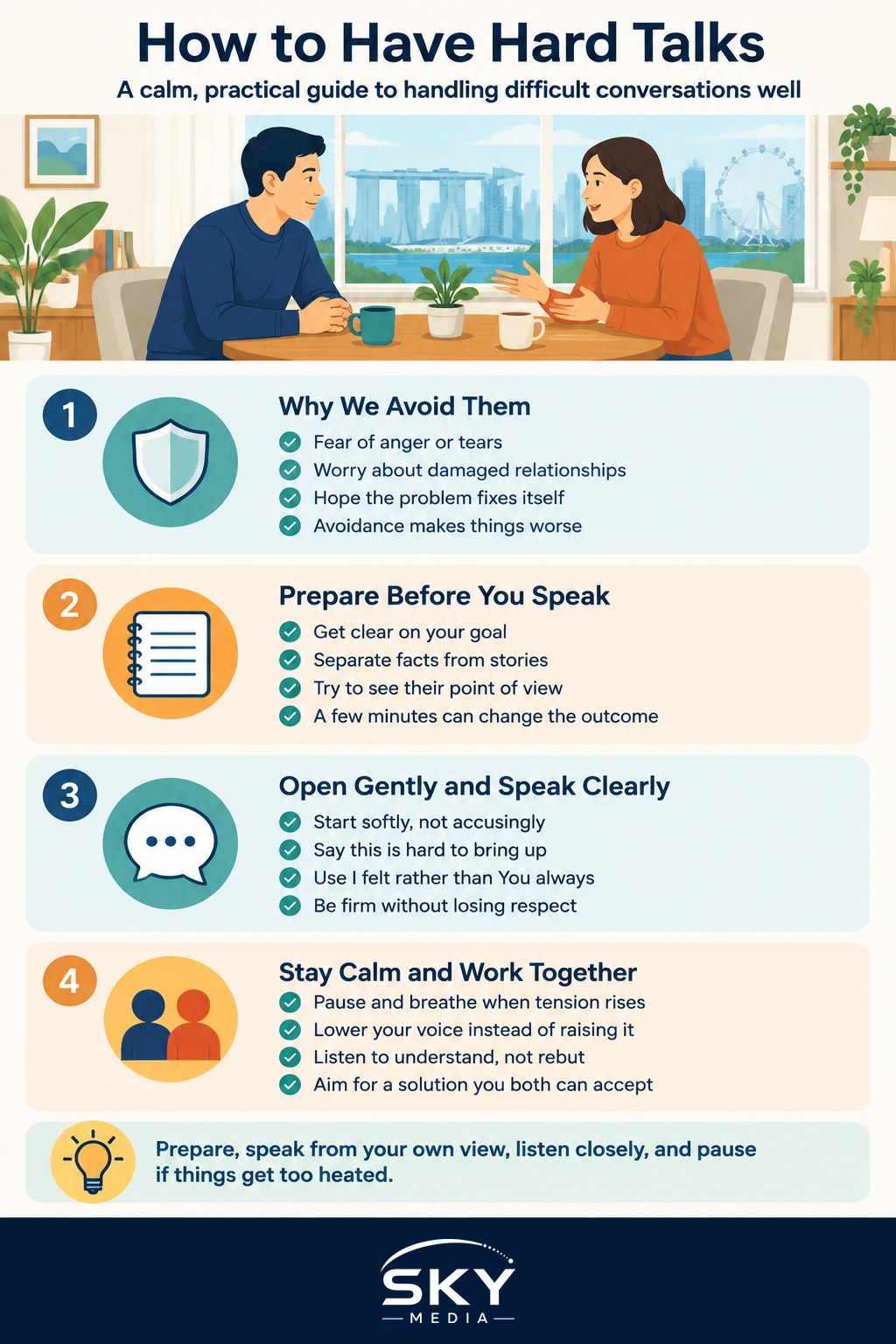
Why we avoid them
We dodge hard conversations because we fear the fallout: anger, tears, damaged relationships, or simply the discomfort of the moment. So we stay quiet and hope the problem fixes itself. It rarely does. Instead, resentment builds, small issues grow, and the eventual conversation becomes much harder than it needed to be.
Avoidance feels safe in the short term and costs you in the long term. Learning to face these talks calmly is one of the most valuable life skills you can build.
Prepare before you speak
Do not walk in cold. A few minutes of preparation transforms the outcome.
- Get clear on your goal. What do you actually want from this conversation? To be understood? To change a behaviour? To repair the relationship? Name it.
- Separate facts from stories. Write down what actually happened, then notice the story you have added on top. “He replied late” is a fact. “He does not respect me” is a story.
- Anticipate their view. What might this look like from their side? Assume they are not a villain but a person with reasons.
This groundwork keeps you steady and fair when emotions rise.
Open softly and honestly
The first thirty seconds set the tone. A harsh or accusing opening puts the other person on the defensive immediately. Instead, be honest about the fact that this is hard, and lead with care.
You might say, “There is something on my mind and I have been nervous to bring it up, because our relationship matters to me.” This signals that you come in peace. Then state your concern plainly, without a long build up that leaves them bracing for the worst.
Speak from your own experience
One of the most useful habits is to speak in terms of your own view rather than accusations. Compare “You always ignore me in meetings” with “I felt overlooked when my point was not picked up.” The first invites a fight. The second shares how you feel and is much harder to argue with.
This does not mean being soft on the issue. You can be clear and firm about what needs to change while still owning your side of it. Firmness and respect can live in the same sentence.
Reactive versus grounded responses
When tension rises, you have a choice about how to show up. Here is the contrast.
| Grounded | Reactive |
|---|---|
| “Help me understand your side.” | “You never listen to me.” |
| Pausing to breathe before replying | Firing back straight away |
| Staying on one issue | Dragging up every past grievance |
| “I feel…” statements | “You always…” accusations |
| Lowering your voice | Raising your voice |
| Taking a break if it overheats | Pushing on until someone breaks |
Stay calm when it heats up
Even with good preparation, difficult conversations can spike. Your heart races, your face flushes, and you feel the urge to attack or flee. The skill here is to notice the surge and slow down rather than react.
Take a slow breath. Lower your voice instead of raising it, which often calms the other person too. If things get too heated to be useful, it is wise to pause: “I can feel this getting tense. Can we take ten minutes and come back to it?” A short break is not weakness. It protects the conversation from words you would regret. These are the same muscles behind handling conflict calmly.
Listen more than you expect to
You may enter with a script, but the conversation will only work if the other person feels heard. After you share your view, genuinely listen to theirs. Ask, “How do you see it?” and then actually take it in rather than planning your rebuttal.
You will often learn something that changes the picture. Even when you do not, letting someone feel understood softens the whole exchange. People become far more open to your concerns once they feel you have truly heard theirs. Strong listening skills are the quiet engine of every hard conversation.
Aim for a shared solution
A difficult conversation is not a battle to win. If one person walks away feeling crushed, you have not really succeeded, because the relationship carries the cost. Aim instead for an outcome you can both accept.
Move towards this together: “So where do we go from here?” or “What would work better for both of us?” Look for the option that meets your core need and theirs. Sometimes you will not fully agree, and that is fine. Even “let us both think about it and talk again” is progress.
Handle strong emotions with grace
The other person may get upset, defensive, or tearful. Do not panic or rush to smooth it over. Emotions are a normal part of anything that matters. Give them a moment. You can acknowledge it kindly: “I can see this is upsetting, and I did not mean to hurt you. Shall we take a breath?”
Staying steady while someone else is emotional is a real skill, and it draws heavily on emotional intelligence. Your calm gives them something solid to lean on, and it usually helps the storm pass faster.
Close with clarity and care
Do not let a hard talk trail off into vagueness. Before you finish, agree on what happens next, even if that is simply to revisit it later. Then end on a note of goodwill: “Thank you for hearing me out. This matters to me because you matter to me.”
That closing repair is important. It reminds you both that the point was never to win, but to sort something out and keep the relationship healthy.
The payoff
Every difficult conversation you handle well makes the next one easier. You learn that the fear is usually worse than the reality, and that honesty delivered with care tends to bring people closer rather than push them apart. Sometimes it may involve holding a boundary or learning to say no without guilt, and that too gets easier with practice.
Prepare, open gently, speak for yourself, listen hard, and stay calm. Do that, and the conversation you have been dreading may turn out to be the one that clears the air and deepens the trust between you.
Explore more: How to Handle Conflict Calmly · How to Say No Without Guilt · How to Develop Emotional Intelligence in Singapore
Frequently Asked Questions
What if the other person refuses to talk about it? Do not force it in the moment. Say that you would like to talk when they are ready, and suggest a time that suits them. Sometimes people need a day to settle. If avoidance continues and it affects your work or wellbeing, consider involving someone neutral.
Should I have a difficult conversation in person or by text? Face to face or by call is usually best, because tone and emotion are hard to read in writing. Text is fine for setting up the conversation or following up on what was agreed. Serious or emotional topics tend to spiral when left to messages.
How do I raise a hard topic with an ageing parent? Choose a calm, private time and start from care rather than criticism. Speak about your own concern, such as worrying about their safety, instead of listing what they are doing wrong. Listen to their view and respect their dignity, and expect that agreement may take more than one conversation.
Is it okay to cry during a difficult conversation? Yes, it is a natural reaction and does not make you weak. Pause, take a breath or a sip of water, and say you need a moment if that helps. You can continue once you feel steadier, or agree to pick the conversation up later.
When should I involve HR or a third party? Consider it when the conversation has repeatedly failed, when you feel unsafe or pressured, or when the issue involves bullying or harassment. A neutral person such as a manager, HR or a mediator can help. For serious workplace matters, check your company’s procedures or MOM’s guidance.
Further reading: How to Build Better Conversation Skills in Daily Life · How to Deal With Difficult People · Using AI for Negotiation and Difficult Conversations