
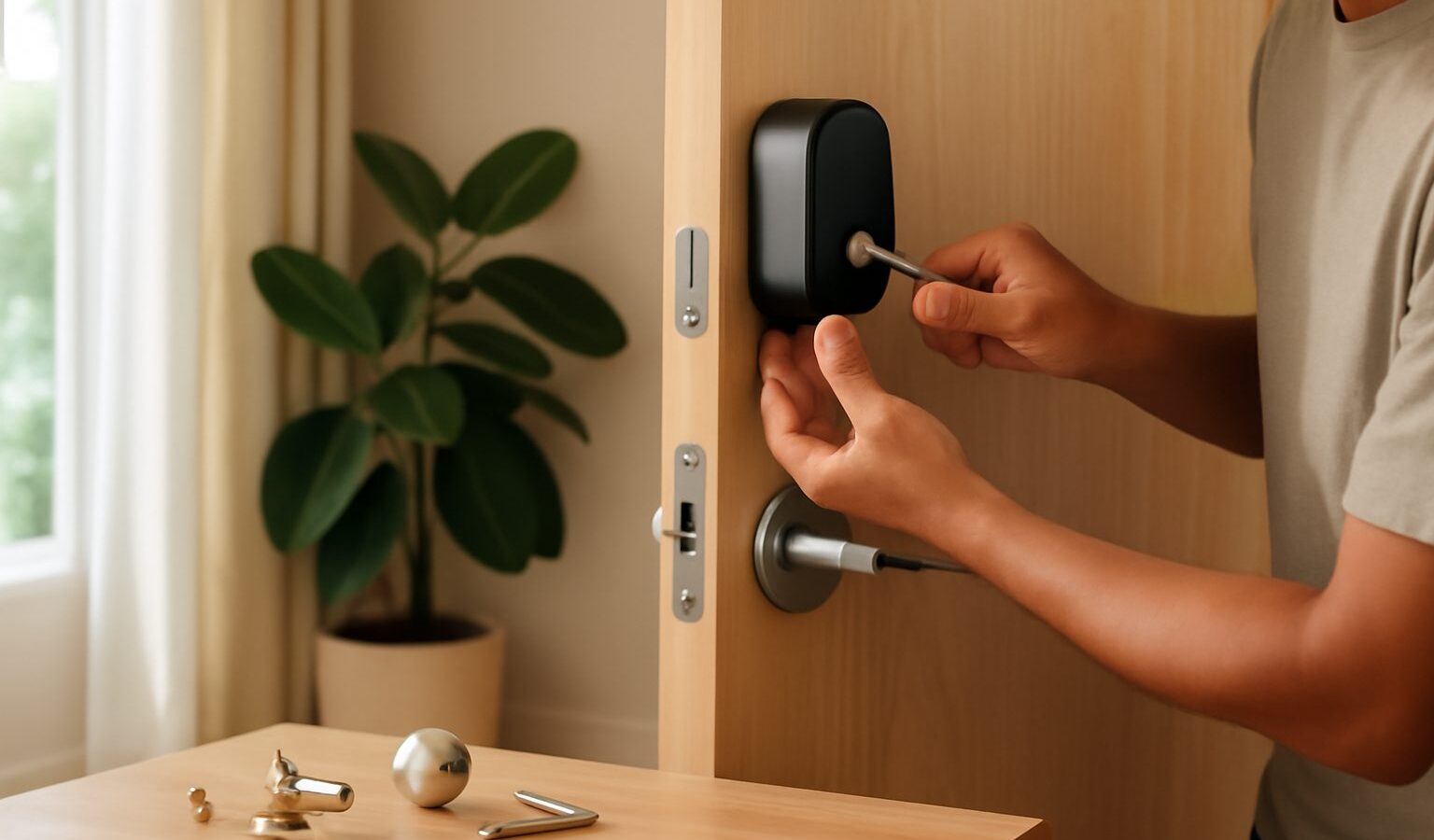
Installing a smart lock can be a satisfying weekend upgrade that ends the daily hunt for keys, but a smart lock is only as good as the fit between the lock and your door. Before you buy anything, you need to know whether your door, gate, and lock are compatible. This guide walks Singapore homeowners through compatibility, measuring, the HDB fire-door question, and the clear signs that you should hand the job to a locksmith.
Start with compatibility, not the lock
The most common mistake is buying a good-looking lock and then discovering it will not fit. Check these first.
- Door thickness: Every smart lock has a supported thickness range. HDB main doors and gates vary, so measure yours.
- Door material: Timber, metal, and composite doors each behave differently for drilling and fixing.
- Existing lock type: Rim locks, mortise locks, and cylinder locks are not interchangeable. Match the smart lock to what your door already uses, or be ready to modify the door.
- Gate versus door: Many Singapore homes want the lock on the metal gate rather than the timber door. Gate locks are a distinct category with their own mounting needs.
Manufacturers publish compatibility charts. Read them before you buy, and if your door is unusual, ask the retailer directly.
Measure carefully before you commit
Good measurements save you from an expensive mistake. Grab a tape measure and note:
- Door thickness at the edge
- Backset, the distance from the door edge to the centre of the existing lock hole
- Cross bore diameter, the size of the existing hole for the handle or cylinder
- Edge bore, the hole drilled into the door edge for the latch
- Distance between the gate frame and the door, if you plan to mount on the gate
Write these numbers down and compare them against the lock’s specification sheet. If anything falls outside the supported range, that lock is not for your door.
HDB fire doors and gate considerations
This is where many DIY plans need a rethink. HDB main doors are often fire-rated doors, and the rules and physical build matter.
- Fire-rated doors are designed to resist fire for a set period. Cutting new holes or heavily modifying one can compromise that rating and may breach requirements. If your lock needs major drilling into a fire door, pause and check the rules that apply to your flat, and consider professional installation.
- Gates are metal and need metal drilling, which is harder and less forgiving than timber. A slipped bit scratches the finish or wanders off line.
- Retrofit locks that fit over your existing lock without major cutting are the friendliest DIY option, because they change the door far less.
When a lock demands significant modification to a fire door, treat that as a strong signal to bring in a professional who understands the requirements.
Tools and preparation
If your lock is a straightforward retrofit and your measurements check out, prepare the following:
- The screwdrivers specified in the manual, usually Phillips head
- A drill only if the instructions require new holes
- A pencil, tape, and the paper template included in the box
- The batteries the lock uses
- Your phone for the companion app setup
Read the entire manual once before you touch the door. Smart locks vary a lot, and the sequence matters.
Installing a retrofit smart lock step by step
Most consumer retrofit locks follow a similar pattern. Always defer to your own manual, but expect something like this.
- Remove the interior thumb turn or handle from your existing lock, leaving the exterior cylinder in place if the design allows.
- Fit the mounting plate using the supplied screws, checking it sits square with a level.
- Attach the smart lock body onto the plate and connect it to the existing thumb turn or tailpiece.
- Insert the batteries and run the calibration routine in the app so the lock learns the locked and unlocked positions.
- Test repeatedly from both inside and outside before you rely on it. Lock and unlock at least a dozen times.
Take your time on calibration. A lock that does not fully throw the bolt is a security gap, not a convenience.
DIY versus hiring a professional
Not every smart lock job is a DIY job. Use this comparison to decide honestly.
| Situation | DIY reasonable | Call a professional |
|---|---|---|
| Retrofit over existing lock, no cutting | Yes | Optional |
| New holes in a fire-rated HDB door | No | Yes |
| Mounting on a metal gate | Sometimes | Often, for a clean result |
| Mortise lock replacement | Rarely | Usually |
| You are unsure about compatibility | No | Yes |
| Lock must integrate with other systems | Depends on skill | Yes for complex setups |
There is no shame in hiring a locksmith. A lock is your home’s first line of defence, and a professional fitting that works flawlessly is money well spent.
Never skip the backup key
Smart locks run on batteries and software, and both can fail at the worst moment. Protect yourself.
- Keep a mechanical backup key if your lock offers one, and store it somewhere safe outside the home, such as with a trusted family member.
- Note where the emergency power terminals are. Many locks let you touch a power bank to the contacts to wake a dead lock.
- Replace batteries as soon as the low-battery warning appears rather than waiting.
- Keep the app updated and note your recovery details so you are not locked out of your own account.
Security habits after installation
Once the lock is on, a few habits keep it trustworthy:
- Change any default PIN immediately and avoid obvious codes.
- Give household members their own codes rather than sharing one.
- Review access logs occasionally if your lock records them.
- Test the auto-lock behaviour so the door does not sit unlocked by mistake.
Enjoy the convenience, respect the caution
Installing a smart lock yourself is achievable when you choose a retrofit model, measure carefully, and respect the special rules around HDB fire doors and metal gates. When the job crosses into major modification, calling a professional is the smart move, not a failure. Get the fit right, keep a backup key, and you will enjoy keyless entry that feels effortless and secure.
Explore more: Smart door locks in Singapore · When to DIY and when to hire a professional · How to hang things on HDB concrete walls