

When you accept a new job, salary is not the only number on the table. A sign-on bonus, sometimes called a joining bonus, is a one-off payment an employer offers to bring you on board. It can help bridge a gap, such as a bonus you are giving up by leaving your current job, or simply sweeten an offer to win you over. Negotiating a sign-on bonus in Singapore is more common than many people think, especially in competitive fields, but it is rarely offered unless you ask. This guide walks through when a sign-on bonus makes sense, how to raise it professionally, and the fine print you must read before you sign anything.
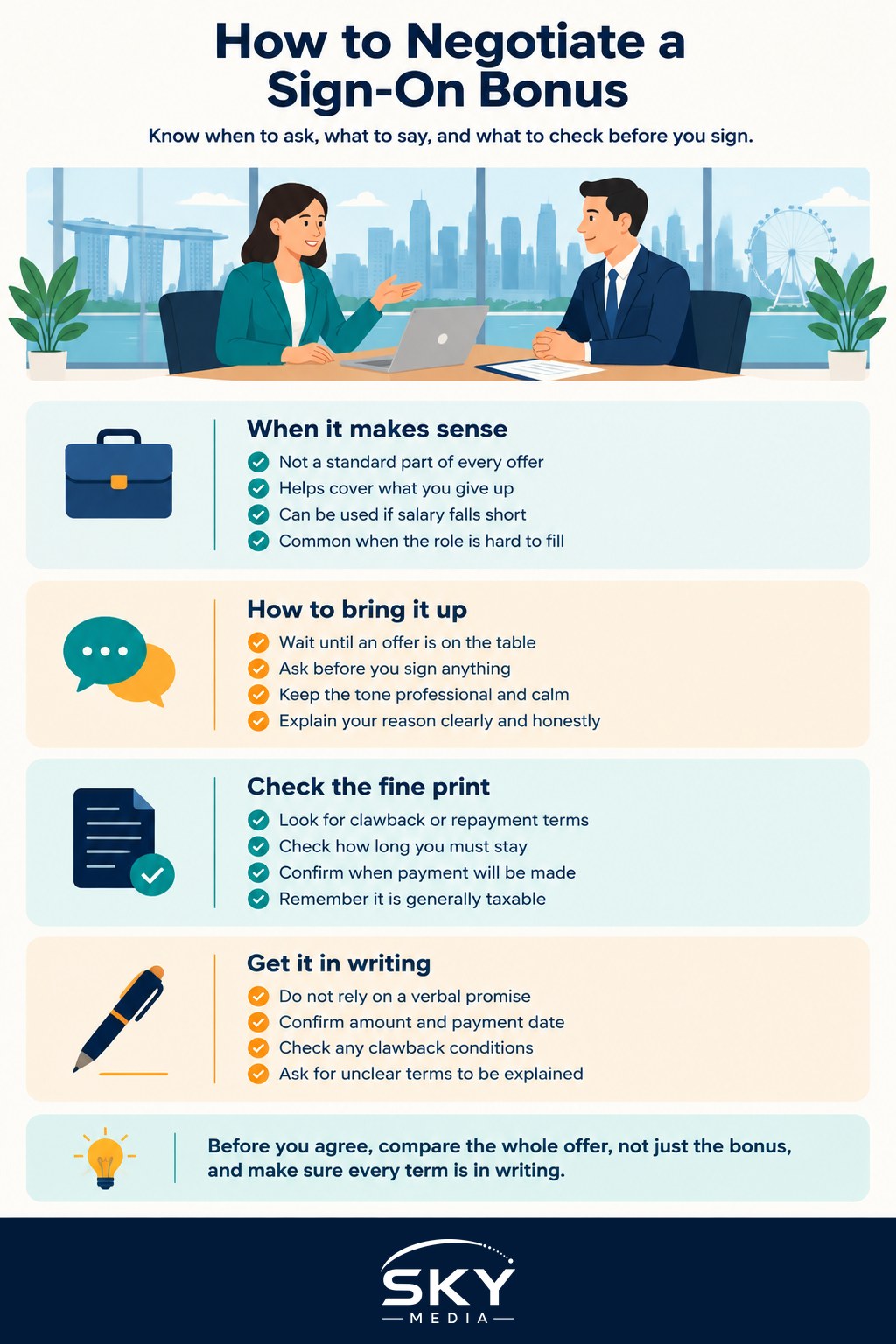
Understand When a Sign-On Bonus Fits
A sign-on bonus is not a standard part of every offer, so it helps to know when asking is reasonable. It tends to come up when you are leaving money on the table by switching jobs, for example an annual bonus you would forfeit by resigning before it pays out, or shares and benefits you lose on departure. It can also appear when an employer wants you badly, when they cannot fully meet your base salary expectation, or when the role is hard to fill.
Amounts vary widely by role, seniority, industry, and employer, and there is no fixed going rate, so avoid anchoring on figures you hear second-hand. The honest approach is to focus on your own situation. What are you actually giving up to make this move, and what would make the switch worthwhile? That gives you a fair, defensible reason to ask, which is far stronger than a number plucked from thin air.
If you are still weighing whether to move at all, our guide on comparing and choosing between job offers can help you see the full picture before you start negotiating any single piece of it.
Raise It at the Right Time and in the Right Way
Timing matters. The best moment to discuss a sign-on bonus is after the employer has decided they want you, usually once a verbal or written offer is on the table, but before you have signed. At that point you have the most leverage, because they have chosen you and do not want to lose you over a gap.
Keep the conversation professional and collaborative rather than demanding. Frame it around a genuine reason, such as the bonus you will forfeit by leaving early, and present it as a way to make the move work for both sides. For example, you might explain that you are enthusiastic about the role and that a joining bonus would help offset what you are leaving behind, making the transition easier to say yes to.
Be specific and calm. If you are compensating for a lost bonus, it is reasonable to reference roughly what you are giving up, based on your real situation. Ask once, clearly, and then let them respond. The general principles in negotiating a job offer beyond salary apply here, since a sign-on bonus is one of several levers you can pull when the base salary is fixed.
Read the Fine Print Before You Celebrate
This is the part that catches people out. A sign-on bonus almost always comes with strings attached, and the most important is the clawback or repayment clause.
- Clawback period. Many sign-on bonuses require you to stay for a set period, often a year or more. Leave before that, and you may have to repay some or all of it.
- Repayment terms. Check whether you would repay the full amount or a pro-rated portion, and whether it is the gross or net sum.
- Payment timing. Some bonuses are paid on your first payslip, others after you pass probation or hit a milestone. Know when the money actually arrives.
- Tax treatment. A sign-on bonus is generally taxable income, so factor that in and check current rules with IRAS rather than assuming.
- Conditions. Read whether resignation, dismissal, or failing probation triggers repayment.
Understand exactly what happens if things do not work out, because a bonus that must be repaid in full if you leave within a year is really a loan against your loyalty. Reading these terms carefully is part of how to read an employment contract, and it is worth doing slowly before you sign.
Get Everything in Writing
Never rely on a verbal promise of a sign-on bonus. Once you have agreed on it, make sure the amount, the payment date, and any clawback conditions are stated clearly in your offer letter or employment contract. If it is not in writing, treat it as if it does not exist.
If any clause is unclear, ask the employer to explain it or put it more plainly before you sign. A reasonable employer will not mind clarifying. This protects you and avoids painful surprises later, particularly around repayment if your plans change.
Keep Perspective on the Bigger Picture
A sign-on bonus is nice, but it is a one-time payment. Do not let a good joining bonus distract you from the parts of the offer that shape your working life for years, like your base salary, the role itself, the team, and your growth prospects. A large bonus attached to a job that is wrong for you is a poor trade.
Weigh the whole package. If the base is lower than you hoped but the bonus and long-term prospects are strong, that may still be a good move. If the bonus is generous but comes with a punishing clawback and a role you are unsure about, be careful.
Negotiating a sign-on bonus in Singapore comes down to asking at the right moment, giving a fair reason, and reading the fine print closely. Stay professional, get the terms in writing, watch the clawback clauses, and keep your eyes on the full offer, and you will make a decision you can feel good about long after the bonus has been spent.