

January feels like a fresh start, and for many young workers it is also the month they start quietly updating their CV. If you plan to resign after bonus in Singapore, the timing matters more than most people realise. Hand in your letter a week too early and you might forfeit a bonus you had counted on. Wait too long and the best roles of the new-year hiring wave may already be filled.
This guide is about timing, not the resignation process itself. It walks through when bonuses are typically paid, the contract clauses that can take money back, how notice periods shape your calendar, and how to line up a new offer without leaving cash on the table.
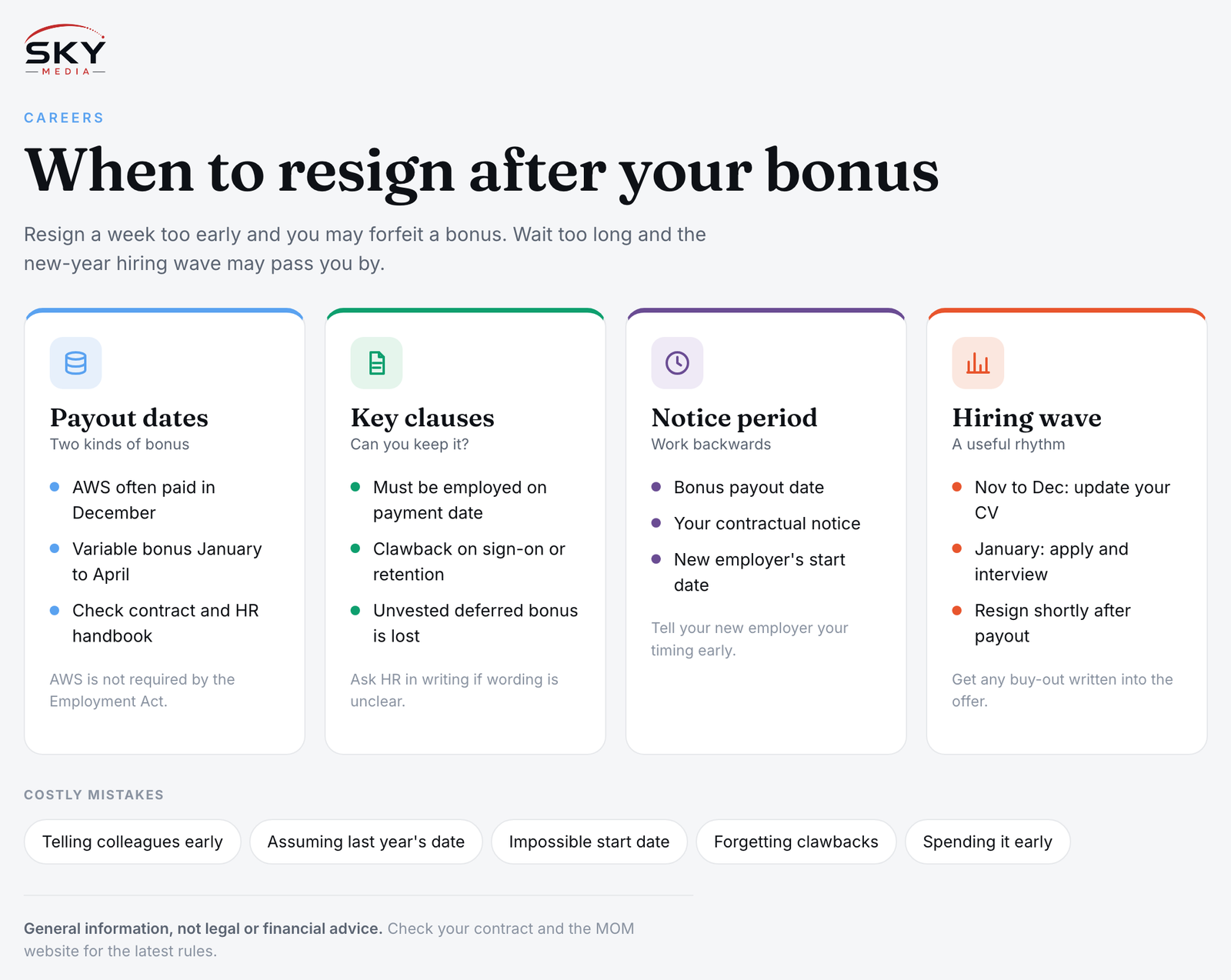
When Year-End Bonuses Are Usually Paid
“Year-end bonus” covers two quite different payments, and they often land at different times.
- The AWS (Annual Wage Supplement). Often called the 13th-month bonus, this is a fixed payment written into many contracts. It is commonly paid in December or alongside the last payslip of the year, but the exact month depends on your employer.
- The variable or performance bonus. This depends on company and individual results. Many employers pay it after the financial year closes and appraisals are done, which can mean anywhere from January to April. Companies with a non-December financial year end may pay at a completely different time.
The AWS is not required by the Employment Act; it exists only if your contract or company policy provides for it. Read your employment contract, offer letter and HR handbook to see exactly what you are entitled to and when. If the wording is unclear, ask HR in writing for the scheduled payout date. For how the payout is treated for income tax, see how your year-end bonus is taxed in Singapore.
The Clauses That Decide Whether You Keep the Money
The payout date alone does not tell you whether you are safe to resign. Several common clauses can affect what you receive or keep.
- “Employed on the payment date” conditions. Many bonus policies say you must be employed, and sometimes not serving notice, on the day the bonus is paid. If you resign before that date, you may receive nothing even if you worked the full year.
- Pro-rating rules. Some contracts pay a pro-rated AWS to people who leave partway through the year; others do not. MOM’s guidance on AWS explains the general position, but your contract is what governs your case.
- Clawback clauses. Sign-on bonuses, retention bonuses and some deferred or variable bonuses come with a condition that you repay part or all of the amount if you leave within a set period after receiving it. The period and repayment terms vary widely.
- Deferred bonuses and share awards. In some industries, part of a bonus vests over later years. Resigning can mean losing the unvested portion.
This is general information, not legal or financial advice. If a large sum depends on the exact wording, ask HR for clarification in writing, and consider getting professional advice before you resign.
How Notice Periods Change Your Calendar
Your notice period is the stretch between handing in your letter and your last day, and it is the piece people most often forget when planning around a bonus.
Your contract usually states the notice period, often from one to three months for professional roles. If your contract is silent, the Employment Act sets minimum notice periods based on how long you have worked there; check the current table on the MOM website. Either side can usually end the contract by paying salary in lieu of notice, and some employers will agree to you using unused annual leave to shorten your notice, but neither is guaranteed.
Work backwards from three dates:
- The bonus payout date (and any “not serving notice” condition).
- Your notice period under your contract.
- Your new employer’s preferred start date.
If your bonus lands at the end of February and your notice is two months, you would only start a new job around the end of April. That is fine if your new employer is willing to wait, and many are used to it, but you need to tell them early.
| Situation | What Usually Happens | What to Check First |
|---|---|---|
| Resign before the bonus payout date | Bonus may be forfeited entirely | Payout conditions in contract or HR policy |
| Resign the day after the bonus is credited | You usually keep it, unless a clawback applies | Clawback period and repayment terms |
| Resign while a retention or sign-on bonus is still “locked in” | You may have to repay part or all of it | Exact repayment formula and deadline |
| Resign with unvested deferred bonus or shares | Unvested portion is often lost | Vesting schedule and leaver rules |
| New employer offers a “buy-out” for lost bonus | They may compensate some of what you forfeit | Get the amount and conditions in the written offer |
Riding the January Hiring Wave
Many Singapore employers confirm their headcount budgets for the new year in December and January, so job postings often pick up after the festive break. Plenty of other workers are also waiting for their bonuses, which means more vacancies open up from February to April as people resign.
That creates a useful rhythm:
- November to December: update your CV and LinkedIn profile, reconnect with former colleagues, and research companies you like. Do not hand in anything yet.
- January: start applying and interviewing. Interviews take time, often several rounds, so beginning now gives you a realistic chance of a signed offer close to your bonus date.
- Bonus payout date: check that the money has been credited correctly before you act.
- Shortly after payout: resign, serve your notice, and start the new role.
Be honest with recruiters about your timing. Saying “my bonus pays out at the end of February and my notice is one month” is normal and helps them plan. Some employers will offer a sign-on bonus to offset what you would lose by leaving early; if they do, make sure the amount and any clawback conditions are written into your offer letter.
If you hold a work pass, timing matters even more, because your pass status changes once employment ends. Read what happens to your work pass after you resign before you set a last day, and do not assume you can bridge a gap without checking with MOM.
Mistakes That Cost People Their Bonus
A few patterns come up again and again:
- Telling colleagues before payout. Word travels. Even if your contract does not technically allow it, an early leak can make the payout awkward or delayed. Keep plans private until the money is in your account.
- Assuming last year’s date applies. Payout dates can shift with company results or a new HR system. Confirm the current year’s date.
- Signing a new offer with an impossible start date. If you promise to start before your notice ends, you may end up negotiating with two employers at once.
- Forgetting about the clawback window. If you received a retention bonus last year, check whether it is still repayable.
- Spending the bonus before it arrives. Treat it as uncertain until it is credited. Our year-end bonus checklist has ideas on what to do with it once it lands.
Resigning Well Once the Timing Is Right
Once your bonus is safely in your account and you have a signed offer, the rest is about leaving on good terms. Write a short, polite resignation letter, give the full notice your contract requires, and offer a proper handover. Singapore’s job market is small, and the manager you leave this year may be your reference, client or colleague later. Our guide on how to resign from a job professionally covers the letter, the conversation and the handover in detail.
Getting the timing right is mostly about reading your own documents carefully and planning a few months ahead. Do that, and you can move on with your bonus, your reputation and your new-year goals intact.