

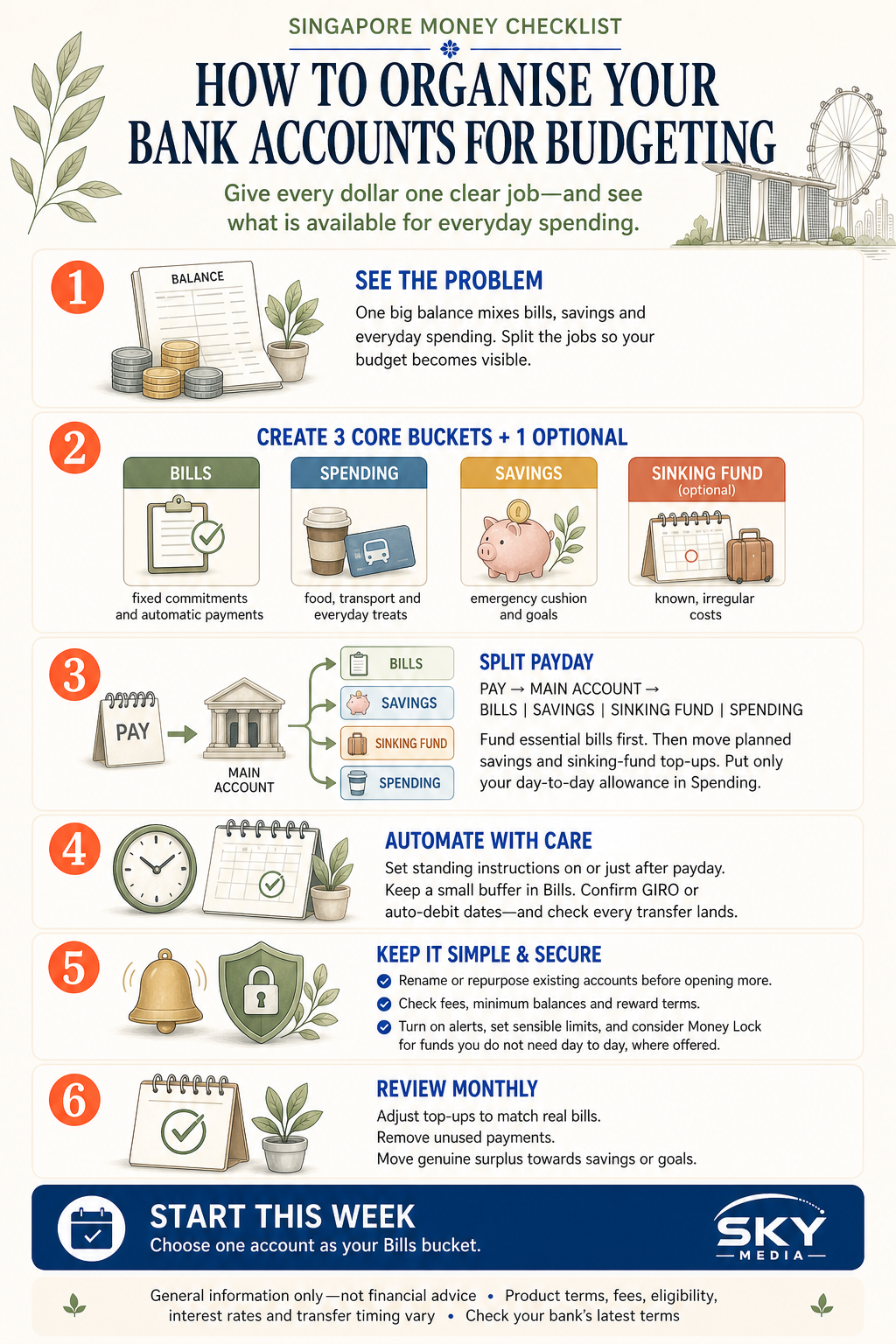
Organising bank accounts for budgeting in Singapore can quietly transform how in control you feel, and it takes no spreadsheet skills at all. Many of us run our whole financial life out of one account: pay goes in, bills go out, savings sit in the same pool as spending money, and by the end of the month it is anyone’s guess what is left. When everything shares one balance, every dollar looks spendable. The fix is simple. Give your accounts clear jobs so the money sorts itself, and a glance at the right balance tells you exactly what is safe to spend.
Why one account makes budgeting so hard
A single account hides information. Your bills money, your savings, and this week’s spending all blur into one number, so you either overspend by accident or hoard nervously because you cannot tell what is truly free. It also makes automation impossible. You cannot set a savings transfer with confidence when you do not know whether the balance is really yours or already promised to a bill.
Separating your money solves this by making each dollar’s purpose visible. It is the same logic as keeping your groceries, transport, and ang bao money in different envelopes, just done digitally. The moment your accounts are split by job, budgeting stops being a monthly guessing game and becomes a system that runs largely on its own.
A simple multi-account setup that works
You do not need a dozen accounts. Most people do well with a small handful, each with one clear job. Think of them as buckets that your pay flows into automatically.
- A bills account, where all your fixed costs live: home costs, utilities, telco plans, insurance, and subscriptions.
- A spending account, for everyday variable costs like food, transport, and small treats. This is the one you actually swipe from.
- A savings account, kept separate so the money is out of sight and harder to raid on impulse.
- Optionally, a sinking-fund account for big known costs like festive spending or an annual renewal.
The key move is that money for bills and savings leaves your spending account automatically, right after payday. Whatever remains in the spending account is genuinely yours to use, with no mental maths required. When that account runs low, you slow down, no guilt attached. Pairing this with tracking your spending tells you how much each bucket really needs.
How the buckets compare
Not every account should behave the same way. Some are for paying out, some for holding, and some for restraint. Here is how the common buckets differ and what each one is for.
| Account bucket | Its one job | How you interact with it |
|---|---|---|
| Bills account | Holds money already promised to fixed costs | Set and forget, let auto-payments draw from it |
| Spending account | Funds day-to-day variable spending | Use this card daily, watch the balance |
| Savings account | Grows your safety net and goals | Money flows in, rarely flows out |
| Sinking fund | Saves ahead for big, occasional costs | Top up monthly, draw only when the cost lands |
Seeing the jobs side by side makes the point clear. Trouble usually starts when one account tries to do two jobs at once, like when savings and spending share a balance. Give each bucket a single purpose and the whole system gets easier to trust.
Set up the automatic flow
The magic ingredient is timing. Arrange for your money to move on or just after payday, before you have a chance to spend it. When your pay lands, standing instructions can sweep the bills money into the bills account, the savings into savings, and the sinking-fund top-up into its pot, leaving your spending account holding only what is free to use.
A rough order of operations:
- Pay lands in a central account, often your salary or main account.
- An automatic transfer funds the bills account with the month’s fixed costs.
- Another transfer moves your planned savings out of reach.
- A smaller transfer tops up any sinking funds for big future costs.
- What is left stays in the spending account as your everyday money.
This “pay yourself and your bills first” order means saving is not something you attempt with the leftovers. It happens up front, automatically, and the leftovers become your spending limit instead. If you want to build the full automated version, our guide on automating your money and savings walks through it step by step.
A few practical tips for Singapore. Keep an eye on any conditions attached to your accounts, such as balance or transaction requirements, since these change and vary by provider, so check the current terms rather than assuming. Watch for fees so your tidy system does not quietly cost you. And take advantage of instant local transfers, which make same-day movements between accounts painless. This is general information, not a recommendation of any particular product, so compare current options for your own situation.
Keep it tidy without overcomplicating
The risk with any system is that it grows fussy until you abandon it. Resist the urge to open an account for every tiny category. A few well-named buckets beat twenty you never check. Rename your accounts inside your banking app so their jobs are obvious at a glance, which removes any doubt about what you are looking at.
Do a quick review once a month to see whether each bucket is funded correctly. If your bills account keeps running short, your fixed costs have crept up and the automatic transfer needs adjusting. If your spending account always has plenty left, you might be able to move more into savings. A short monthly look keeps the whole thing honest, and a monthly money review is the natural home for this check.
Where to start this week: open or repurpose one extra account to be your bills bucket, work out your total monthly fixed costs, and set a standing transfer to fund it right after payday. That single change alone will make your spending money finally mean something. You can add the savings and sinking-fund buckets once the first flow feels comfortable.
Organising bank accounts for budgeting in Singapore is one of those quiet upgrades that pays off every single day. Once each dollar has a job and the transfers run themselves, you stop wondering what you can afford, because the right account already tells you.
Explore more
Turn this structure into a hands-off system with our guide on automating your money and savings, and use a dedicated bucket for the big stuff with sinking funds for big expenses. To keep every account funded correctly, make a habit of a monthly money review.