
Ranking up in competitive games is one of the most satisfying goals in gaming, and one of the most misunderstood. Many players think climbing is about grinding endless matches or having the fastest reflexes, when it is really about steady habits, honest review, and improving one skill at a time. Whether you play a team shooter, a MOBA (a five-versus-five strategy game), or a fighting game, the path up the ladder follows the same principles. This guide lays out a calm, practical approach to ranking up that works for busy players in Singapore, without the burnout that comes from chasing wins the wrong way.
What Rank Actually Measures
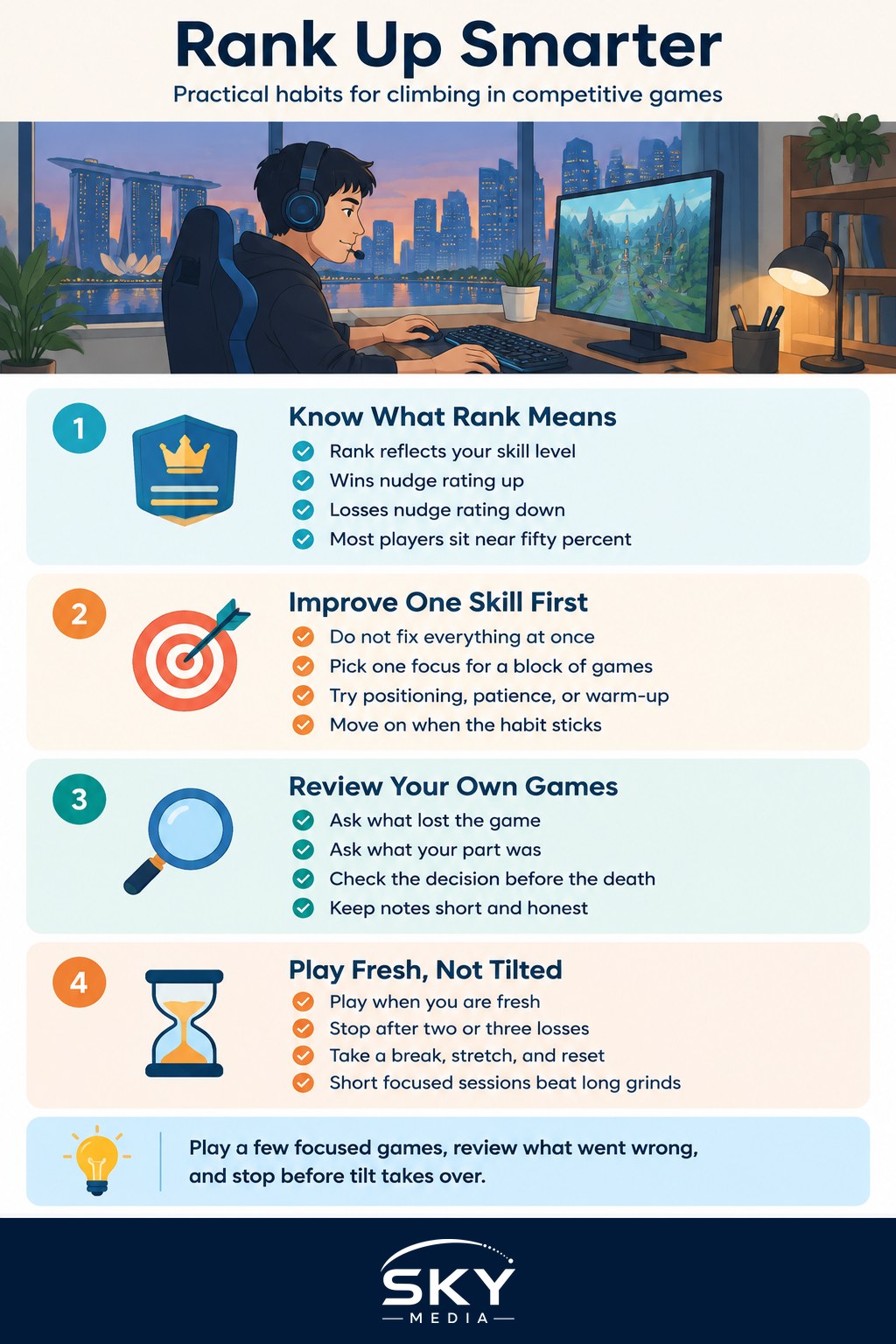
Before you climb, it helps to understand what you are climbing. In most competitive games, rank is a rough estimate of your skill produced by a matchmaking system. When you win, the system nudges your rating up; when you lose, it nudges it down. Over many games, it tries to place you against opponents of similar ability, which is why the win rate of most players hovers near half.
That last point matters. If you sit around a fifty percent win rate, the system thinks it has found your level. To move up, you do not need to win every game; you need to win a little more often than you lose, consistently, over time. A player who wins fifty-five percent of matches will climb steadily, even though nearly half their games are losses.
This reframes the whole exercise. You are not trying to be perfect. You are trying to tilt the odds slightly in your favour, again and again, by playing a bit better than the average person at your current level. That is a far kinder and more achievable goal than “never lose.”
Focus on One Skill at a Time
The fastest way to stall is to try to fix everything at once. Competitive games have many layers: mechanics, positioning, game sense (reading what is likely to happen next), decision-making, and communication. Trying to improve all of them in a single session leaves you overwhelmed and improving none.
Instead, pick one focus for a block of games. For example:
- This week, positioning. Ask only one question each death: was I standing somewhere sensible?
- Next week, patience. Notice how often you take a fight you did not need to take.
- The week after, warm-up. Spend a few minutes on mechanics before ranked so your first game is not a write-off.
Narrowing your attention like this makes progress visible. When you are only watching one thing, you actually notice it, and noticing is the first step to changing it. Once a habit sticks, move your focus to the next weakness. This slow, layered approach beats frantic all-at-once effort every time.
Strong communication is one of those layers worth its own focus, and it pairs closely with the habits in communication and teamwork in games. In team titles, a squad that talks well often out-ranks a squad with better individual aim.
Review Your Own Games Honestly
The single habit that separates climbers from plateaued players is reviewing their own play. It is uncomfortable, because it means facing your mistakes, but it is where nearly all the improvement lives. You do not need fancy tools. After a loss, ask three plain questions: what actually lost us the game, what was my part in it, and what would I do differently next time.
Most games let you rewatch a match or at least a summary. If yours does, watch a death or two and look for the decision before the death, not the death itself. Players usually die because of a choice made several seconds earlier, such as pushing too far or ignoring the map. Spotting that earlier mistake is worth more than blaming your aim.
Be honest but not harsh. The goal is information, not self-punishment. “I overextended there” is useful. “I am terrible at this game” is not, and it only tilts you. Keeping a short, kind record of recurring mistakes turns vague frustration into a clear to-do list.
Play the Numbers, Not Every Game
Ranking up is a marathon, and how you manage your energy matters as much as your skill. Two ideas help here: play when you are fresh, and stop when you are tilted.
A tilted player, meaning one who is frustrated and playing worse because of it, loses games they would normally win, which loses rank, which makes them more tilted. It is a spiral. The professional move is boring: after two or three losses in a row, take a break. Stand up, stretch, drink some water, and come back later. Your rank will still be there.
The table below contrasts the mindset that climbs with the mindset that stalls, so you can catch yourself drifting.
| Situation | Climbing mindset | Stalling mindset |
|---|---|---|
| After a loss | “What can I learn from this?” | “My teammates threw again” |
| A losing streak | Take a break, reset, return fresh | Queue again immediately while tilted |
| Improving | Focus on one skill for a while | Try to fix everything at once |
| Reviewing | Rewatch and note the earlier mistake | Skip review, just queue more |
| Session length | Stop while still enjoying it | Grind for hours chasing one more win |
| Win rate near 50% | Aim to win slightly more, patiently | Expect to win every single game |
Notice that most of the difference is emotional, not mechanical. Managing your own head is a genuine competitive skill, and it is one you can practise.
Ranking Up From a Home in Singapore
Practical conditions shape how well you can climb, and a few local realities are worth planning around. A stable connection matters in ranked, where a single lag spike can cost a fight. A wired connection or a seat near the router keeps your ping steady, and playing during quieter hours can help too, since a congested home network at peak evening times adds delay.
Time is the real constraint for most Singaporean players juggling work, school and family in a shared flat. You do not need marathon sessions to climb. Two or three focused games, played well and reviewed, beat six tired ones played on autopilot. Protect your sleep, because a rested mind reacts faster and tilts less, and this is general wellbeing guidance rather than any promise about a specific result. If ranked ever stops being fun and starts feeling like a chore that eats your rest or study time, step back; the ladder is a hobby, not a job.
Solo players face an extra challenge, since you cannot control your teammates. Learning to carry your own weight and stay calm without a coordinated squad is a skill in itself, covered in surviving solo queue. Combine that composure with steady review and single-skill focus, and ranking up stops feeling like luck. It becomes what it really is: the natural result of playing a little smarter each week.
Frequently Asked Questions
How long does it usually take to rank up? It varies with how often you play, your starting level and how well you review, so no timeline is guaranteed. Progress is usually slow and uneven. Judge yourself on the trend over weeks and months, not on a single session or a bad streak.
Is it better to play ranked with friends or alone? It depends on what you want. Friends give coordination and communication, which can help climbing in team games. Solo play tests your own fundamentals. Some games match groups differently, so check how your game handles parties.
Should I take breaks from ranked when I plateau? Yes, a short break often helps. Stepping away lets you reset, and returning with one specific focus works better than grinding while stuck. Use the time to review your play or practise a single skill in a casual mode.
Does the time of day I play affect my rank? It can affect the players you meet and your own alertness. Play when you are rested rather than late and tired, and when your connection is steady. Peak home-network hours may add lag, so a wired connection helps.
Is it worth paying for a coach to rank up faster? It can be, but it is not necessary. Free reviews, guides and your own recordings can take you far. If you hire a coach, check reviews, agree what you want to work on and be cautious about anyone promising guaranteed results.
Further reading: How to Improve Your Decision Making in Games · What Are Battle Royale Games? · What Are MOBA Games?