

Ranked has a way of getting under your skin. A close loss, a rough teammate or a promotion on the line can send your heart racing and your decisions out the window. Staying calm in ranked is a skill you can practise like any other, using simple tools such as breathing, tilt control and well-timed breaks. Composure will not fix every game, but it will stop you from throwing the ones you could have won.
This is about everyday wellbeing and steadier play, not clinical advice. The aim is to help you enjoy competing and make clearer decisions when the pressure rises.
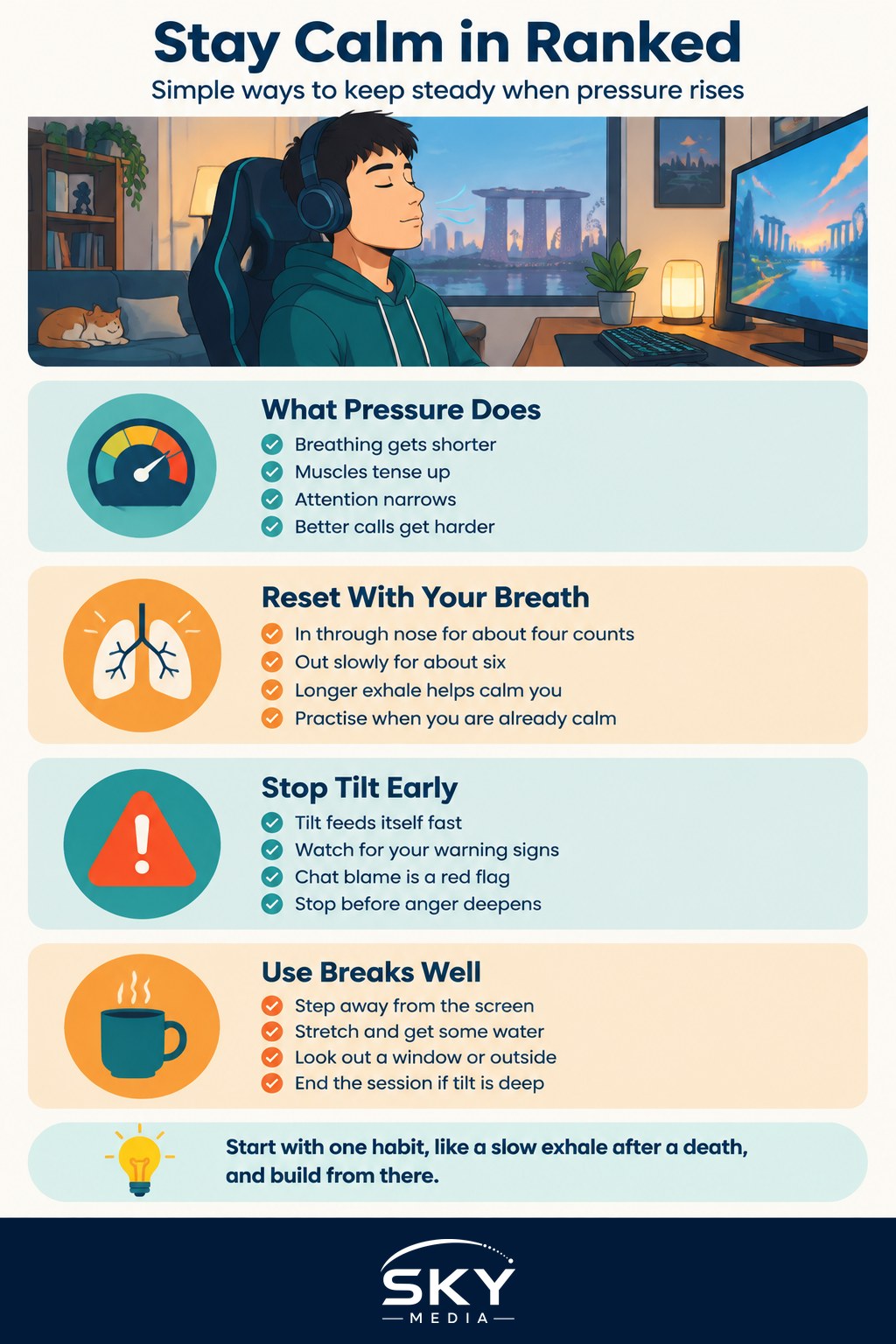
Understand what pressure does to your play
When you feel stressed, your body reacts before your mind catches up. Your breathing shortens, your muscles tense and your attention narrows. That narrowing is the real problem in a competitive game, because the wide awareness you need to make good calls is exactly what stress takes away first.
Recognising this is half the battle. When you notice your grip tightening or your thoughts turning to frustration, treat it as a signal rather than a verdict. Your body is telling you it has shifted into a reactive state, and you can gently steer it back. Naming the feeling, “I am getting tense,” creates a small gap between the feeling and your next click, and that gap is where better decisions live.
Use your breath to reset
The fastest tool you have is your breath, because it is the one part of the stress response you can control directly. Slowing your breathing tells your body the emergency is over.
Try this between rounds or after a death: breathe in slowly through your nose for about four counts, then out slowly for about six. A longer exhale than inhale is the part that calms you. Two or three of these is often enough to loosen your shoulders and widen your attention again. It sounds almost too simple, but it works precisely because it targets the physical side of stress rather than trying to argue yourself calm.
Practise it in low-stakes moments so it becomes automatic. If you only ever try to breathe deliberately when you are already furious, it will feel foreign. Build the habit when you are calm and it will be there when you need it.
Manage tilt before it snowballs
Tilt is the slow slide from playing well to playing angry, and its danger is that it feeds itself. One frustrating moment leads to a rushed play, which leads to another mistake, which fuels more frustration. Breaking that loop early is far easier than climbing out once you are deep in it.
Watch for your personal warning signs. Common ones include blaming teammates in chat, playing faster and more aggressively than usual, or a running commentary of frustration in your head. When you catch one, take it seriously.
Compare your options for handling pressure
Different tools suit different levels of stress. Match the response to how far gone you are.
| Tool | Best for | Time it takes | Effect |
|---|---|---|---|
| Slow breathing | Mild in-game tension | Seconds | Quick physical reset |
| Reframing the moment | Frustration at a mistake | Seconds | Restores perspective |
| A short break | Building tilt between games | A few minutes | Interrupts the spiral |
| Ending the session | Deep or lasting tilt | Rest of the day | Protects your rank and mood |
The key insight is that small tools handle small stress, and no small tool will rescue you from real tilt. Once you are genuinely angry, the honest move is to stop playing, not to push on hoping the next game fixes it.
Take breaks that actually help
A good break is one where you step away from the screen, not just alt-tab to something equally stimulating. Stand up, stretch, get some water, look out a window or step outside for a minute. The point is to let your nervous system settle, which needs a genuine change of input, not just a different tab.
Even a two-minute break between ranked games resets you more than you would expect. And there is no shame in ending a session early. Logging off while you are tilted protects both your rank and your enjoyment, and the ladder will still be there tomorrow when you are fresh.
Reframe how you see mistakes
A lot of ranked pressure comes from how we talk to ourselves after an error. If every mistake feels like proof that you are bad, each game becomes a threat. If a mistake is simply information about what to practise, the pressure eases and you actually improve faster.
Try to treat a lost game as a single data point rather than a judgement on your worth as a player. You will still care, and you should, but caring does not have to mean spiralling. The players who climb steadily are usually the ones who stay level-headed, learn one thing from each loss and keep going.
Build calm as a habit
Composure is not a switch you flip in a crisis. It is a habit you build across many games, and the small routines are what make it dependable.
- Set a loss limit. Decide before you start how many losses in a row will end your session, then honour it.
- Warm up first. A few minutes of casual play settles the nerves before you touch ranked.
- Sleep and basics matter. You will always feel pressure more sharply when you are tired, hungry or wound up from the day.
None of these are dramatic, and that is the point. Calm is built from unglamorous habits repeated often.
Play the long game
You will still have games that get to you, because ranked is designed to matter and that is part of why we love it. The goal is not to feel nothing. It is to notice the pressure sooner, use a breath or a break, and return to steadier play more often than you used to. Start with one habit, the slow exhale after a death is a fine place to begin, and let the rest build over time. Staying calm in ranked keeps the game fun, and a player having fun is usually a player who wins more too.
Explore more: How to Deal With Tilt in Gaming · Surviving Solo Queue · How to Rank Up in Competitive Games
Frequently Asked Questions
What should I do right after a frustrating loss in ranked? Pause before queuing again. Stand up, drink some water, and take a few slow breaths with a longer exhale. If you still feel wound up, skip the next game. Queuing while angry tends to lead to another rushed loss.
Does blaming teammates in chat hurt my own performance? Usually it does. Blaming others is a common sign of tilt, and it pulls your attention away from your own play and invites more conflict. Muting chat, or limiting yourself to short useful callouts, helps you keep your focus.
Is it normal to feel anxious before a promotion match? Yes, it is very common, because the stakes feel higher. A short warm-up in a casual game, steady breathing and treating the match as one data point can settle the nerves. If gaming stress spills into your daily life, consider talking to a doctor or counsellor.
Can lack of sleep make me tilt more easily? Yes. Being tired, hungry or wound up from the day makes pressure feel sharper and your patience shorter. Playing ranked when rested and fed is one of the simplest ways to stay level-headed.
Further reading: Understanding Ranked Systems and MMR