
Walk down any supermarket aisle or scroll any shopping app and you will see it: leafy green packaging, words like “eco”, “natural” and “planet-friendly”, and pictures of forests on products that have very little to do with forests. Some of these claims are genuine. Many are not. Learning to spot greenwashing singapore shoppers face every day is one of the most useful sustainability skills you can build, because it means your good intentions actually land where they matter instead of being spent on clever marketing.
Greenwashing is when a product, brand or service is made to look more environmentally friendly than it really is. The good news is that once you know the common tricks, they are surprisingly easy to see through. This guide walks through the red flags, the labels you can actually trust here, and how to stay a savvy, hopeful consumer rather than a jaded one.
What Greenwashing Actually Looks Like
Greenwashing is rarely an outright lie. More often it is a selective truth, a vague word, or a distraction. A brand highlights one small green feature while staying quiet about a much bigger problem. A bottle is splashed with the word “natural”, which means almost nothing on its own. A label is designed to look official when no independent body stands behind it.
The reason it works is that most of us are busy and want to do the right thing. We see a green leaf, feel reassured, and move on. Sellers know this. Spotting greenwashing is not about assuming everyone is lying to you. It is about slowing down for a moment and asking a simple question: what is the actual evidence behind this claim?
Red Flags to Watch For
A few patterns come up again and again. None of these guarantees a product is bad, but each is a signal to look a little closer.
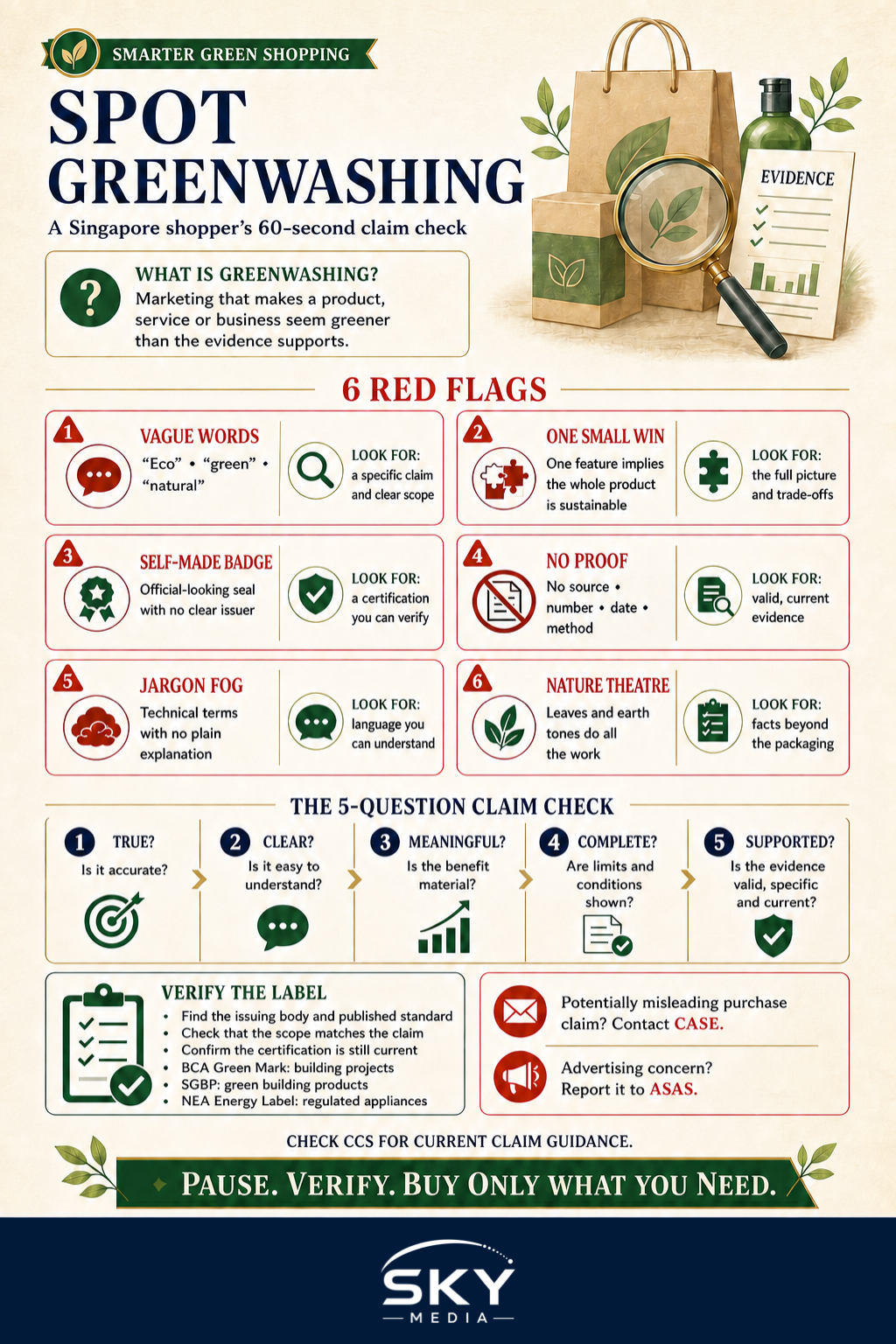
- Vague feel-good words with no proof. “Eco-friendly”, “green”, “natural”, “clean” and “responsible” have no fixed legal meaning on their own. If a claim is not backed by a specific fact or a recognised certification, treat it as decoration, not information.
- Hidden trade-offs. A product shouts about one green feature while ignoring the rest of its footprint. A “recyclable” item wrapped in three layers of plastic, or a “energy-saving” gadget you did not need in the first place.
- Fake or self-made labels. Some badges look like official seals but are simply invented by the brand itself. A green circle with the company’s own slogan is not a certification.
- Focusing on one tiny feature. A single recycled component, or removing one ingredient, gets treated as if the whole product is now sustainable.
- No numbers, no source, no date. Genuine claims can usually be checked. If a brand says something is “better for the planet” but offers nothing you can verify, that is a gap worth noticing.
- Nature imagery doing the heavy lifting. Leaves, earth tones and animals create a green feeling without making any real claim at all.
Certifications and Labels You Can Trust
The antidote to vague claims is independent verification. In Singapore and beyond, a handful of recognised certifications carry real weight because a third party checks them, not the seller. Because criteria and coverage are updated over time, it is always worth confirming the current details on the official source rather than taking a badge at face value.
- BCA Green Mark for buildings and, increasingly, for products and spaces, run by the Building and Construction Authority. It is a good sign of assessed environmental performance rather than marketing.
- Energy labels and appliance tick ratings overseen by the National Environment Agency, which let you compare the efficiency of fridges, air-conditioners and other appliances on a like-for-like basis. Check the NEA site for how the current scale works.
- MSC (Marine Stewardship Council) and similar seafood labels, which indicate seafood from fisheries assessed against sustainability standards. Useful when you are at the supermarket wondering which fish to pick.
- Established international eco-labels for things like paper, timber, cleaning products and electronics, where an independent organisation sets and checks the standard.
When you see a real certification, you can usually look it up, find the standard it is based on, and see who audits it. When you cannot find any of that, the label may be doing more for the brand than for the planet.
Red Flags Versus What to Look For Instead
| Greenwashing red flag | What to look for instead |
|---|---|
| Vague words like “eco”, “natural”, “green” with nothing behind them | A specific, checkable claim (what, how much, verified by whom) |
| A badge or seal designed by the brand itself | An independent certification you can look up (Green Mark, MSC, NEA energy label) |
| One small green feature highlighted, rest ignored | Honesty about the whole product, including its trade-offs |
| Lots of leaves and earthy imagery, few facts | Plain information: materials, energy use, disposal, sourcing |
| “Better for the planet” with no source or detail | A source you can check, or clear guidance to an official body |
Asking for Proof Without Becoming a Cynic
The healthiest approach sits between blind trust and total suspicion. You do not need to interrogate every purchase or assume every green claim is a scam. Plenty of Singapore businesses are making genuine, honest efforts, and treating them all as liars is both unfair and exhausting.
A few gentle habits go a long way:
- Pause on the claim. Ask what it actually means and whether there is any evidence attached.
- Look past the front of the pack. Check the back label, the ingredients, the packaging, and the disposal instructions.
- Trust independent labels over self-praise. A verified certification beats a brand’s own adjectives every time.
- Reward genuine transparency. Brands that are open about their limits, including what they have not yet fixed, are usually more credible than those that claim perfection.
- Remember that buying less is the strongest green choice. No certification beats simply not buying something you do not need.
Being a savvy sustainable consumer is not about catching everyone out. It is about spending your attention and money where they do real good, staying encouraged rather than discouraged, and celebrating the honest efforts when you find them. Small, informed choices, repeated often, are exactly how a greener Singapore gets built.
Explore more
If shopping is where you feel the pull of green claims most, our guide to sustainable fashion in Singapore shows how to read clothing claims and buy better. And for the home, sustainable home products in Singapore covers the everyday swaps worth making, and how to tell a genuine one from a cleverly marketed one.