

Coaching sells a promise: that with your guidance, someone will get somewhere they could not reach alone. A coaching business in Singapore can be started with almost no capital, which is exactly why the market is crowded and why credibility is everything. Anyone can call themselves a coach, so your job is to prove you deliver results. This guide covers the opportunity, finding a niche and clients, pricing, and the ACRA and IRAS essentials.
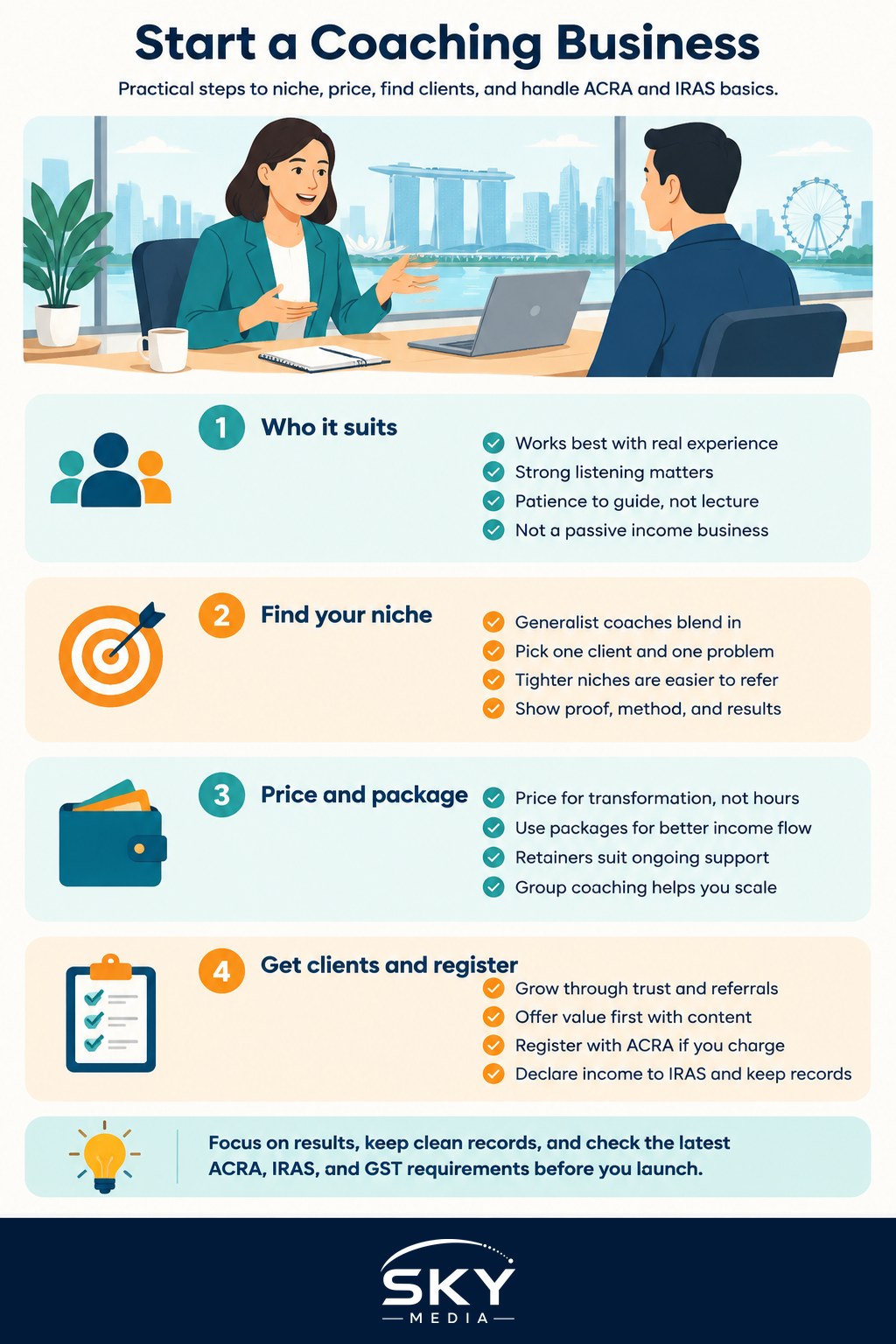
The opportunity and who it suits
Coaching spans many fields: career, business, life, executive, health and fitness, relationships, finance mindset, and more. The common thread is helping a client set goals, work through obstacles, and stay accountable. Demand exists because people will pay for structure and support to change something that matters to them, and because self-help content alone rarely gets them there.
This path suits people with real, demonstrable experience in what they coach, strong listening skills, and the patience to guide rather than lecture. It suits those willing to do the unglamorous work of marketing and selling, because clients do not appear on their own. It is a poor fit for anyone who wants passive income; coaching is a service you deliver in person or live, so your time is the product, which caps how much one person can earn without adding group programmes or products.
Be honest about your qualifications. Coaching is largely unregulated in Singapore, but that cuts both ways: the lack of a required licence means clients judge you on reputation, results, and any recognised certification you hold in your field.
Finding a niche and positioning
A generalist “life coach” struggles to stand out. A coach who helps mid-career professionals move into management, or helps new parents rebuild fitness, is instantly clearer and easier to refer. Narrow your niche to a specific person with a specific problem and a specific outcome. Counterintuitively, a tighter niche usually brings more clients, not fewer, because your marketing speaks directly to someone.
Your positioning rests on proof. Gather it deliberately:
- Results and testimonials from early clients, even discounted or free ones at the start.
- Relevant certification in your field where it exists, which reassures clients and, for some corporate work, may be expected.
- Content that demonstrates thinking, such as articles, talks, or short videos that show how you help.
- A clear method, a named framework or process, so clients understand what working with you looks like.
Pricing and packaging your service
Coaches commonly undercharge at the start, then resent the work. Price on the transformation you deliver and the value to the client, not on an hourly rate alone. Package your service so clients buy an outcome over time rather than a single session, which suits coaching better and stabilises your income.
The table compares common models so you can choose intentionally.
| Model | How it works | Best for | Trade-off |
|---|---|---|---|
| Per session | Pay as you go | Testing fit, one-off help | Unpredictable income |
| Packages | Block of sessions upfront | Real transformation | Bigger commitment to sell |
| Retainer | Ongoing monthly support | Executives, businesses | Must keep delivering value |
| Group coaching | Many clients at once | Scaling beyond your hours | Less individual attention |
Group programmes and digital products let you serve more people without adding hours, which is the usual route past the income ceiling of one-to-one work. Do not invent price points to match others; test what your market and your results support.
Finding clients
Most coaching clients come through trust, so your marketing is really relationship-building at scale. Reliable channels include:
- Your existing network and referrals. Tell people clearly what you now do and who you help.
- Free value first, such as a workshop, a talk, or useful content, so prospects experience your thinking before they buy.
- A discovery conversation rather than a hard sell, where you and the client check fit and agree on goals.
- Partnerships with businesses, communities, or complementary professionals who serve the same clients.
- Corporate work, where companies engage coaches for their staff; this often pays well but has a longer sales cycle.
Deliver results, ask happy clients for referrals and testimonials, and the business compounds.
Registering the business: ACRA and IRAS
Coaching for a fee on any regular basis is a business, so register with ACRA. Many coaches start as a sole proprietorship for simplicity; a private limited company offers liability protection and a more professional footing as you take on corporate clients or grow. A corporate services provider or accountant can advise on structure.
Your coaching income is taxable and must be declared to IRAS. Keep the basics right:
- Separate your business and personal money.
- Keep records of certification courses, software, marketing, and other costs, which are typically deductible.
- Track turnover against the GST registration threshold set by IRAS and register if you cross it; check the current figure.
- Use a clear client agreement covering scope, fees, cancellations, and confidentiality; consider professional indemnity insurance for peace of mind.
This is general information, not legal, tax, or professional advice. Rules change, so confirm the current position with ACRA, IRAS, or a qualified professional, and get proper advice on contracts and insurance.
Common pitfalls to avoid
- Staying a generalist. A vague offer is a weak offer; niche down.
- Undercharging and overdelivering until you burn out. Price for the value and protect your energy.
- Selling single sessions when packages serve clients and cash flow better.
- Overpromising outcomes. You guide; the client does the work. Avoid guarantees, especially in health or finance areas, and stay within your competence.
- Neglecting the business side, then facing tax-season chaos. Register and keep records from day one.
Prove you deliver, niche tightly, price for value, and keep clean books. Coaching rewards patience and integrity more than hype, and the coaches who last build their businesses on results.
Explore more
If your expertise can be taught to many at once, compare this with selling online courses, a natural way to scale past one-to-one work. To build the audience and trust that bring clients, see how to become a content creator in Singapore, and audio storytelling in starting a podcast business can showcase your thinking.
Frequently Asked Questions
Do I need a coaching certification to start coaching in Singapore? No licence is required, since coaching is largely unregulated here. That means clients judge you on reputation, results and any recognised certification in your field. A relevant credential can reassure clients and may be expected for some corporate work.
Can I start coaching part-time while keeping my day job? Yes, many coaches begin on the side with a few clients. Check your employment contract for any restrictions on outside work first. Starting part-time lets you build testimonials and a method before you commit fully.
How do I stop coaching from capping my income? Because your time is the product, one-to-one work has a ceiling. The usual way past it is group programmes, workshops or digital products that serve more people without adding hours. Packages and retainers also stabilise income compared with single sessions.
What should be in a coaching client agreement? Cover the scope of the work, fees, cancellation and rescheduling terms, and confidentiality. It sets expectations on both sides and avoids disputes later. A lawyer can review your template, and professional indemnity insurance is worth considering.
Is it okay to coach in areas like health or money? Stay within your competence and avoid guarantees. Coaching on habits or mindset is different from medical, legal or financial advice, which needs proper qualifications. Be clear about where your role ends and refer clients to a doctor or licensed adviser when needed.