

If you know how to do something people want to learn, you can package it once and sell it many times. That is the appeal of selling online courses in Singapore: it turns a skill into an asset that earns while you sleep. The reality is more demanding than the pitch suggests, because a course only sells if it solves a real problem for a real audience, and if you treat the income like the business it is. This guide covers choosing a topic, pricing, platforms, and the ACRA and IRAS side.
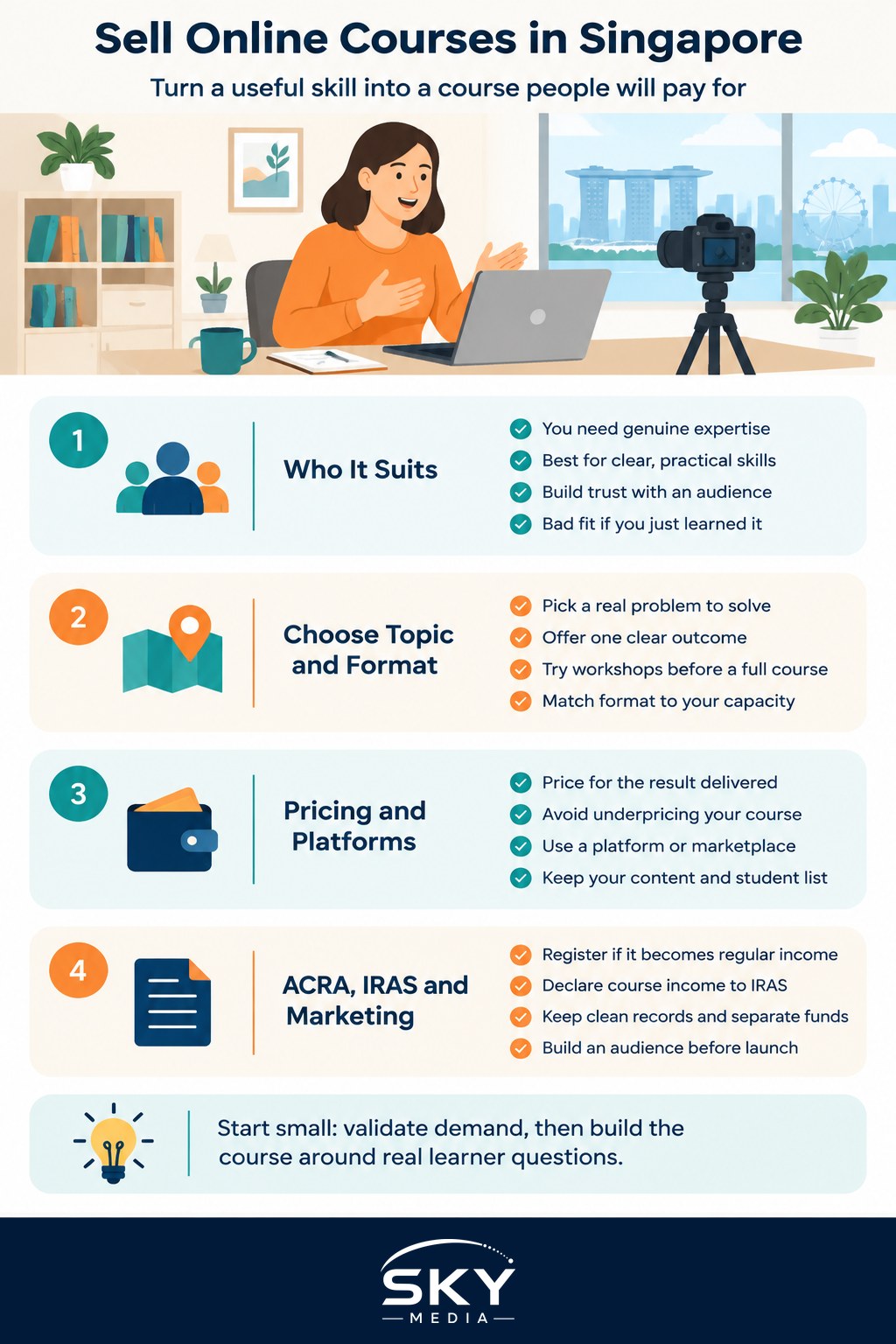
The opportunity and who it suits
Singaporeans invest heavily in skills, whether for career progression, side income, or personal interest, and much of that learning has moved online. That demand is real, but so is the competition, including free tutorials on every topic imaginable. Your course wins when it saves people time, gives them a clear path, or offers guidance and accountability that free content cannot.
This suits practitioners with genuine, demonstrable expertise: a designer, a coder, a baker, a language teacher, an accountant, a fitness coach. It suits people who can explain things patiently and who already have, or can build, an audience that trusts them. It is a poor fit for anyone hoping to teach something they only just learned, because refunds and bad reviews follow thin material quickly.
Start by validating demand before you build. Talk to potential learners about their struggles, run a small workshop or a free lesson, and watch what people actually ask for. Build the course around their questions, not around everything you know.
Choosing a topic and format
The best course topics sit where three things overlap: something you can teach credibly, something people will pay to solve, and something with a clear outcome. “Improve your photography” is vague; “shoot and edit product photos for your online shop in a weekend” promises a result.
Formats range from simple to intensive, and each carries different work and price expectations:
- Self-paced video course, recorded once and sold repeatedly. Lowest ongoing effort, most crowded market.
- Cohort-based course, run live over a few weeks with a group. Higher price, higher effort, stronger results and testimonials.
- Workshops or masterclasses, short and focused, good for testing a topic before building something bigger.
- Membership or drip content, releasing lessons over time for a recurring fee.
- Blended, a self-paced core plus live calls or a community.
Match the format to your audience and your capacity. Many creators start with a short paid workshop to prove demand, then expand the winners into a full course.
Pricing without guesswork
Price on the value of the outcome, not the number of videos. A course that helps someone earn or save money, or land a job, can command far more than its length suggests. Underpricing is the more common mistake; it signals low value and attracts buyers who need the most support.
The table compares broad pricing approaches so you can choose deliberately.
| Approach | How it works | Best for | Trade-off |
|---|---|---|---|
| Value-based | Price to the result delivered | Clear, valuable outcomes | Must prove the outcome |
| Tiered | Basic, plus, premium options | Different budgets | More to build and support |
| Cohort premium | Higher price for live access | Accountability and results | Caps how many you serve |
| Low-cost entry | Cheap tripwire, upsell later | Building a buyer list | Thin margins alone |
Whatever you choose, avoid inventing figures you cannot justify. Test a price, watch conversion, and adjust. Offering a clear refund policy builds trust and, handled honestly, rarely gets abused.
Platforms and delivery
You do not need to build technology from scratch. Course platforms and marketplaces handle hosting, payments, and student access for a fee or a revenue share. The broad choice is between a marketplace, which brings its own audience but takes a larger cut and controls pricing, and a hosted platform on your own site, which keeps more margin and control but leaves marketing entirely to you.
Whichever you use, plan the learner experience: clear modules, downloadable resources, and a way to answer questions. Payment gateways handle local and card payments; check their fees and terms. Keep your own copy of your content and your student list, because relying on a single platform is a risk if its terms change.
Registering the business: ACRA and IRAS
Selling courses is a business the moment you do it to make money on any regular basis. That means registering with ACRA, commonly as a sole proprietorship to start, or a private limited company as revenue and liability grow. A corporate services provider or accountant can advise on the right structure for you.
Course income is taxable and must be declared to IRAS. Keep it clean from the start:
- Use a separate account for course income and expenses.
- Keep records of platform fees, software, advertising, and production costs, which are typically deductible.
- Track turnover against the GST registration threshold set by IRAS and register if you cross it; check the current figure.
- Selling to overseas learners adds cross-border tax and GST considerations, so get advice as sales grow.
This is general information, not tax or legal advice. Rules change, so confirm the current position with ACRA, IRAS, or a qualified professional before you decide.
Marketing and common pitfalls
A course does not sell itself. Build an audience first through free content, an email list, or a community, so you have people to sell to on launch day. Testimonials and clear before-and-after results are your strongest marketing, so gather them from early students.
Watch for these traps:
- Building before validating. Sell or pre-sell a small version first, then build what people actually bought.
- Overloading the course. Learners want a clear path to one outcome, not everything you know.
- Ignoring student results. Courses that get people to an outcome earn referrals and repeat sales.
- Overpromising in ads. Local advertising standards apply, so do not guarantee specific incomes or results.
- Neglecting the business setup, then facing a messy tax season. Register and keep records early.
Teach something people genuinely want, price it to the value it delivers, and treat the earnings as a real business. Done well, one solid course can fund the next.
Explore more
If teaching is really one-to-one, compare this with starting a coaching business, which shares much of the same audience and trust-building. To grow the audience that buys your course, see how to become a content creator in Singapore, and if video is your medium, starting a YouTube business pairs well.
Frequently Asked Questions
How do I know if people will actually pay for my course idea? Test before you build. Talk to potential learners about their struggles, run a free lesson or small paid workshop, and see what they ask for. If people sign up or pre-pay for a small version, that is stronger proof than likes or compliments.
Is it better to sell on a course marketplace or my own website? Each has a trade-off. A marketplace brings built-in shoppers but takes a bigger cut and often controls pricing, while your own hosted platform keeps more margin and control but leaves all the marketing to you. Many creators start on one and add the other later.
Should I offer refunds on my online course? A clear, fair refund policy generally helps more than it hurts, because it lowers the risk for first-time buyers. Handled honestly, it is rarely abused. State the terms plainly on the sales page, and check any marketplace or payment platform rules that also apply.
What can I legally promise in my course ads? Stick to what you can honestly support. Local advertising standards apply, so avoid guaranteeing specific incomes, jobs or results. Describe what the course teaches and share genuine student outcomes, with testimonials you have permission to use.
What if I sell my course to students outside Singapore? Overseas sales can bring extra tax, GST and payment considerations, and the rules vary by country. Keep clear records from the start and speak to an accountant or check with IRAS as sales grow, rather than assuming your local setup covers everything.