

General Paper, or GP, worries many junior college students because there is no textbook to memorise and no single correct answer. That is exactly what makes it teachable once you know where to put your effort. Learning how to study general paper singapore JC students can rely on comes down to reading widely, thinking clearly, and writing with structure. This guide gives you honest, practical steps, without pretending any method guarantees a grade.
One important note before we start. Syllabuses and exam formats are set by MOE and SEAB and can change, so please check your current syllabus, your school, or SEAB for the exact paper components, question types, and requirements. The advice here is general study technique, not a fixed description of the paper.
Read widely and build a bank of ideas
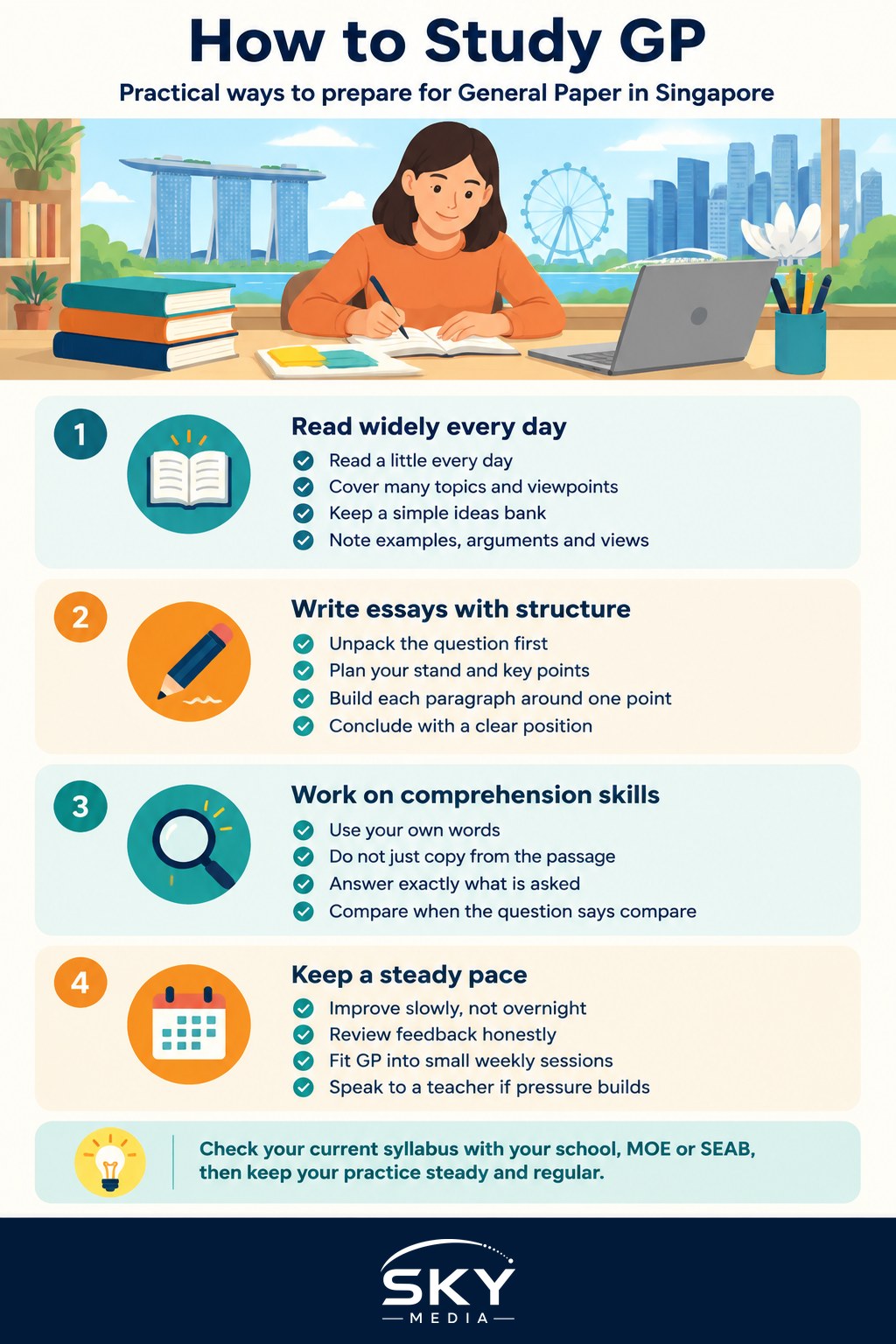
GP tests how well you understand the world and can discuss it. You cannot cram a worldview the night before, so the single most useful habit is regular, curious reading. Aim to read a little every day across a mix of topics such as science and technology, the environment, society, the economy, the arts, and current affairs in Singapore and abroad.
As you read, keep an ideas bank. This can be a simple notebook or a note on your phone. For each issue, jot down the main arguments on different sides, a striking example or statistic, and your own view. Over a few months this becomes a personal store of material you can draw on in essays. Reading also quietly improves your vocabulary and sentence sense, which the paper rewards.
If organising all this input feels overwhelming, the approach in building a second brain for study notes helps you file and find ideas later, and dealing with information overload offers ways to read widely without drowning in it.
Master essay technique
The essay is where structure and clarity matter most. A strong GP essay usually has a clear stand, well-developed paragraphs, and balance.
Try this routine when practising.
- Unpack the question. Underline the key words and decide what it is really asking. Many weak essays answer a slightly different question from the one set.
- Plan before you write. Spend a few minutes listing your stand and three or four main points with examples. A plan keeps you from drifting.
- Write focused paragraphs. Each paragraph should make one point, explain it, support it with a real example, and link back to the question.
- Address the other side. Showing you understand opposing views, then explaining why your stand still holds, signals mature thinking.
- Conclude with a clear position rather than sitting on the fence.
Practise timing gradually. Early on, write essays with no time limit so you can focus on quality. Later, add time pressure so you learn to plan and write at a workable pace. For broader planning skills, improving your essay writing is a useful companion read.
Handle the comprehension and application skills
GP also asks you to read a passage or passages closely and answer questions, which often includes explaining ideas in your own words and applying them. Two habits help a lot.
First, answer in your own words. When a question asks you to explain what a writer means, rephrasing rather than lifting the text shows you actually understood it. Watch out for simply copying sentences from the passage.
Second, read the question carefully and give exactly what it asks for. If it asks for two reasons, give two clear reasons. If it asks you to compare, compare rather than describe each thing separately. Reviewing your marked work honestly is the fastest way to improve, and how to use model answers and mark schemes shows how to learn from feedback without just memorising sample answers.
Stay steady and keep perspective
GP improves slowly and unevenly, which can be frustrating when you have worked hard and the grade has not moved yet. That is normal for a skill-based subject. Keep reading, keep writing regularly, and keep reviewing feedback, and the gains usually show over a term or two rather than a week.
Balance matters too. GP sits alongside your other demanding subjects, so build it into your week in small, consistent doses rather than long, tiring sessions. If the pressure ever feels heavy or you feel persistently low, speak to a teacher or a school counsellor.
Above all, treat GP as a chance to become a sharper, more informed thinker, which is a skill that serves you long after the exam. Read widely, write clearly, review honestly, and check your current syllabus so you are preparing for the real paper. Do that steadily and you give yourself a fair, honest chance of doing well.
Official sources: SEAB