

For many students, Malay Language is a living part of home and heritage, while for others it feels more like a school subject to be managed, especially when the language is not spoken much at home. Either way, the path to doing well is much the same, built on steady exposure, smart practice, and a genuine feel for how the language is used. Bahasa Melayu is a beautiful, expressive language, and studying it can be a real source of pride and connection. If you have been looking for how to study malay language subject singapore students can follow with confidence, this guide walks through practical habits across the main skills. Do check your current syllabus and paper format with your teacher, MOE, or SEAB, since components and requirements are set by MOE and SEAB and can be updated over time.
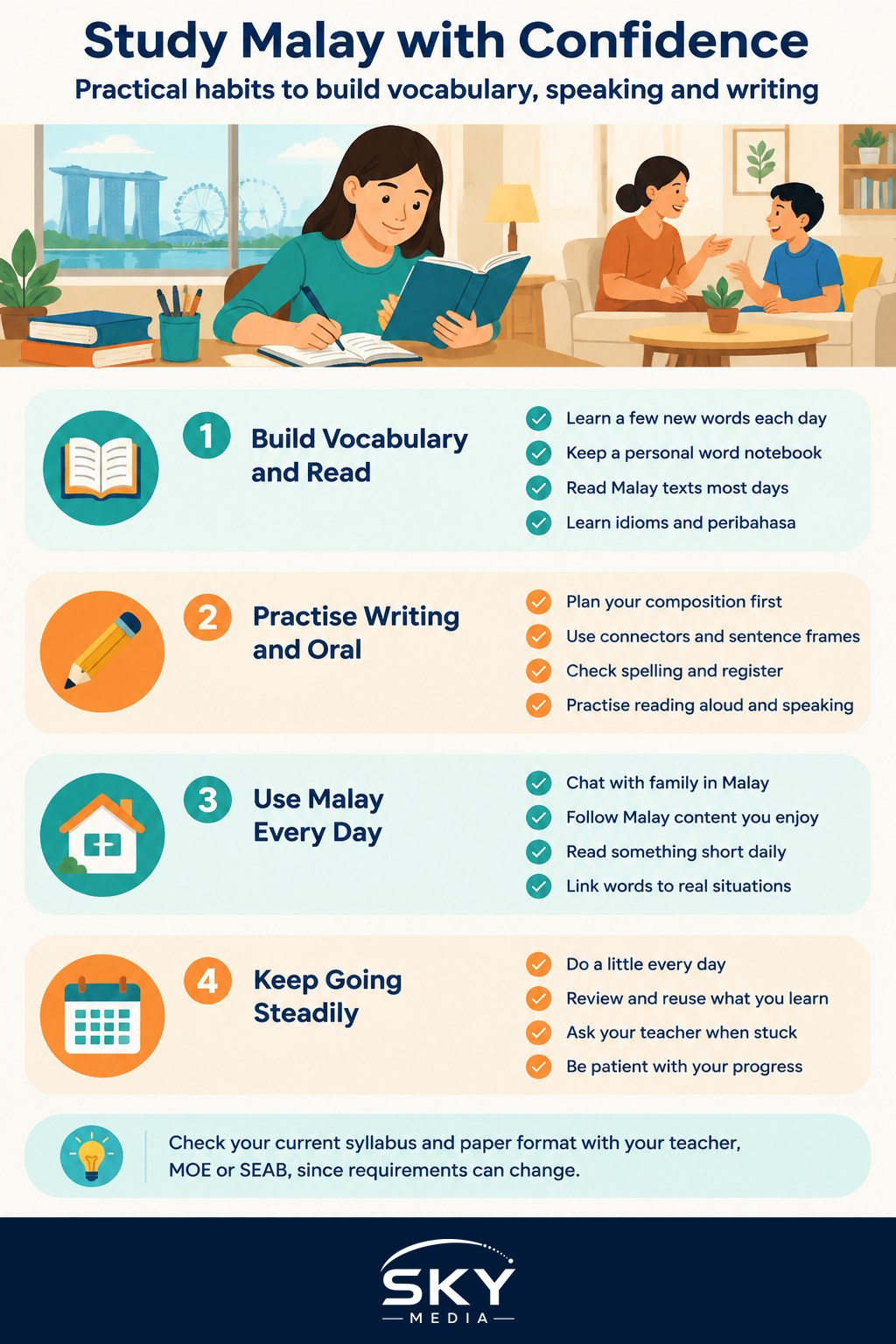
Build Vocabulary and Read Widely
Vocabulary is the engine of language learning, and without enough words both comprehension and writing suffer. The reliable way to grow your vocabulary is a little and often, learning and reviewing a handful of new words each day rather than cramming long lists before a test. Keep a personal notebook of new terms you meet in class and in reading, along with an example sentence for each so you know how the word is really used.
Reading widely is just as important. Beyond your textbook, read Malay news articles, short stories, and passages that stretch you slightly without overwhelming you. Regular reading trains your eye to recognise sentence patterns, common phrases, and the flow of natural Malay, so comprehension shifts from decoding to genuine understanding. A few habits that help:
- Keep and review a personal word list, grouped by theme where possible.
- Learn useful idioms and peribahasa, since a well placed proverb lifts your writing and speech.
- Read a short Malay text most days to keep exposure steady.
- Note down phrases and sentence structures you can reuse in composition.
Techniques such as spaced repetition for better memory work well for vocabulary, and the wider ideas in learning malay or tamil in singapore offer helpful encouragement, especially if the language is new territory at home.
Practise Composition, Oral, and Listening
Writing rewards preparation. Build a bank of useful connectors, phrases, and sentence structures you can adapt across topics, and practise planning before you write so your piece has a clear beginning, middle, and end. A shorter, well organised composition with accurate language usually reads better than a long one full of errors. Pay attention to spelling, sentence structure, and appropriate register, and read your finished work through to catch slips.
The oral component tests reading aloud and conversation. For reading aloud, practise pronunciation, intonation, and pacing so your delivery sounds natural and confident. For the conversation, prepare your views on common everyday themes, and practise giving opinions with reasons and examples rather than one word answers. Speaking Malay aloud regularly, even to yourself or a family member, builds the fluency that makes the oral far less daunting. Listening improves with exposure too, so watch Malay programmes, follow the news, or listen to simple podcasts to train your ear for natural speech. The general advice in preparing for oral exams and presentations applies well to the speaking component.
Connect the Language to Everyday Life
The students who find Malay easiest are usually those who let it live outside the classroom. Try to weave the language into daily routines, chatting with family, following Malay content you enjoy, or reading something short each day. When a language is part of ordinary life rather than confined to homework, it sticks far more naturally and feels less like a chore.
This everyday approach also strengthens the cultural understanding that good language use depends on. Knowing the customs, values, and context behind expressions helps you use them appropriately and appreciate the richness of the language. The same steady, exposure led habits apply across mother tongue subjects, as you will see in how to study the chinese language subject.
Stay Consistent and Be Kind to Yourself
The single most important lesson in studying Malay is consistency. A little every day, reading a passage, learning a few words, and speaking a few sentences, does far more than long weekend cramming. Small daily steps compound into real, visible progress over a term.
Be patient with yourself, especially if the language does not come easily at home. Progress in any language is gradual and sometimes hard to see day to day, but it is real, so celebrate the small wins and ask your teacher whenever you are stuck. Your exam result does not measure your worth or your connection to the language and culture. With steady vocabulary building, regular reading, and confident speaking practice, studying Malay can become far more than a subject on the timetable, growing into a skill and a heritage you carry with pride.
Official sources: SEAB
Further reading: How to Study the Tamil Language Subject in Singapore