

If you are writing a literature review in Singapore, whether for a polytechnic project, a university module, or a postgraduate thesis, the task can feel daunting at first. A literature review is not just a summary of everything you have read. It is a careful, organised discussion of what other researchers have already found on your topic, and where the gaps or debates still lie. Done well, it shows your reader that you understand the field and that your own work has a sensible place within it. This guide walks you through the whole process, from finding sources to writing them up honestly.
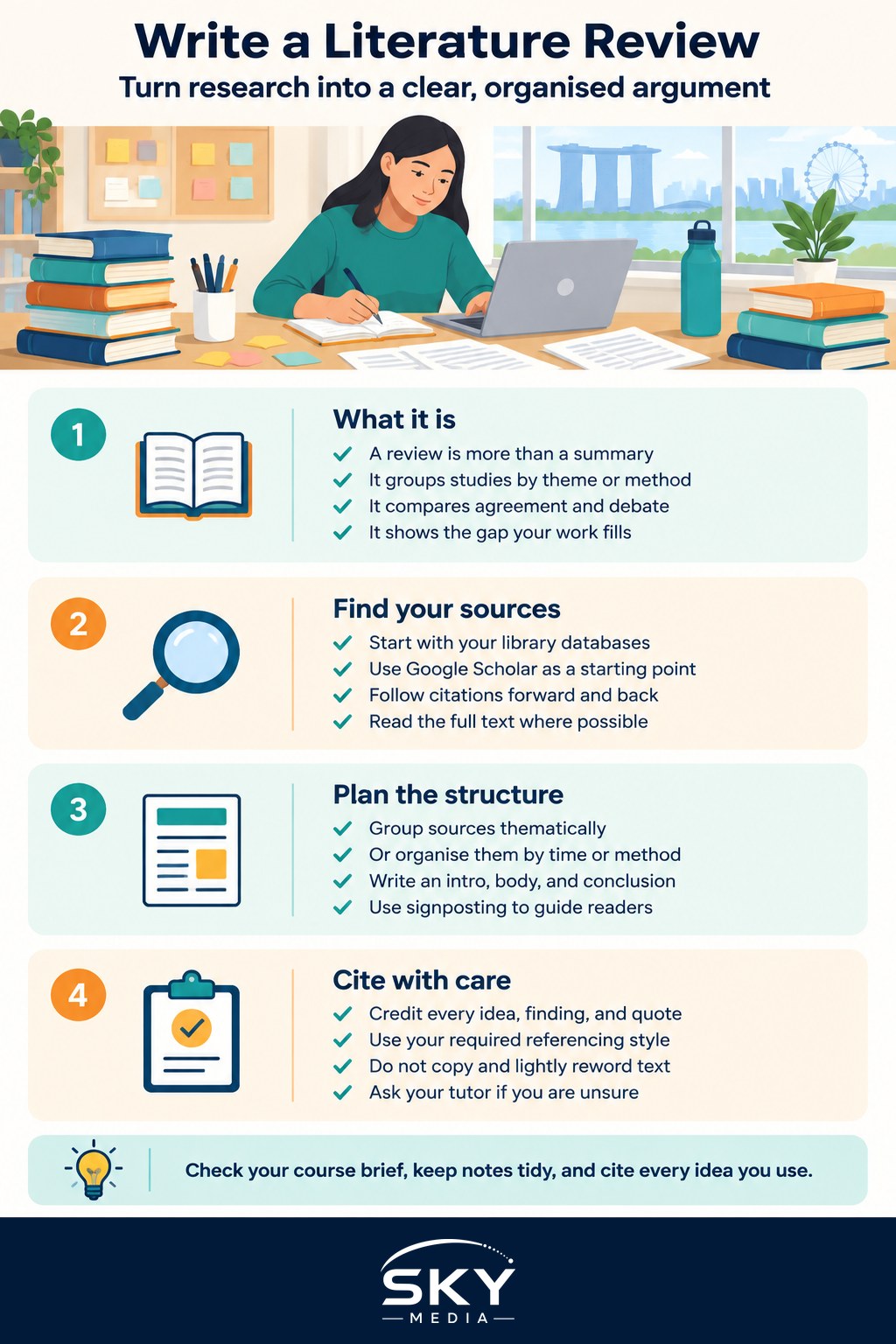
What a Literature Review Actually Is
A literature review answers a simple question: what do we already know about this topic, and what do we still need to find out? It groups existing studies by theme, method, or viewpoint, compares what they say, and points out where they agree, disagree, or leave questions open. That gap is usually what your own research or argument then tries to address.
It helps to remember what a literature review is not. It is not a list of one paragraph summaries, one per source, stacked on top of each other. That is an annotated bibliography, which is a useful earlier step but a different thing. A review synthesises. It weaves sources together so the reader follows an argument, not a reading list.
Before you start, be clear on your scope. A short review for an undergraduate assignment might cover ten to twenty sources. A thesis chapter could cover many more. Check your assignment brief or ask your tutor how broad you are expected to go, because expectations vary by course and level.
Finding and Reading Your Sources
Start with your library. The National Library Board and every local university and polytechnic library give you access to academic databases such as JSTOR, Scopus, and subject-specific collections. Google Scholar is a helpful starting point, but always try to reach the full text through your institution so you are reading peer-reviewed work rather than whatever appears first.
Search with a mix of keywords, then follow the trail. When you find a strong, recent paper, look at what it cites and who has cited it since. This “snowballing” quickly surfaces the key studies everyone in the field keeps returning to.
As you read, take structured notes. For each source, jot down the research question, the method, the main finding, and any limitation the authors admit. Keeping these notes tidy from the start saves hours later. Good habits here connect closely with wider study skills, and it is worth building a system for this, much like the approach in how to summarise and condense your notes.
Organising and Structuring the Review
Once you have read enough to see patterns, group your sources. The most common approach is thematic: each section of your review covers one theme or sub-question, and within it you discuss the relevant studies together. Other reviews are organised chronologically, to show how thinking has developed, or methodologically, to compare different approaches to the same problem.
Sketch an outline before you write. A typical shape is:
- An introduction that states your topic, scope, and the question the review addresses.
- A body split into themed sections, each comparing and contrasting studies rather than listing them.
- A conclusion that draws the threads together and names the gap your own work will fill.
Use signposting language so the reader always knows where they are. Phrases such as “several studies suggest”, “in contrast”, and “however, few have examined” show that you are analysing, not just reporting.
Writing With Academic Integrity
This is the part that matters most. A literature review rests on other people’s work, so you must credit it properly. Cite every idea, finding, or quotation you draw on, using the referencing style your course requires, whether that is APA, MLA, or another. If you are unsure how to format citations, our guide on referencing and citing sources breaks it down clearly.
Never copy chunks of text and lightly reword them while keeping the structure. That is still plagiarism. Read, understand, and then explain the idea in your own words with a citation. If you use AI tools to help you search or draft, be honest about it and stay within your institution’s rules, which differ from school to school and change over time. When in doubt, ask your tutor rather than guessing. For a fuller picture, see academic integrity and avoiding plagiarism.
A Final Word
Writing a literature review is really about joining a conversation that has been going on longer than you. Read widely, listen carefully to what others have found, be honest about what you have used, and then show clearly where your own contribution fits. Take it one theme at a time, keep your notes and citations tidy from the start, and the finished review will feel far less overwhelming than it did on day one.
Frequently Asked Questions
What is the difference between a literature review and an annotated bibliography? An annotated bibliography lists sources, each with a short summary, one after another. A literature review synthesises them, grouping studies by theme and comparing what they say so the reader follows an argument. The bibliography is a useful early step, but a review needs analysis.
How many sources do I need for a literature review? It depends on your course and level, so check your assignment brief or ask your tutor. A short undergraduate review will usually cover fewer sources than a thesis chapter. Aim for relevant, credible sources that let you cover the key debates, not simply a high number.
Can I use Google Scholar, or should I stick to library databases? Google Scholar is a fine starting point, but try to reach the full text through your institution’s library so you are reading peer-reviewed work. Library databases offer subject-specific collections and fuller access. Combine both and follow citations to find key studies.
What is snowballing and how does it help? Snowballing means using one strong paper to find others. Look at its reference list and at the later papers that cite it. This quickly surfaces the studies that everyone in the field keeps returning to and helps you see how the discussion has developed.
How do I know when to stop reading and start writing? Start once the same studies and themes keep appearing and you can see patterns, agreements and gaps. Reading can continue as you write. Sketching an outline early shows you which sections are thin, so you can read with purpose instead of endlessly.
Further reading: How to Write a Research Proposal in Singapore · How to Write a Thesis or Dissertation