
If you buy or sell goods across borders, three letters on a quote can quietly decide who pays for the ship, who buys the insurance and who gets the bill for import GST. Those letters are Incoterms. This guide to Incoterms in Singapore is for small traders, e-commerce sellers and first-time importers who keep seeing “FOB Shenzhen” or “CIF Singapore” on supplier quotes and want to know what they are actually agreeing to.
This is general information, not legal or tax advice. For the rules on permits, duties and GST, check with Singapore Customs and IRAS,.
What Incoterms Are, and What They Are Not
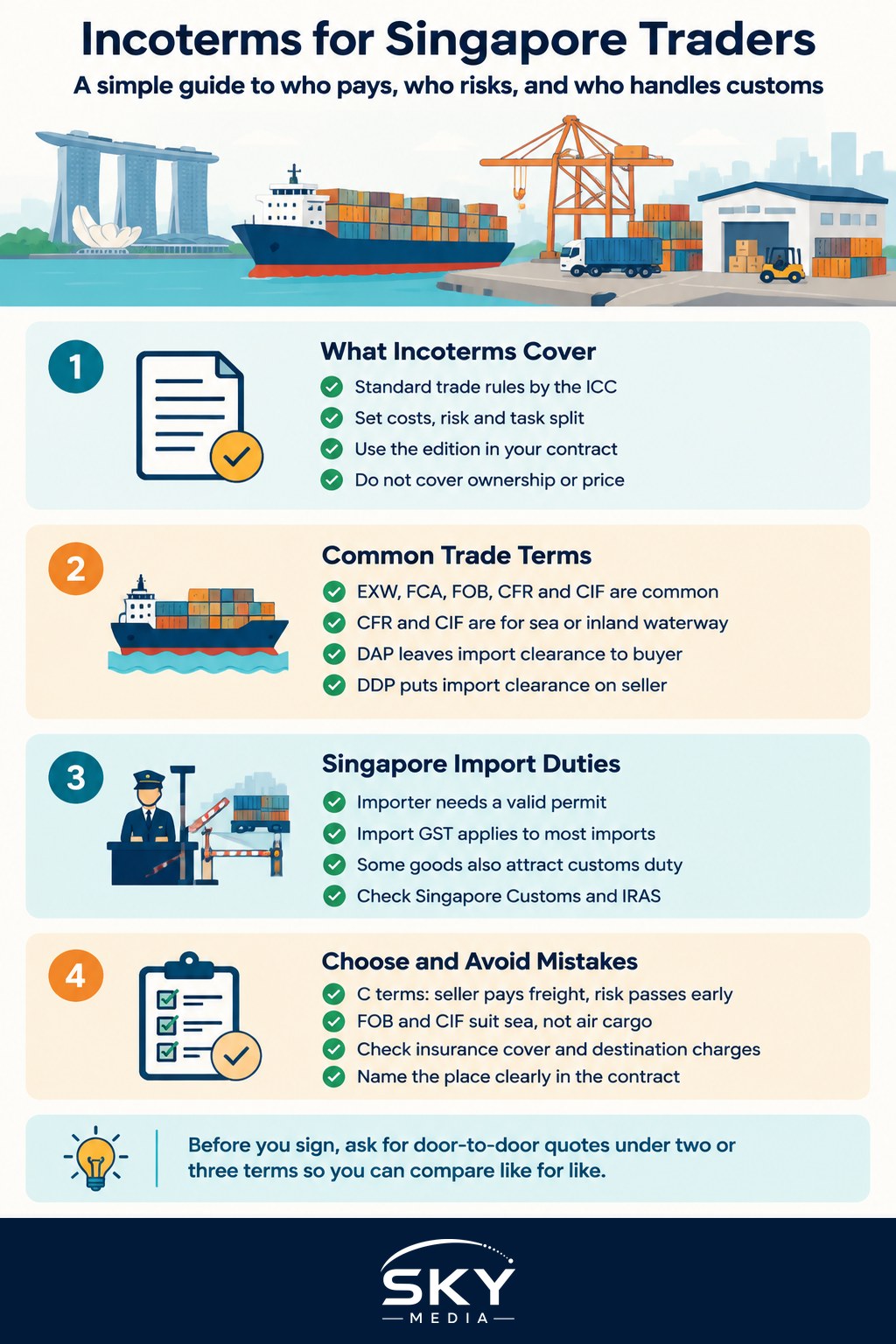
Incoterms (International Commercial Terms) are a set of standard trade rules published by the International Chamber of Commerce (ICC). The current edition at the time of writing is Incoterms 2020, and the ICC revises them roughly once a decade, so always state the edition in your contract, for example “FOB Port Klang, Incoterms 2020”.
Each rule answers three practical questions:
- Costs: which party pays for each leg of the journey, from the factory floor to the buyer’s door.
- Risk: the exact point where the risk of loss or damage passes from seller to buyer.
- Tasks: who handles export clearance, import clearance, loading and unloading.
What Incoterms do not cover matters just as much. They do not say when ownership (title) passes, they do not set the price or payment terms, and they do not decide what happens if one side breaches the contract. Those belong in your sales contract. If you pay by documentary credit, the Incoterm must also line up with the documents the bank expects, which our guide to letters of credit for Singapore importers and exporters explains.
The Common Incoterms at a Glance
There are 11 rules in Incoterms 2020. Four of them (FAS, FOB, CFR and CIF) are meant only for sea and inland waterway shipments. The other seven work for any mode, including air, road and containers moving through multiple carriers. These are the ones Singapore traders see most often:
| Incoterm | Seller pays main freight? | Seller buys cargo insurance? | Risk passes to buyer | Who handles import clearance and duties/GST |
|---|---|---|---|---|
| EXW (Ex Works) | No | No | When goods are made available at seller’s premises | Buyer |
| FCA (Free Carrier) | No | No | When goods are handed to buyer’s carrier at named place | Buyer |
| FOB (Free On Board) | No | No | When goods are loaded on board the vessel at origin port | Buyer |
| CFR (Cost and Freight) | Yes, to destination port | No | When goods are loaded on board at origin port | Buyer |
| CIF (Cost, Insurance and Freight) | Yes, to destination port | Yes, minimum cover | When goods are loaded on board at origin port | Buyer |
| DAP (Delivered At Place) | Yes, to named place | No obligation | When goods arrive, ready for unloading | Buyer |
| DDP (Delivered Duty Paid) | Yes, to named place | No obligation | When goods arrive, ready for unloading | Seller |
The detail most newcomers miss is in the “C” terms (CFR, CIF, CPT and CIP). The seller pays freight all the way to the destination, but the risk passes to the buyer back at the origin, once the goods are loaded. If a container is damaged at sea under CIF, it is the buyer who claims on the insurance the seller arranged.
Who Pays Freight, Insurance and Duties Under Each Group
It helps to think in four families.
E term (EXW): the buyer does almost everything. The seller simply makes the goods available at its warehouse. The buyer arranges pickup, export clearance in the seller’s country, freight, insurance and import. EXW looks cheap, but foreign buyers often struggle with export formalities abroad.
F terms (FCA, FAS, FOB): the buyer pays the main carriage. The seller delivers the goods to the buyer’s chosen carrier or ship and clears them for export. From there, the buyer pays the ocean or air freight and decides whether to insure. FOB is still widely quoted for container shipments, though FCA usually fits containerised cargo better.
C terms (CPT, CIP, CFR, CIF): the seller pays the main carriage, but risk passes early. The seller books and pays freight to the named destination. Under CIF and CIP, the seller must also buy insurance for the buyer’s benefit. Incoterms 2020 sets a minimum level of cover: basic cover for CIF and a higher, broader level for CIP.
D terms (DAP, DPU, DDP): the seller carries the goods and the risk to the destination. Under DAP and DPU, the buyer still handles import clearance and pays any duties and taxes. Under DDP, the seller takes on everything, including import clearance and taxes in the buyer’s country. DDP is the most demanding term for a seller.
How Incoterms Interact With Singapore Import GST and Permits
When goods come into Singapore, the party acting as importer must ensure a valid permit is obtained through TradeNet (the national trade declaration system, usually filed by a declaring agent or freight forwarder) and that import GST and any customs duty are paid. Singapore levies customs or excise duties on a small group of goods, such as liquor, tobacco products, motor vehicles and petroleum products, while GST applies to most imports. Rates and thresholds change, so check the current position on the Singapore Customs and IRAS websites rather than relying on a quote from a supplier.
This is where the Incoterm becomes very practical:
- Buying on FOB, CIF or DAP into Singapore: you, the buyer, are responsible for the import permit and for paying import GST and any duty. Budget for it on top of the supplier’s price.
- Buying on DDP into Singapore: the overseas seller is supposed to clear the goods and pay import GST. Make sure they actually have a way to do this in Singapore, usually through a local agent, or the shipment can stall at the port while everyone argues over who files.
- GST-registered businesses: import GST paid may generally be claimable as input tax, subject to IRAS rules. A DDP arrangement where someone else is the importer can affect who is entitled to that claim, so ask your accountant before agreeing.
- Exporting from Singapore: under most terms, the seller handles export clearance. Our guide to the export permit in Singapore for new exporters walks through that side of the process.
Choosing the Right Incoterm for Your Deal
There is no single best term. Use these questions to narrow it down:
- Who has the better freight rates? If your forwarder in Singapore gets good rates, buying on FCA or FOB and booking the freight yourself can cut costs and give you control over transit times.
- How much control do you want over the goods in transit? With C terms, the seller picks the carrier and the insurer. You inherit their choices but bear the risk.
- Can the other party realistically do the tasks assigned? An overseas buyer on EXW may not be able to file export declarations in your country. An overseas seller on DDP may not be able to import into Singapore.
- Does it match your payment method? Under a letter of credit, banks look for documents such as a bill of lading showing goods on board. Terms like FOB and CIF fit naturally; EXW often does not.
- Have you named the place precisely? “FOB Shanghai” is vague. Name the port, terminal or address.
Common Mistakes Singapore Traders Make
- Using FOB or CIF for air freight. These are sea-only terms. For air shipments, use FCA, CPT, CIP or a D term.
- Assuming the seller’s CIF insurance is enough. Minimum cover may exclude risks you care about. Check the policy and consider topping up.
- Forgetting destination charges. Under CFR and CIF, terminal handling, delivery orders and local haulage at the destination are often billed to the buyer even though “freight” was included.
- Quoting DDP without knowing the buyer’s taxes. Sellers can be caught out by duties, GST or VAT abroad that wipe out the margin.
- Not stating the edition. Older contracts may still reference Incoterms 2010, which differs in places.
Before you sign, ask a freight forwarder to quote door-to-door costs under two or three different terms so you can compare like for like.
Frequently Asked Questions
Is FOB or FCA better for container shipments? FCA usually fits containerised cargo better, though FOB is still widely quoted. FOB only works for sea and inland waterway shipments and transfers risk once goods are loaded on board. Ask your forwarder to quote both so you can compare.
Who pays import GST if I buy on DDP? The overseas seller is supposed to clear the goods and pay import GST, but only if they can actually do it in Singapore, usually through a local agent. Otherwise the shipment may stall at the port. Ask your accountant how it affects any input tax claim.
Can I use FOB or CIF for an air freight shipment? No, FOB, CIF, CFR and FAS are meant only for sea and inland waterway shipments. For air freight, use FCA, CPT, CIP or a D term such as DAP or DDP, and name the airport or place precisely.
Is the insurance included in CIF enough to protect my cargo? It only has to meet a minimum level of cover, which may exclude risks you care about. Under CIF the buyer claims on the policy the seller arranged. Check the policy wording and consider topping up with your own cover.
Why does EXW cause problems for overseas buyers? EXW looks cheap because the seller only makes goods available at its premises, but the buyer must handle pickup and export clearance in the seller’s country. Foreign buyers often struggle with those formalities, so FCA is often a safer alternative.
Official sources: Enterprise Singapore
Further reading: Trade Credit Insurance for Singapore Exporters and B2B Sellers