

Singapore has a wide network of free trade agreements (FTAs), and each one can lower or remove import duties on goods that qualify. But those savings do not happen automatically. Your overseas buyer usually needs proof that your goods meet the agreement’s rules of origin, and that proof is often a certificate of origin. This guide explains how a certificate of origin Singapore exporters obtain can help buyers claim preferential tariffs, what “origin” really means, and the practical steps to get it right.
This is general information, not legal or trade advice. FTA rules are detailed and change over time, so confirm the current requirements with Singapore Customs and, where useful, a licensed customs broker or trade adviser.
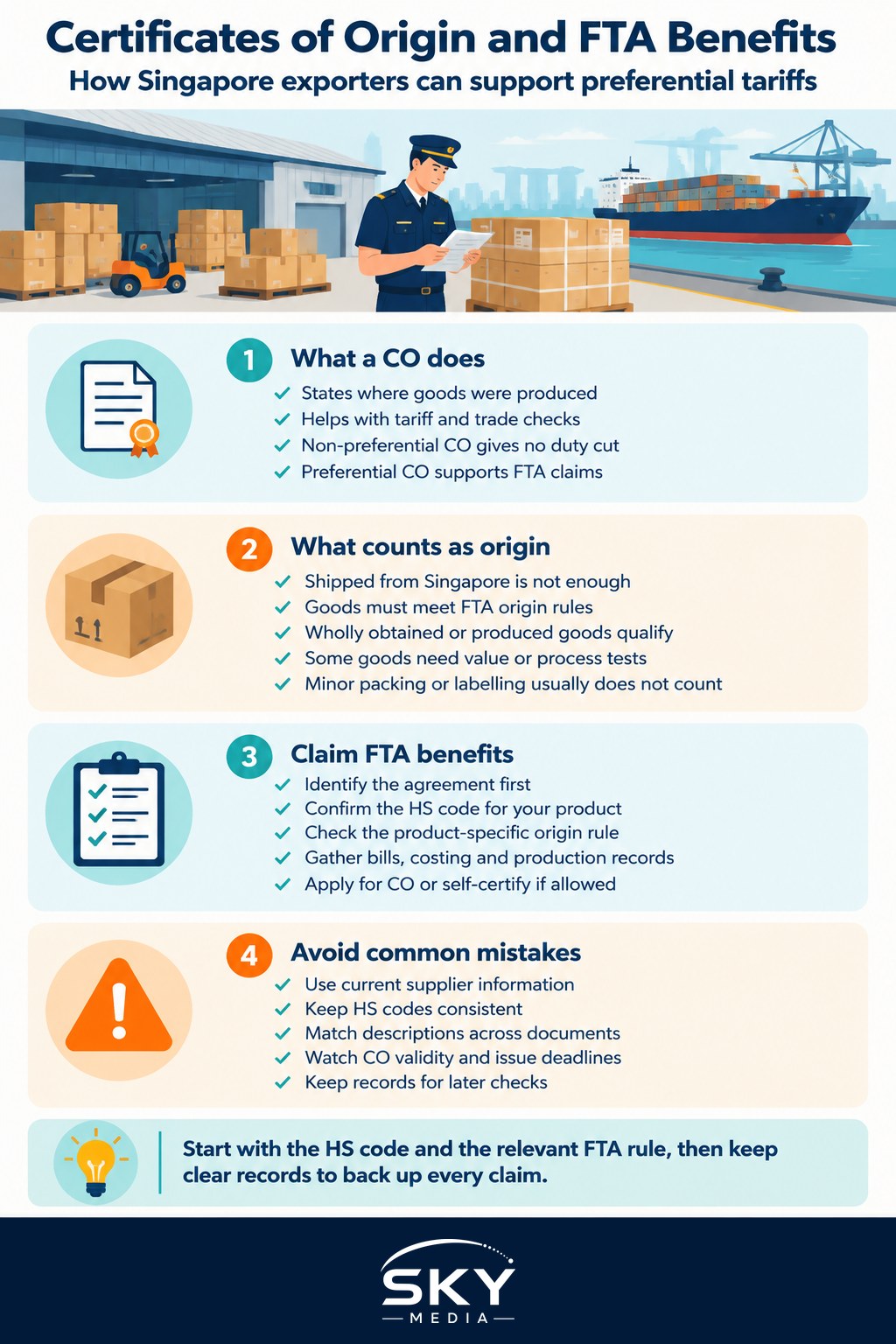
What a Certificate of Origin Does
A certificate of origin (CO) is a document that states the country where goods were produced. Importing countries use it for several purposes, including applying the correct tariff, enforcing trade measures and meeting buyer or bank requirements.
There are two broad types:
- Non-preferential CO. Confirms origin for general purposes, for example because a buyer, a letter of credit or the importing country requires it. It does not give a tariff discount.
- Preferential CO. Confirms that goods meet the rules of origin under a specific FTA, so the importer can claim a lower or zero duty rate under that agreement.
It is the preferential type that unlocks FTA savings. It is also more demanding, because you must show that your goods genuinely qualify.
| Point of comparison | Non-preferential CO | Preferential CO |
|---|---|---|
| Purpose | General proof of origin | Claim reduced FTA duty rates |
| Who typically issues it in Singapore | Authorised bodies such as certain chambers of commerce, or Singapore Customs | Singapore Customs, or self-certification where the FTA allows it |
| Origin test | General origin rules | The specific FTA’s rules of origin for that product |
| Tariff benefit | None directly | Lower or zero duty in the partner country |
| Typical paperwork | Commercial invoice and shipping details | Product costing, bill of materials, production details and HS codes |
The exact issuing arrangements and options can change, so check Singapore Customs’ website for the current position on each FTA.
Rules of Origin in Plain Terms
The most important idea for exporters is that “shipped from Singapore” is not the same as “originating in Singapore”. Goods must meet the rules of origin in the FTA, which generally fall into a few types:
- Wholly obtained or produced. Goods entirely grown, mined or made in Singapore (or within the FTA region) from local materials.
- Regional value content. A minimum share of the product’s value must come from the FTA region, worked out using a formula set in the agreement.
- Change in tariff classification. Imported materials must be transformed enough that the finished product falls under a different tariff code from its inputs.
- Specific process rules. For some products, a particular manufacturing process must happen in the region.
Rules are set per product and per agreement, and the same product can qualify under one FTA but not another. Simple operations such as repacking, labelling or minor assembly usually do not confer origin.
Why the HS code matters
Tariffs and rules of origin are both organised by Harmonised System (HS) codes, the international product classification system. Getting the HS code right is the foundation. A wrong code can lead to the wrong rule being applied, a rejected claim or penalties at the destination. If you are unsure, check with Singapore Customs, which offers classification guidance.
How to Claim FTA Benefits Step by Step
The process below is a general outline. Steps and system names can change, so follow Singapore Customs’ current instructions.
- Identify the agreement. Find out which FTA or FTAs cover trade between Singapore and your buyer’s country. Where more than one applies, compare duty rates and origin rules.
- Classify your product. Confirm the HS code for your goods and look up the duty rate under the FTA versus the normal rate.
- Check the product-specific rule of origin. Read the rule for your HS code in the relevant FTA and test your product against it.
- Gather evidence. Prepare your bill of materials, supplier documents showing where inputs come from, costing breakdowns and production records.
- Register or set up as needed. Some preferential origin processes require manufacturers or exporters to register details with Singapore Customs before applying. Check what applies to you.
- Apply for the CO or self-certify. Apply for a preferential CO through the official channel, or issue an origin declaration if the FTA and your status allow self-certification.
- Send the documents to your buyer. The importer presents the CO or declaration to their customs authority when claiming the preferential rate.
- Keep records. Retain supporting documents for the period required, as either country’s customs may verify origin after shipment.
Your export permit and your CO are separate things. Our guide to the export permit for new exporters covers the permit side of shipping goods out of Singapore.
Common Mistakes That Cost Exporters
Many FTA claims fail for avoidable reasons:
- Assuming Singapore origin because goods ship from Singapore. Re-exported or lightly processed goods often do not qualify.
- Using outdated supplier information. If a supplier changes where it sources materials, your origin calculation may change too.
- Wrong or inconsistent HS codes between invoices, permits and the CO.
- Mismatched details. Descriptions, quantities and consignee names should match across the invoice, packing list and CO.
- Missing deadlines or validity rules. Some agreements set time limits on when a CO is issued or how long it is valid.
- Poor record-keeping. Without documents to back up your claim, a later verification can lead to the buyer losing the preferential rate and possibly paying back duties.
Special Situations Worth Knowing
Goods passing through Singapore
Singapore is a major trading hub, and many companies move goods through it without manufacturing here. Some FTAs allow a back-to-back CO, which lets an intermediate party issue a new CO based on the original one from the first exporting country. The conditions are strict, so check whether the relevant FTA allows it and what evidence is needed.
Letters of credit
If your buyer pays through a letter of credit, the bank may require a CO as one of the documents. Small errors can cause a discrepancy and delay payment. See our guide to letters of credit for importers and exporters for how documentary payment works.
Choosing between overlapping FTAs
Singapore can have more than one agreement with the same partner, for example a bilateral FTA and a regional agreement. Each may have different duty rates and origin rules, so compare them for your specific product rather than assuming one is always better.
Where to Get Help
For official guidance, start with Singapore Customs, which publishes information on FTAs, rules of origin and CO procedures, and runs outreach for traders. Enterprise Singapore also offers resources for companies expanding overseas. Trade associations and chambers of commerce can help with non-preferential COs and practical advice, and licensed customs brokers or freight forwarders can handle much of the paperwork for you.
Getting origin right takes some effort at the start, but once your products, HS codes and supplier records are documented, claiming FTA benefits becomes a repeatable process that can make your goods more competitive in overseas markets.
Frequently Asked Questions
Is a certificate of origin the same as an export permit? No, they are separate. An export permit covers shipping goods out of Singapore, while a certificate of origin states where goods were produced and may support a preferential tariff claim abroad. Most exports need the permit, but a CO depends on your buyer’s needs.
Do goods shipped from Singapore automatically qualify for FTA rates? No. Shipped from Singapore is not the same as originating in Singapore. Goods must meet the specific FTA’s rules of origin, and re-exported or lightly processed goods, such as simple repacking or labelling, often do not qualify.
What documents do I need to apply for a preferential CO? Expect to prepare your bill of materials, supplier documents showing where inputs come from, costing breakdowns, production records and the HS code. Check Singapore Customs for the current process, including whether you must register first or can self-certify.
What happens if my FTA claim is checked after shipment? Either country’s customs may verify origin after shipment. Without supporting records, your buyer could lose the preferential rate and possibly pay back duties. Keep supporting documents for the required period and make sure details match across the invoice, packing list and CO.
Can I get help with the CO paperwork? Yes. Singapore Customs publishes FTA and CO guidance, and Enterprise Singapore offers resources for companies expanding overseas. Trade associations and chambers of commerce can help with non-preferential COs, and licensed customs brokers or freight forwarders can handle much of the paperwork.
Official sources: Enterprise Singapore
Further reading: Trade Credit Insurance for Singapore Exporters and B2B Sellers · Incoterms Explained for Singapore Importers and Exporters