

Once the O-levels are behind them, teenagers in Singapore face a decision that can feel enormous: junior college, polytechnic, or the Institute of Technical Education. The JC vs Poly vs ITE question in Singapore stirs plenty of opinions from relatives and friends, but the honest answer is that there is no single best path, only the one that fits your particular child. This guide offers a calm, general overview of what each pathway is like, how they progress towards further study, and how to match the choice to your child’s strengths and interests. Because MOE and the institutions update admission arrangements over time, treat this as orientation and check the current details and requirements on the official websites before deciding.
Three Roads From Secondary School
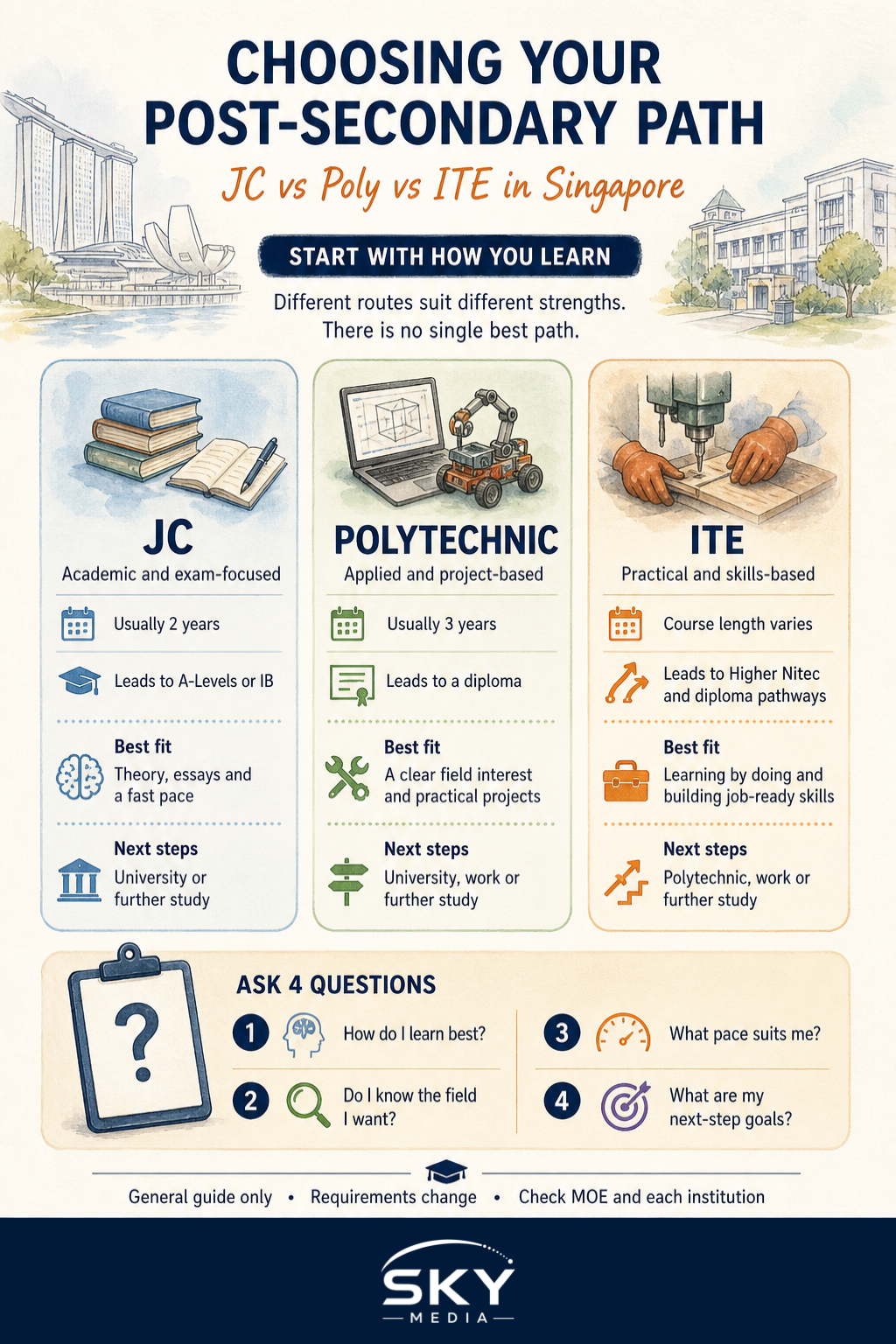
At the heart of the choice is a difference in style rather than status. Junior college is the more academic route, a short and intensive run towards A-level examinations. Polytechnic is applied and industry-focused, with hands-on projects across a wide spread of diploma courses. The ITE offers practical, skills-based training with strong industry links and clear routes onward.
It helps to retire the idea that these paths are ranked. They are different environments suited to different learners, and each one leads somewhere worthwhile. A child who thrives on essays, debate and abstract thinking may love JC; a child who learns by doing, building and applying may flourish in a polytechnic or the ITE. The task is not to reach for the most prestigious label but to picture your teenager genuinely enjoying, and doing well in, the daily experience of that place.
What Each Pathway Is Like
The lived experience of each route differs in ways that matter more than any brochure suggests.
- Junior college. JC is a shorter, faster and more academic programme leading to the A-levels. Students study a set of subjects in depth, with a strong emphasis on examinations, critical thinking and independent study. It suits learners who are comfortable with academic pressure and are aiming largely at university.
- Polytechnic. Poly runs over a longer period and offers diplomas in a huge range of fields, from engineering and design to business, health sciences and media. Learning is project-based and practical, often with internships and industry attachments, giving students a taste of a real field early.
- Institute of Technical Education. The ITE provides hands-on, skills-based training with close ties to industry. It suits students who learn best by doing and want to build practical, employable skills, and it offers clear progression for those who wish to continue studying.
There are also other routes beyond these three, including certain schools that run integrated or through-train programmes, and specialised or arts institutions. The right question is always which environment lets your child grow, not which one sounds most impressive at a family gathering.
Comparing the Options
Because the three paths differ across several dimensions at once, seeing them side by side can clear the fog. Treat the table as a general guide to the shape of each route, not a scoring sheet.
| Feature | Junior College (JC) | Polytechnic | ITE |
|---|---|---|---|
| Learning style | Academic, exam-focused, theoretical | Applied, project-based, broad diploma courses | Hands-on, practical, skills-based |
| Leads to | A-level examinations | A diploma in a chosen field | A skills qualification in a chosen trade or field |
| Duration | Shorter and intensive | Longer than JC | Varies by course |
| Progresses to | University; other further study | University; work; further study | Polytechnic; further study; work |
| Best suits | Learners who enjoy academic study | Learners who like applying ideas to real projects | Learners who thrive doing practical, hands-on work |
Notice that every row ends somewhere open, not closed. That is the point: all three pathways can lead on to university or further study and to fulfilling careers, just by different roads and timelines.
Matching the Path to Your Child
The most useful thing you can do is set aside the league-table instinct and look closely at the young person in front of you. A few honest questions help more than any ranking:
- How does my child learn best? Do they light up in discussion and reading, or when they are building, designing or solving something practical?
- What are they interested in? A poly or ITE course can let a teenager dive into a field they already love, which is a powerful motivator.
- Do they know what they want yet? JC keeps options broad for a child still exploring; a diploma course commits earlier to a field, which suits a child with a clearer direction.
- How do they cope with pressure and pace? JC is intense and fast; other routes spread learning differently. Match the environment to your child’s temperament, not your hopes.
Involve your teenager fully in this. They are old enough to have real preferences, and a child who chooses their own path, with your guidance, arrives with the buy-in that carries them through the tough early weeks. Open houses and taster sessions are invaluable here, so visit together and let your child feel the atmosphere of each place.
Every Path Leads Somewhere
Perhaps the most important message to give your child is that this choice is not a verdict on their future. Pathways in Singapore are deliberately flexible and connected. A polytechnic diploma can lead to university; ITE graduates can progress to a polytechnic and beyond; and many successful adults arrived at their careers by routes no one predicted for them at seventeen.
Admission into each pathway generally considers a student’s results alongside the requirements of specific courses, and there are various placement and application exercises depending on the route. The precise criteria, course requirements and timelines change from year to year, so rather than fixing your hopes to any figure, look up the current admission details on MOE and the institutions’ own websites and treat them as your live reference. We deliberately avoid quoting cut-off points here, because they shift and can mislead.
If your child does not get their first choice, it is genuinely not the end of the road. There are appeals, alternative courses, and later opportunities to switch or progress. What matters most is that your child feels supported to grow wherever they land. A motivated young person on a path that fits them will nearly always outgrow the labels that once seemed to matter so much.
Explore more
The pathway decision follows on naturally from earlier ones, so it helps to see the whole arc. Our guide to secondary school posting in Singapore explains the step just before this, and shows how many routes open up after the O-levels. Whatever your child chooses, confirm the current admission requirements and timelines on MOE and the institutions’ own sites before you commit.