

Job shadowing at work means spending a few hours or days alongside a colleague in another role, watching how they actually do their job. It is one of the cheapest and most practical ways to learn about a team, test a possible career move or understand the people your own work affects. Yet many employees never try it, mostly because asking feels awkward and nobody is sure how to make it useful.
This guide is about doing it well inside your own organisation: how to request it, how to structure it so it does not become a burden for the person you shadow, and how to turn what you see into real learning. It is not about formal mentoring or applying for an internal transfer, though shadowing can lead to either.
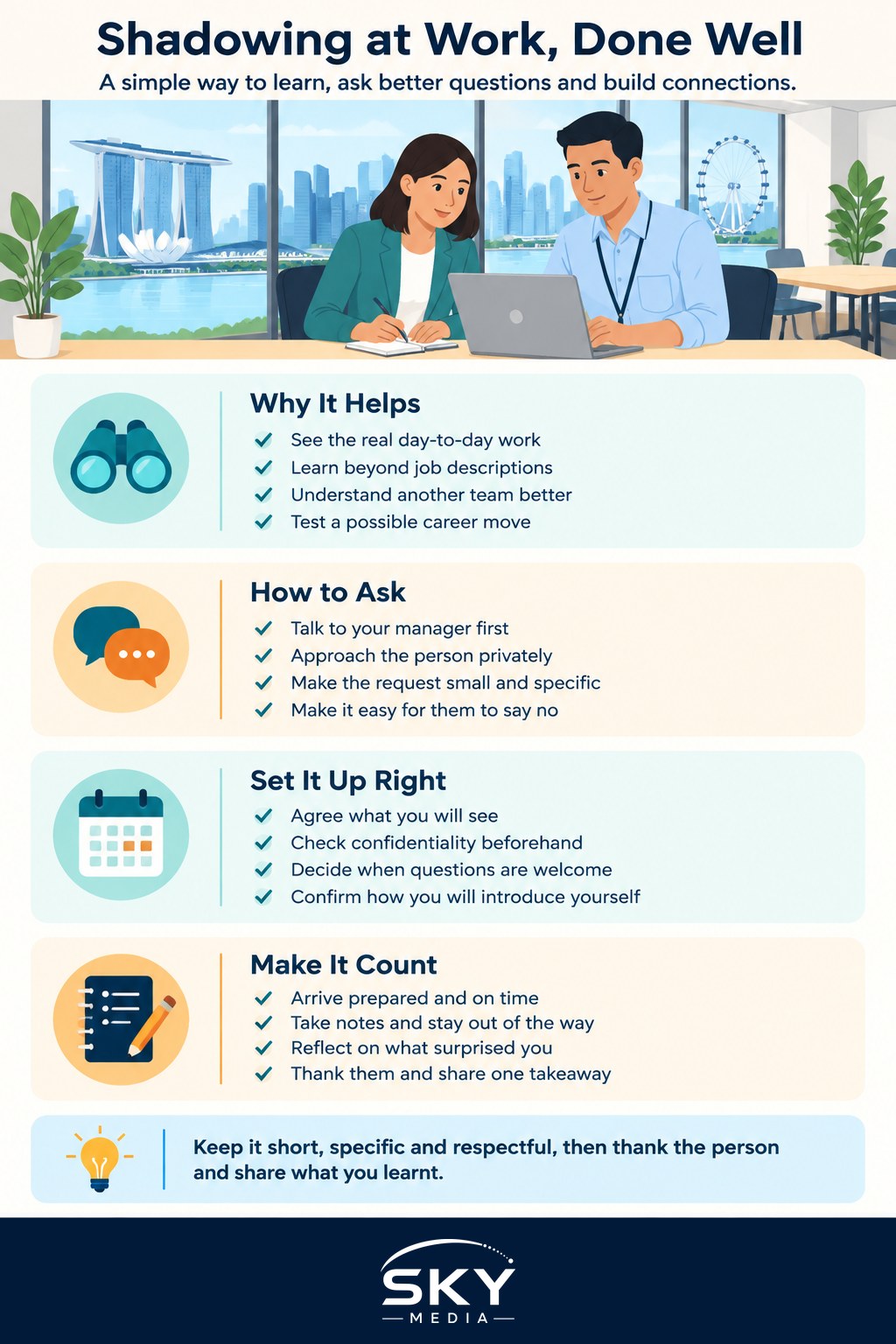
Why Shadowing Works When Reading and Meetings Do Not
Job descriptions and team presentations show the tidy version of a role. Shadowing shows the messy one: the tools people really use, the decisions they make quickly, the interruptions and the workarounds. You get to see things that nobody thinks to explain because they have become second nature.
Common reasons employees ask to shadow someone:
- Exploring a different career path. For example, someone in operations curious about product, finance or data work.
- Working better with another team. Sales staff shadowing customer support, or engineers sitting with the people who use their systems.
- Preparing for a bigger role. Watching how a senior colleague handles stakeholder meetings, planning or difficult calls.
- Learning a specific skill. Seeing how an experienced colleague negotiates, runs a workshop or reviews a report.
Being clear about which of these you want helps everything that follows. “I would like to understand your job” is vague. “I want to see how you prepare for and run supplier negotiations” is easy to say yes to.
How to Ask Without Putting Anyone on the Spot
The awkwardness usually comes from asking the wrong way: too vaguely, too publicly, or without thinking about the other person’s workload.
Talk to your own manager first. Shadowing takes you away from your desk, so your manager should be comfortable with the time. They may also know the right person to approach or be able to make the introduction. In some organisations HR or the learning and development team has a process for this, so ask.
Approach the person privately. A short message or a quick chat works better than asking in a group meeting where they may feel pressured.
Make it small and specific. Suggest a limited time, such as a morning or two half days, and explain what you hope to learn. A small first request is easier to accept.
Make it easy to say no. Something like “If the timing is not right, no problem at all” takes the pressure off and makes a yes more genuine.
A simple request might read: “I am interested in how the planning team builds the quarterly forecast. Would you be open to me sitting in with you for a morning in the next few weeks? I will keep out of the way and can fit around whatever suits you. My manager is supportive.”
Structuring the Session So It Is Useful for Both Sides
A shadowing session without a plan often turns into you watching someone answer emails. A little structure fixes that.
Agree on these points beforehand:
- What you will see. Ask which meetings or tasks would be most representative and which ones you should skip.
- Confidentiality. Some meetings involve personal data, salaries, clients or performance matters. Confirm what you may attend and what you should not share afterwards. Follow your company’s policies and any confidentiality obligations.
- When questions are welcome. Many people prefer you save questions for a set break rather than interrupting.
- How you will introduce yourself. If you join meetings, agree on a one-line introduction so others are not confused.
- Whether you can help. Sometimes a small task, such as taking notes, makes the session more engaging and gives something back.
Here is how the main stages compare in terms of what you do and what to avoid.
| Stage | What to do | What to avoid |
|---|---|---|
| Asking | Be specific, suggest a short time, involve your manager | Vague requests, asking in public, pressuring the person |
| Planning | Agree goals, meetings to attend, confidentiality and question time | Turning up with no plan and expecting to be entertained |
| On the day | Arrive prepared, take notes, stay quiet in meetings unless invited | Checking your phone, critiquing their methods, interrupting |
| Debrief | Ask your saved questions, summarise what you learnt | Overstaying or making it another long meeting |
| Follow-up | Send a thank-you, share one takeaway, tell your manager | Disappearing, or repeating private details to others |
Behaving Well on the Day
The person you shadow is still doing their real job, so your aim is to learn without slowing them down.
- Prepare. Read up on what their team does and any background materials they suggest, so you do not ask questions you could answer yourself.
- Arrive on time and stay flexible. Plans change; if an urgent issue appears, offer to step out.
- Take notes, quietly. Jot down terms, tools and decisions you want to ask about later.
- Observe, do not judge. You may see processes that look inefficient. There is usually context you do not know. Save “why do you do it this way?” for the debrief and ask it with curiosity rather than criticism.
- Respect confidentiality. What you see in someone else’s meetings is not yours to repeat.
- Watch your phone. Glancing at messages signals that you are not really interested.
In Singapore’s workplaces, where teams can be multicultural and hierarchies vary, it also helps to follow the tone set by the person you shadow. If they are formal with a senior stakeholder, follow their lead.
Turning Observation Into Real Learning
Shadowing only pays off if you process what you saw. Within a day or two, write a short reflection:
- What surprised you? Note anything different from what you expected the role to involve.
- What skills did you see in action? List them concretely, such as “summarising a technical issue for a non-technical client”.
- What would you need to learn to do this? This is useful if you are considering a move.
- What changes for your own work? Maybe you will hand off information in a different format, or understand why another team asks for certain details.
Then close the loop:
- Thank the person in writing and mention one specific thing you found valuable. People are more likely to help again when they know it mattered.
- Share a short summary with your manager. It shows the time was well spent and may lead to a project, a stretch assignment or further learning.
- Offer something back. Invite them to shadow you or share your team’s perspective if it would help them.
Over time, a few well-run shadowing sessions build relationships across the organisation, which also helps with building visibility at work without bragging. If you enjoy guiding others in return, our article on how to be a good mentor at work covers the other side of workplace learning.
When Shadowing Points Towards a Bigger Change
Sometimes shadowing confirms you want to move into a different role. Other times it shows you would rather reshape your current job. Both are useful outcomes.
If you want to stay in your role but bring in some of what you learnt, ideas from job crafting can help you adjust your tasks and relationships. If you are seriously considering a move to another team, talk to your manager and HR about the proper internal process rather than relying on the goodwill of the person you shadowed. If you hold a work pass and the move would change your job or employer, check the current requirements with the Ministry of Manpower (MOM) first.
Done thoughtfully, job shadowing at work is less about the hours you spend watching and more about the questions, reflections and relationships that follow.