

Singapore is a regular stop on K-pop tours, and alongside the big stadium concerts you will often see fan meeting dates announced for idols, groups and actors. If you are planning your first kpop fan meeting Singapore trip, it helps to know that a fan meet is a very different event from a concert. The ticket tiers, the perks and even the vibe in the hall all work differently.
This guide explains what happens at a fan meeting, how tiered ticketing and perks such as hi-touch and send-off usually work, and how to prepare so you enjoy the day rather than stress about it. If you are new to the genre itself, start with Getting Into K-pop and C-pop in Singapore.
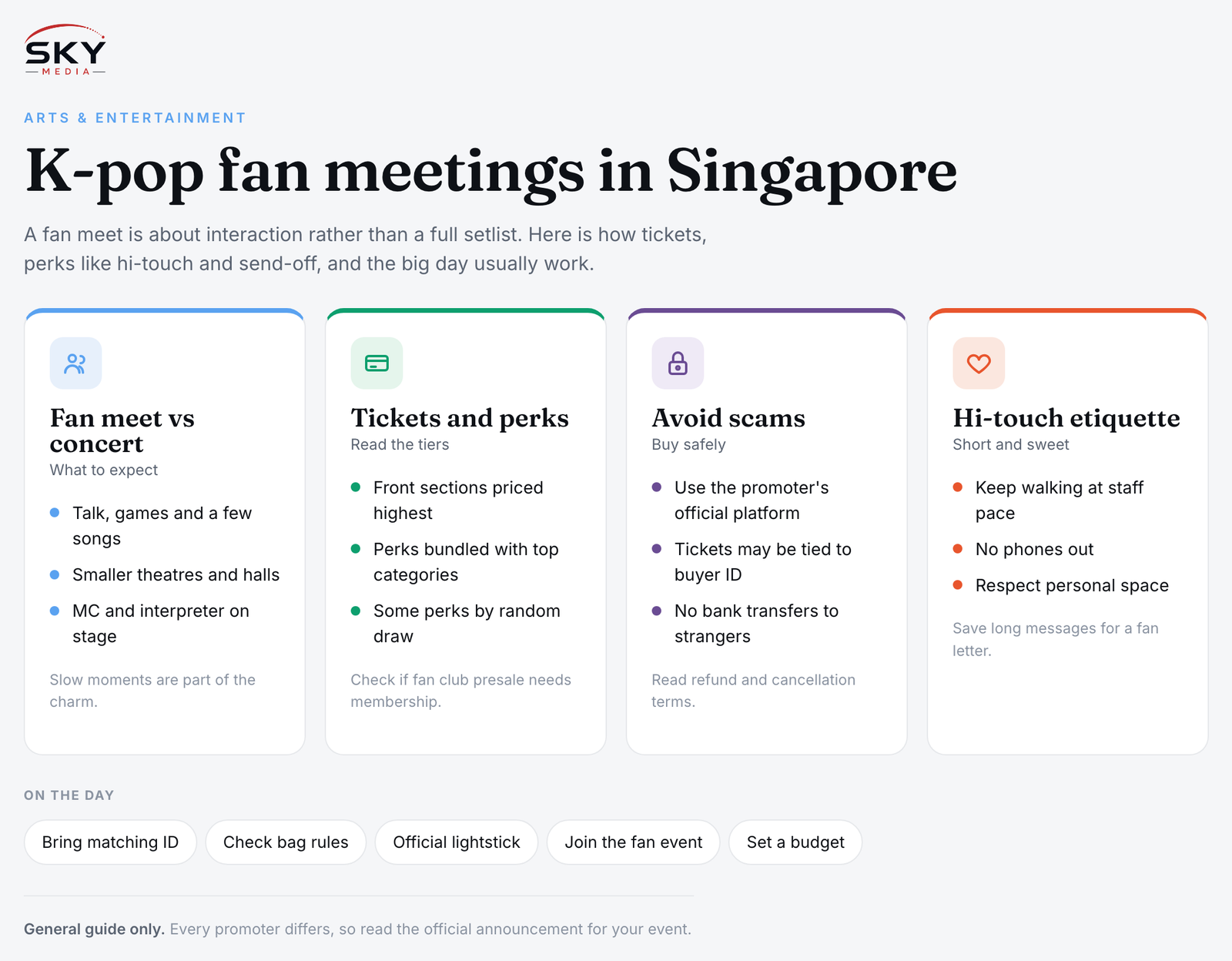
Fan Meeting vs Concert: The Key Differences
A concert is about the performance. A fan meeting is about interaction. Fan meets usually take place in smaller venues such as theatres, convention halls or indoor arenas, and the programme mixes a few songs with talk segments, games and moments built around the audience.
| Aspect | Concert | Fan meeting |
|---|---|---|
| Main focus | Full setlist, staging, choreography | Talk, games, fan interaction, a few songs |
| Typical venue | Stadium or large arena | Theatre, hall or smaller arena |
| Length of performance | Usually many songs | Fewer songs, more segments in between |
| Language | Mostly singing | Talking in Korean with an interpreter or host |
| Special perks | Sometimes soundcheck access | Often hi-touch, send-off, group photo or lucky draws |
Common segments include a Q&A using questions fans submitted in advance, challenges or games, the idol reacting to local food or phrases, and a “fan event” where the audience holds up slogans or cards at a planned moment. Many fan meets are hosted by an MC who speaks English, with an interpreter translating the Korean. Expect plenty of laughter and some slow-paced moments, which is part of the charm.
How Ticket Tiers and Perks Usually Work
Every promoter structures things differently, so always read the official announcement carefully. That said, most fan meeting ticket pages follow a familiar pattern.
- Seating categories. Tickets are split into categories by section, with front sections priced highest. Seat maps are usually published with the ticket announcement.
- Perk bundles. Higher categories often come with perks such as hi-touch, send-off, a group photo, signed posters or entry into a lucky draw. Lower categories may have no perks at all.
- Perks by draw. Sometimes only a certain number of ticket holders in a category receive a perk, chosen randomly. Read whether a perk is guaranteed or “selected by random draw”.
- Membership presales. Official fan club members may get early access. Check whether you need a membership number and whether it must match the ticket buyer’s name.
Common perk terms explained:
- Hi-touch. Fans walk past the idols in a line and high-five them. It is very quick, usually just a few seconds, and staff keep the line moving.
- Send-off. After the show, the idols stand on stage or at an exit point and wave as fans file past. There is typically no physical contact.
- Group photo. A photo of the idols with a section of the audience behind them, usually shared later on the promoter’s social media.
- Soundcheck or rehearsal viewing. Rarer at fan meets, but sometimes offered with top tiers.
Buying Tickets Without Getting Scammed
Popular fan meets can sell out quickly, which makes them prime territory for scams. Protect yourself with these habits.
- Buy from the official ticketing platform named by the promoter. The promoter’s official social media accounts will state the correct platform and sale times.
- Prepare before sale day. Create your ticketing account in advance, verify your details and save your payment method if the platform allows it.
- Be careful with resale. Many fan meet tickets are tied to the buyer’s identity, and perk eligibility may be checked against ID. Resale is often restricted. Buying from strangers on social media or marketplace apps carries a real risk of fake or duplicated tickets.
- Never pay by bank transfer to an unknown seller. The Singapore Police Force regularly warns about concert and event ticket scams. If you have been scammed, report it to the police.
- Read refund and cancellation terms. Events can be postponed or members can be absent due to health or schedules. Know what the promoter’s policy says.
Preparing for the Day
Fan meetings often involve long waits, especially if you are collecting merchandise or queuing for perks.
- Bring the right ID. Perk queues and some entries check that your name matches the ticket. Bring your NRIC, passport or other ID accepted by the organiser.
- Know the bag and item rules. Venues typically restrict large bags, professional cameras, and recording equipment. Check what is allowed before you go.
- Official lightstick and slogans. Most groups have an official lightstick. Fan-made slogans or cards for a planned fan event are often distributed by fan groups outside the venue.
- Merchandise booths. Official merch booths often open before the show and items can sell out. Some fans arrive very early; decide how much queuing you are willing to do and bring water.
- Arrive early but pace yourself. Indoor venues can be cold, while queues outside can be hot and humid. Wear comfortable shoes and carry a light layer.
- Photocards and trading. Many fans trade photocards before the show. Our K-pop photocard collecting guide covers how trading usually works and how to avoid fakes.
Hi-Touch and Send-Off Etiquette
These moments are short, so it is worth knowing the unwritten rules before your turn.
- Follow staff instructions. Keep walking at the pace they set. Stopping or holding hands slows the line for everyone and may get you moved along firmly.
- No phones out. Photography and recording are almost always banned during hi-touch and send-off. Put your phone away so you do not risk being removed from the queue.
- Keep it brief. A quick “thank you” or “fighting” works. Long messages are better written in a letter if the organiser accepts fan letters.
- Respect personal space. No grabbing, no gifts thrust into hands unless the organiser has a gift collection point.
- Be kind to fellow fans. Everyone is excited. Do not push in the queue, and keep your lightstick and slogans out of others’ sightlines during the show.
Making the Most of the Experience
The best fan meets feel like a shared celebration rather than a transaction. A few ideas:
- Learn a few fan chants for the songs being performed, which fan accounts usually share before the event.
- Join the fan event. If fan groups are organising a coordinated moment, take the card or slogan and follow the cue. Idols often react warmly.
- Go with friends or meet others. Fan communities in Singapore are active on social media and chat apps, and many people make lasting friends through events.
- Set a budget. Between tickets, merch, albums and travel, costs can add up. Decide in advance what matters most to you, whether that is a perk tier or just being in the room.
If you want to go beyond watching, many fans also pick up the choreography; our guide to Getting Into K-Pop Dance is a good starting point.
After the Show
Once it is over, check the promoter’s social media for group photos or announcements of lucky draw winners. Take care heading home, as transport around the venue can be crowded after the event ends. Then enjoy the fan accounts sharing fancams and highlights, as long as they come from parts of the show where recording was allowed.
Frequently Asked Questions
Is a fan meeting better than a concert for a first-timer? It depends on what you want. A concert delivers full songs and staging, while a fan meeting is smaller and focused on talking, games and perks. If you want to feel close to the artist, a fan meeting suits you. For big production and dancing, choose a concert.
Do I need to understand Korean to enjoy a K-pop fan meeting? No. Many fan meets have an English-speaking MC and an interpreter translating the Korean, so you can follow the Q&A and games. Knowing a few fan chants for the songs performed adds to the fun, and fan accounts usually share them beforehand.
Can I change the name on my fan meeting ticket if I cannot go? That depends on the promoter. Many fan meet tickets are tied to the buyer’s identity, and perk eligibility may be checked against ID, so transfers are often restricted. Read the ticket terms and ask the official ticketing platform instead of selling to strangers.
How do I get fan club presale access for a K-pop fan meeting? Official fan club members may get early access, so join the official fan club well before sale day. Check whether you need a membership number and whether it must match the buyer’s name on the ticket, and follow the promoter’s announcements.
Can my teenager go to a K-pop fan meeting on their own? Check the event’s age and entry rules on the promoter’s announcement, as they vary. If your teen goes, agree on a meeting point and return plan, make sure they bring the right ID, and remind them to buy tickets only from the official platform.
Further reading: Meeting Performers After a Show: Stage Door and Autograph Etiquette