
Kindergarten fees can be a real line item in a young family’s budget, especially if you have more than one child in preschool. KiFAS kindergarten fee assistance is the government scheme that helps lower- and middle-income families pay monthly kindergarten fees at participating kindergartens. It is separate from the help available once a child reaches primary school, and it has its own rules on eligibility, income and how to apply.
This guide walks through how KiFAS works, who it is for, which kindergartens take part, and the practical steps to apply. Scheme details, income thresholds and subsidy amounts are reviewed from time to time, so always confirm the current figures with ECDA (the Early Childhood Development Agency) or your kindergarten before making decisions.
What KiFAS Is and Who Runs It
KiFAS stands for Kindergarten Fee Assistance Scheme. It is administered by ECDA, the government agency that oversees preschools in Singapore, including childcare centres and kindergartens.
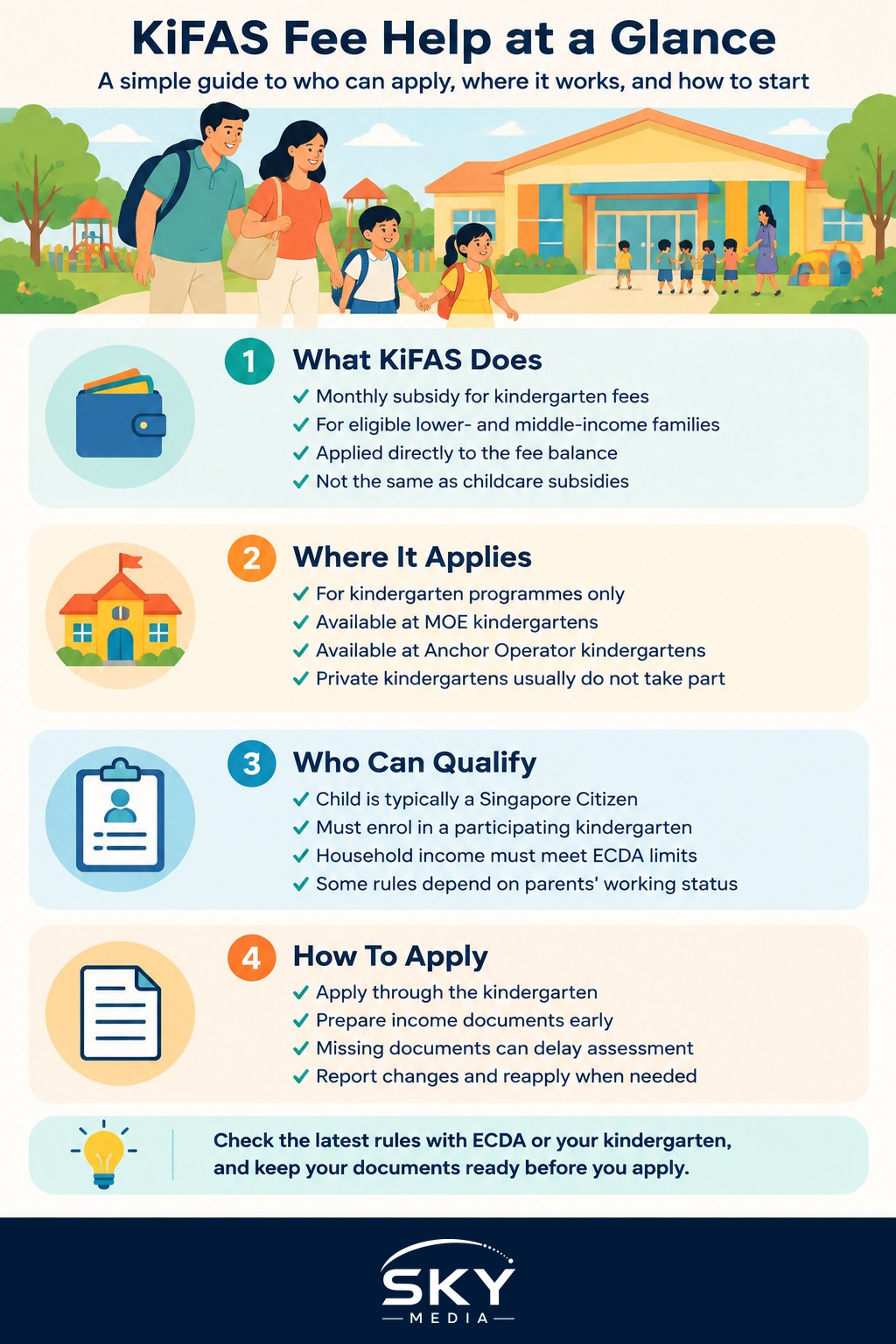
The scheme gives eligible families a monthly subsidy that reduces the fee they pay to the kindergarten. Instead of paying the full monthly fee and claiming back later, the subsidy is generally applied directly to the fee, so parents pay the balance, known as the net fee.
Key features to understand:
- It is means-tested. The subsidy amount depends on household income, so lower-income families receive more help.
- It applies to kindergarten programmes, not full-day childcare. Childcare centres have their own subsidies, which work differently.
- It covers fees, not everything. Registration fees, uniforms, books, deposits and optional enrichment are usually not covered. Ask the kindergarten what the monthly fee includes.
Which Kindergartens Take Part
KiFAS is available at kindergartens run by MOE (the Ministry of Education) and by Anchor Operators. Anchor Operators are larger preschool operators that receive government funding in return for keeping fees affordable and meeting quality standards. Families often know these as the kindergartens linked to major community and union-affiliated operators.
Private kindergartens outside these groups generally do not offer KiFAS, although they may have their own bursaries or fee arrangements. If you are still choosing a kindergarten, compare the options in our guide to MOE Kindergarten vs Private Preschool in Singapore, and read MOE Kindergartens Explained for how MOE kindergartens are run.
The participating list can change, so check with ECDA or ask the kindergarten directly whether it accepts KiFAS applications.
Eligibility and How Income Is Assessed
Eligibility rules are set by ECDA. In general, families need to meet conditions such as these:
- Citizenship. The child is typically required to be a Singapore Citizen. Check ECDA’s rules if your child holds a different status.
- Enrolment. The child must be enrolled in a kindergarten programme at a participating MOE or Anchor Operator kindergarten.
- Household income. The family’s gross monthly household income, or the per capita income for larger households, must fall within ECDA’s limits.
- Working status. Some conditions may relate to whether parents are working. Check how ECDA treats your situation, for example if a parent is between jobs or caring for family.
How household income is usually worked out
Gross monthly household income generally means the total gross income of the parents, and in some cases other household members, before CPF deductions. Per capita income divides the household income by the number of family members, which helps larger families with more dependants.
Because the income bands, the use of per capita income and the subsidy amount for each band are reviewed periodically, this guide does not quote figures. Look up the current table on ECDA’s website or ask the kindergarten’s office, which usually has an up-to-date summary.
How to Apply for KiFAS Step by Step
The application is usually made through the kindergarten, which submits it for assessment. The table below shows a typical flow.
| Step | What you do | What happens next |
|---|---|---|
| 1. Confirm the kindergarten takes part | Ask the MOE or Anchor Operator kindergarten about KiFAS | Staff explain the forms and the documents they need |
| 2. Gather documents | Prepare income documents for working household members, such as recent payslips or employer letters | Missing documents are a common cause of delays |
| 3. Submit the application | Hand in the form and documents through the kindergarten, or via any online channel it uses | The application is sent for assessment |
| 4. Receive the outcome | The kindergarten or ECDA informs you of the subsidy amount | The subsidy is applied to your monthly fee from the approved date |
| 5. Renew when required | Reapply when your assistance period ends or your circumstances change | Continued help depends on reassessment |
Practical tips:
- Apply early. Submit when you enrol or as soon as your finances change, as subsidies generally do not backdate indefinitely.
- Keep copies of everything you submit, and note the date.
- Self-employed parents may need different proof of income, such as tax assessments. Ask the kindergarten what is accepted.
- Report changes. Tell the kindergarten if your income, household size or employment changes, as this can affect your subsidy.
How KiFAS Fits With Other Support
KiFAS is one part of a wider support system for families with young children. Depending on your situation, you may also be able to use:
- Baby Bonus and the Child Development Account (CDA). Funds in a child’s CDA can often be used at approved preschools to pay the net fee. Check with the kindergarten whether it accepts CDA payments.
- Operator or community help. Some Anchor Operators and community organisations offer extra help for families in financial difficulty, such as help with registration fees or materials.
- Primary school assistance later on. Once your child moves to Primary 1, a separate MOE scheme applies. See School Fees and Financial Assistance in Singapore for how that works.
- Wider government schemes. For a broader look at household support, see Financial Assistance Schemes and Eligibility in Singapore.
If your family is facing serious financial strain, your nearest Social Service Office or a family service centre can help you understand what support you may qualify for across different agencies.
Common Questions From Parents
Can I apply if my child is already in K1 or K2? Usually yes. You do not have to apply only at the start of the year, but the subsidy generally applies from the approved date, not before.
Does KiFAS cover childcare centres? No. Full-day and half-day childcare programmes have separate subsidies. If your child attends a childcare centre that also runs a kindergarten curriculum, ask which subsidy applies.
Will my subsidy change if my income changes? It can. Reassessment may increase or reduce the subsidy, so report changes promptly.
Where do I check the latest rules? ECDA’s website and your kindergarten’s office are the best sources for current eligibility, income bands and subsidy amounts.
Do private kindergartens accept KiFAS? Generally not. KiFAS is available at kindergartens run by MOE and by Anchor Operators, while private kindergartens outside these groups may offer their own bursaries or fee arrangements. The participating list can change, so ask ECDA or the kindergarten directly.
Can a child who is not a Singapore Citizen get KiFAS? The child is typically required to be a Singapore Citizen. If your child holds a different status, check ECDA’s rules directly, as eligibility conditions are set by the agency and reviewed from time to time.
What documents should I prepare for a KiFAS application? Income documents for working household members, such as recent payslips or employer letters. Self-employed parents may need different proof, such as tax assessments. Missing documents are a common cause of delays, so ask the kindergarten what it accepts.
Does KiFAS cover registration fees and uniforms? Usually not. The subsidy applies to monthly kindergarten fees, while registration fees, uniforms, books, deposits and optional enrichment are generally not covered. Ask the kindergarten exactly what the monthly fee includes.
Can I use my child’s CDA money to pay the kindergarten fee? Often, yes. Funds in a child’s Child Development Account can usually be used at approved preschools to pay the net fee after subsidies. Check with the kindergarten whether it accepts CDA payments before you rely on this.
KiFAS can make a meaningful difference to monthly costs for eligible families. Confirm the kindergarten takes part, gather your income documents early, and check the current figures with ECDA so you know exactly what to expect.
Official sources: Early Childhood Development Agency (ECDA)
Further reading: Student Care Fee Assistance (SCFA) Explained: Who Qualifies and How to Apply