

When an elderly parent becomes frail and needs daily help with bathing, dressing or moving around, the costs add up quickly: a helper, adult diapers, a wheelchair, transport to appointments. Many families know about long-term care insurance like ElderShield and CareShield Life, but some seniors were never covered by those schemes at all.
That is where Pioneer Generation disability assistance and IDAPE come in. These are two government cash assistance schemes aimed at older Singaporeans with severe disability. This guide explains what each one is for, who it is meant for and how families can apply. It is general information only. Eligibility rules and payout amounts are set and reviewed by the government, so always confirm the current details with the Agency for Integrated Care (AIC) before you rely on them.
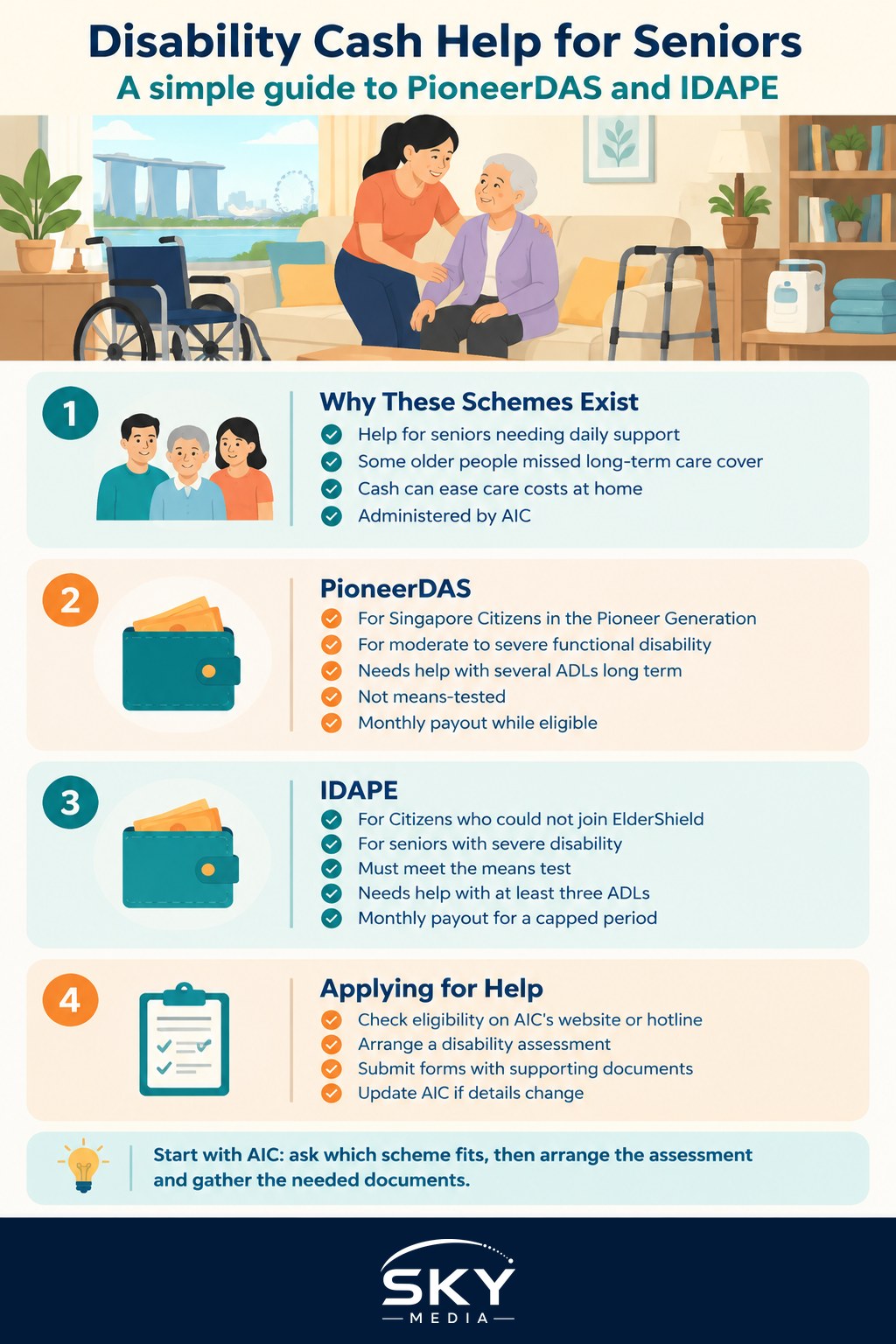
Why These Schemes Exist
Singapore’s long-term care insurance has evolved in stages:
- ElderShield launched in 2002 as a severe disability insurance scheme for Singapore Citizens and Permanent Residents with a MediSave account, generally starting from age 40.
- CareShield Life later replaced it for younger cohorts, with broader and lifelong coverage.
When ElderShield began, some older people could not join. They were either already beyond the entry age, or they already had a disability at the time. These seniors had no long-term care insurance payout to fall back on if they became severely disabled.
The Interim Disability Assistance Programme for the Elderly (IDAPE) was introduced to help this group. Separately, the Pioneer Generation Disability Assistance Scheme (PioneerDAS) was introduced as part of the Pioneer Generation Package to give extra support to Pioneers with disability, whether or not they have insurance.
The healthcare subsidies in the Pioneer Generation Package, such as outpatient and MediShield Life support, are covered in our guide to the Pioneer and Merdeka Generation Packages. This article focuses only on the disability cash schemes.
What PioneerDAS Is
PioneerDAS gives a fixed monthly cash payout to Pioneers who have a moderate to severe functional disability. The money is not tied to a specific bill. Families typically use it towards care costs, such as a caregiver, medical supplies or transport.
Who it is for, in general terms:
- Singapore Citizens who are part of the Pioneer Generation. You can check Pioneer status through official channels or the Pioneer card if you have one. Our article on the Pioneer Generation explains who counts.
- Pioneers who have been assessed as needing help with a number of the six Activities of Daily Living (ADLs), on a permanent or long-term basis.
The six ADLs used in Singapore’s disability schemes are:
- Washing (bathing)
- Dressing
- Feeding (eating)
- Toileting
- Walking or moving around
- Transferring (for example, from bed to chair)
PioneerDAS is not means-tested in the way many schemes are, because it is a benefit tied to Pioneer status. The payout amount is set by the government. Check AIC’s website for the current monthly amount and whether it can be received alongside other payouts your parent already gets.
What IDAPE Is
IDAPE is a means-tested scheme that provides a monthly cash payout for a limited period to Singapore Citizens with severe disability who were not eligible to join ElderShield when it started, because of their age or a pre-existing disability.
Who it is for, in general terms:
- Singapore Citizens who were too old to join ElderShield at its launch, or who already had a disability at that time.
- Seniors assessed as unable to perform at least three of the six ADLs.
- Households that meet the means test. The payout level depends on household income per person.
IDAPE payouts are paid for a capped period rather than for life. Because IDAPE was designed for a specific, closed group of older Singaporeans, AIC may change how and when applications are accepted. Check AIC’s website for whether applications are still open and the current payout tiers.
PioneerDAS vs IDAPE at a Glance
| Point | PioneerDAS | IDAPE |
|---|---|---|
| Who it targets | Pioneers with functional disability | Seniors who could not join ElderShield |
| Citizenship | Singapore Citizens (Pioneers) | Singapore Citizens |
| Means-tested | No, tied to Pioneer status | Yes, based on household income |
| Disability level | Needs help with several ADLs, long term | Unable to perform at least three ADLs |
| Payout duration | Monthly, ongoing while eligible | Monthly, for a capped period |
| Administered by | Agency for Integrated Care | Agency for Integrated Care |
How the Disability Assessment Works
Both schemes depend on a functional disability assessment. This is not a diagnosis of a specific illness. Instead, an accredited assessor, usually a doctor or trained professional, checks what the person can and cannot do independently in daily life.
What families should know:
- Book through approved channels. AIC lists how to arrange an assessment, which may be done at a clinic, hospital or at home for seniors who cannot travel easily.
- Be honest about daily routines. Describe what a typical day looks like, including the help your parent needs. Do not exaggerate or minimise.
- Bring documents. NRIC, any medical reports and details of current care arrangements make the process smoother.
- Ask about fees. There may be an assessment fee, which can be subsidised in some cases. Check current details with AIC or the assessing clinic.
This guide is not medical advice. The assessment outcome is decided by the accredited assessor according to the scheme’s criteria.
How to Apply and What Happens Next
The general steps are similar for both schemes:
- Check eligibility on AIC’s website or by calling AIC’s hotline.
- Arrange the disability assessment with an accredited assessor.
- Submit the application with the assessment report and supporting documents. For IDAPE, household income details will be needed for the means test.
- Wait for the outcome. AIC will inform you of the result and, if approved, how payouts will be made.
- Keep details updated. Inform AIC of changes such as a new bank account, change of address or a change in condition.
If your parent lacks mental capacity to apply, the person acting for them may need legal authority, such as a donee under a Lasting Power of Attorney or a court-appointed deputy. Ask AIC what documents they need in that case.
Other Support to Look At Together
PioneerDAS and IDAPE are just part of the picture. Depending on your family’s situation, also ask about:
- CareShield Life and ElderShield claims if your parent is insured.
- Home Caregiving Grant, which supports families caring for a loved one at home.
- ElderFund and MediFund for seniors with limited means.
- Subsidies for home care, day care and nursing homes through AIC.
Our overview of financial assistance schemes and eligibility in Singapore can help you map out the wider options.
The simplest first step is to contact AIC, describe your parent’s situation honestly and ask which schemes apply. One conversation can uncover support your family did not know about.
Frequently Asked Questions
Can a Pioneer who is already getting CareShield Life or ElderShield also receive PioneerDAS? PioneerDAS is tied to Pioneer status, so it is meant to give extra support whether or not a senior has insurance. Whether it can be received together with other payouts depends on current rules, so check AIC’s website or hotline for the up-to-date position.
What if my parent is not a Pioneer and never joined ElderShield? IDAPE was designed for this group, covering Singapore Citizens who were too old or already disabled when ElderShield started. It is means-tested and requires an assessment showing inability to perform at least three of the six daily activities. Ask AIC whether applications are still open.
How do I get a disability assessment for a parent who cannot leave the house? Ask AIC about assessors who can see your parent at home. The assessment is usually done by a doctor or trained professional and can take place at a clinic, hospital or in the home. Have the NRIC, medical reports and a list of the daily help your parent needs ready.
Who can apply on behalf of a parent with dementia? If your parent can no longer make decisions, the person applying may need legal authority, such as a donee under a Lasting Power of Attorney or a court-appointed deputy. Contact AIC to find out exactly which documents they accept before you submit anything.
What other help can caregivers ask about besides cash payouts? Caregivers can ask about the Home Caregiving Grant, ElderFund and MediFund for those with limited means, and subsidised home care, day care and nursing home options through AIC. A single conversation with AIC can show which of these fit your family’s situation.
Official sources: Agency for Integrated Care
Further reading: The Medication Assistance Fund (MAF) Explained for Seniors