

Some of Singapore’s quietest landed estates sit on short lanes that are not public roads at all. A private road landed property in Singapore can feel wonderfully secluded, with little through traffic and children cycling in the lane. It also comes with questions that a house on a public road never raises: who fixes the potholes, who owns the tarmac, and will the next buyer’s bank care?
This guide focuses on those private-street questions. For the wider buying process, start with our guide to buying a landed home. This is general information, not legal advice; your conveyancing lawyer is the right person to confirm the position for a specific property.
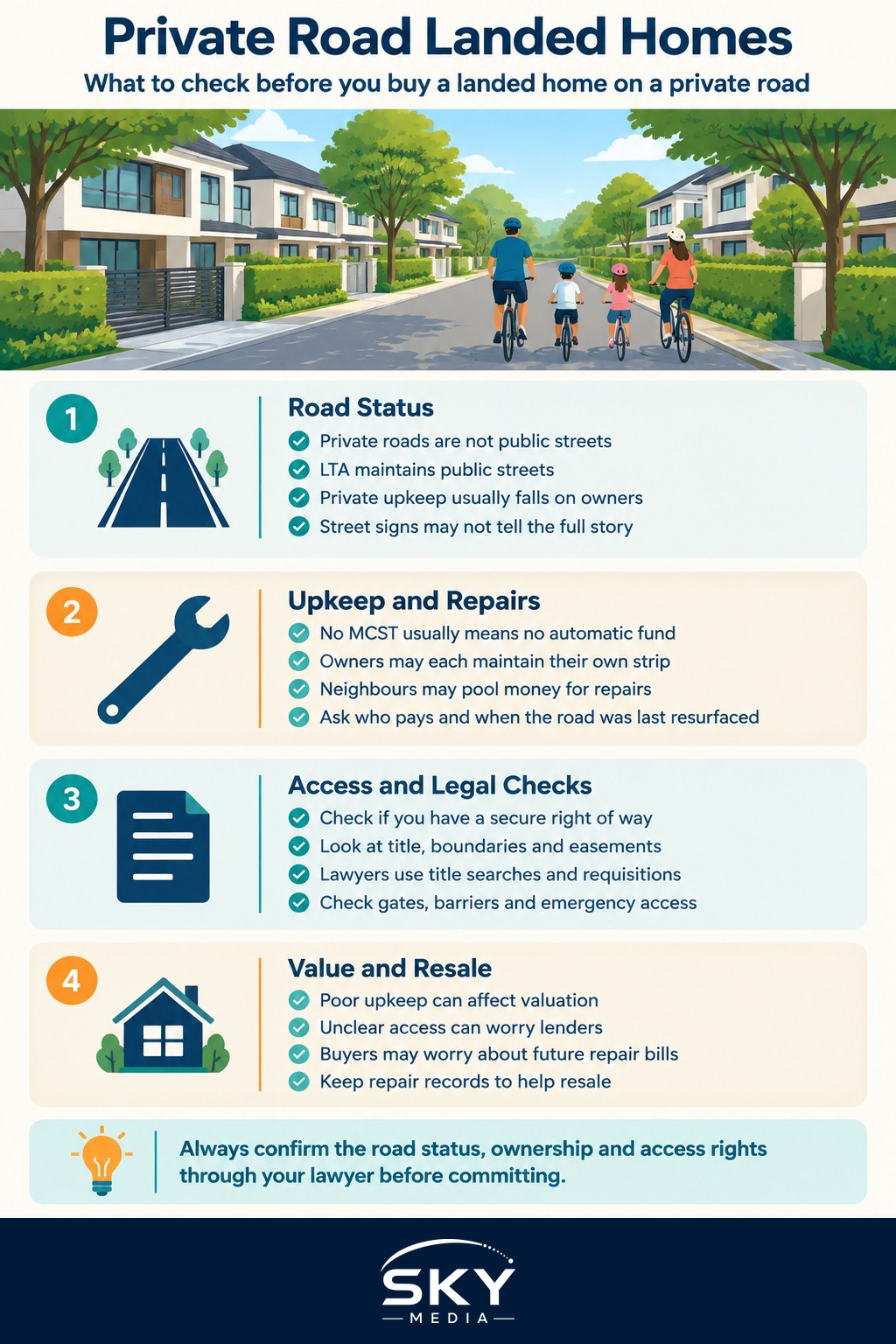
Public Road vs Private Road: What the Difference Means
In Singapore, public streets are maintained by the Land Transport Authority (LTA). That covers resurfacing, drains along the road, street lighting and road signs. A private street is one that has not been taken over as a public street, so its upkeep generally falls on the owners of the land it sits on or the properties fronting it.
A private road can look exactly like a public one. Some have a “private road” sign, many do not. Some are owned by the individual house owners, each holding a strip of the lane, while others sit on a separate lot owned by a developer, a company or a group of owners. Over the years, LTA has taken over some private streets as public streets, so a street’s status today may differ from what an older resident remembers.
The only reliable way to know is through your lawyer’s checks, not the street sign or the agent’s description.
How a Private Road Compares Day to Day
| Issue | Public road | Private road |
|---|---|---|
| Road resurfacing and pothole repair | LTA | Owners or the road’s owner, often shared informally |
| Street lighting and road drains | Public agencies | Often owners’ responsibility, check each item |
| Right to drive in and out | Public right of passage | Depends on title, easements or rights of way |
| Through traffic and parking by outsiders | Open to the public | Often less, but rules depend on ownership |
| Effect on valuation and resale | Neutral | Can be neutral, positive or negative depending on condition and access |
Who Pays for Upkeep, and How It Is Shared
Unlike a condominium, a landed street generally has no MCST (Management Corporation Strata Title, the body that runs a strata development and collects maintenance fees). On a private road, there is usually no automatic fund for repairs. In practice, costs tend to be handled in one of these ways:
- Each owner maintains their own strip. This works when the lane is short and neighbours get along, but patchy repairs can leave an uneven surface.
- Neighbours pool money for a joint repair. Residents collect contributions when the road needs resurfacing or a drain needs clearing. There may be no legal obligation for every household to pay, which can create friction.
- A residents’ association or informal committee. Some estates have a group that coordinates repairs, security gates or landscaping. Ask whether it exists, how it collects money, and whether there are records of past works.
- A separate owner holds the road lot. If a company or individual owns the road itself, find out whether they maintain it and whether any charges or restrictions apply to residents.
When viewing, walk the whole road, not just the stretch in front of the house. Look for cracks, sunken patches, standing water after rain, blocked drains and broken lighting. Ask neighbours when the road was last resurfaced and who paid. Remember that resurfacing costs can be significant and can change over time, so get your own contractor quotation if a major repair looks likely, rather than relying on hearsay.
Access Rights: The Check That Matters Most
The biggest legal question for a house on a private road is whether you have a secure right to get to it. If the road is on land you do not own, your access may depend on a registered easement or right of way, or on rights that arise from the original subdivision. Without a clear right, you could in theory face disputes about passage, parking or works on the road.
Points your lawyer will typically look at include:
- Title and lot boundaries. Whether the house’s land title includes part of the road, and who owns the remaining road lots. Title and survey information is held by the Singapore Land Authority (SLA).
- Easements and rights of way. Whether rights of passage are registered for the property, and on what terms.
- Legal requisitions. As part of a purchase, lawyers send formal enquiries (legal requisitions) to government agencies. The replies can reveal whether the road fronting the property is a public street, whether there are road line plans affecting it, and other planning matters. Our guide on how to check if a property is near a future road line explains road reserves in more detail.
- Restrictions on gates and barriers. Some private roads have gates or bollards. Check whether any are lawful, who controls them, and whether emergency vehicles, refuse trucks and delivery vans can still get through.
If the house has a long shared driveway rather than a true road, many of the same questions apply; see our guide to buying a home with a long driveway.
How a Private Road Can Affect Financing and Resale
A private road is not automatically a problem when you sell. Some buyers actively look for the privacy and low traffic. But condition and clarity drive the outcome:
- Valuation. A bank’s valuer may note a poorly maintained road or unclear access. If the valuation comes in lower than your offer, you will need more cash to cover the gap.
- Buyer pool. Some buyers are cautious about future repair bills or the possibility of disputes with neighbours, which can narrow interest.
- Due diligence questions at resale. Expect the next buyer’s lawyer to ask the same things you are asking now. Keeping records of repairs, contributions and any agreements with neighbours makes your sale smoother. Our guide to selling a private property covers the wider steps.
- Future takeover. If a private street is ever taken over as a public street, upkeep would shift to the authorities, but there may be conditions or works needed first. Do not buy assuming this will happen; check the current position with LTA through your lawyer.
A Practical Checklist Before You Commit
Before you sign the Option to Purchase, or within the option period:
- Ask the seller and agent directly whether the road is public or private, and treat the answer as a starting point only.
- Instruct your lawyer to confirm the road’s status, ownership and your access rights through title searches and legal requisitions.
- Walk the full length of the road in daylight and after heavy rain.
- Talk to two or three neighbours about repairs, contributions, parking habits and any disputes.
- Ask whether there is a residents’ group, and request records of past works if available.
- Get a contractor’s opinion if the surface or drains look tired, so you can factor costs into your offer.
- Check with your bank or broker early whether the valuer has any concerns.
If you are a foreigner, landed purchases have separate approval rules on top of all this, so check the current requirements with the Singapore Land Authority before you start viewing.
The Bottom Line
A house on a private road can be a lovely place to live, as long as you understand what you are taking on. Clarify ownership and access first, budget realistically for shared upkeep, and keep good records so that when it is your turn to sell, the private road is a selling point rather than a question mark.
Official sources: URA