

The veena is one of the oldest and most revered instruments of South Indian classical music, and Singapore has a small but committed community of teachers and students who keep it alive. If you want to learn veena in Singapore, whether as a child, a parent picking it up alongside your kids, or an adult returning to something you heard at home growing up, this guide explains what the instrument is, where lessons are usually found, what the first year looks like and how to choose a teacher and an instrument.
What Makes the Carnatic Veena Different
The instrument most people mean by “veena” in Singapore is the Saraswati veena, the main stringed instrument of Carnatic music, the classical tradition of South India. It is often confused with the sitar, which belongs to the Hindustani (North Indian) tradition. The two look a little alike from a distance, but they are played and learned quite differently.
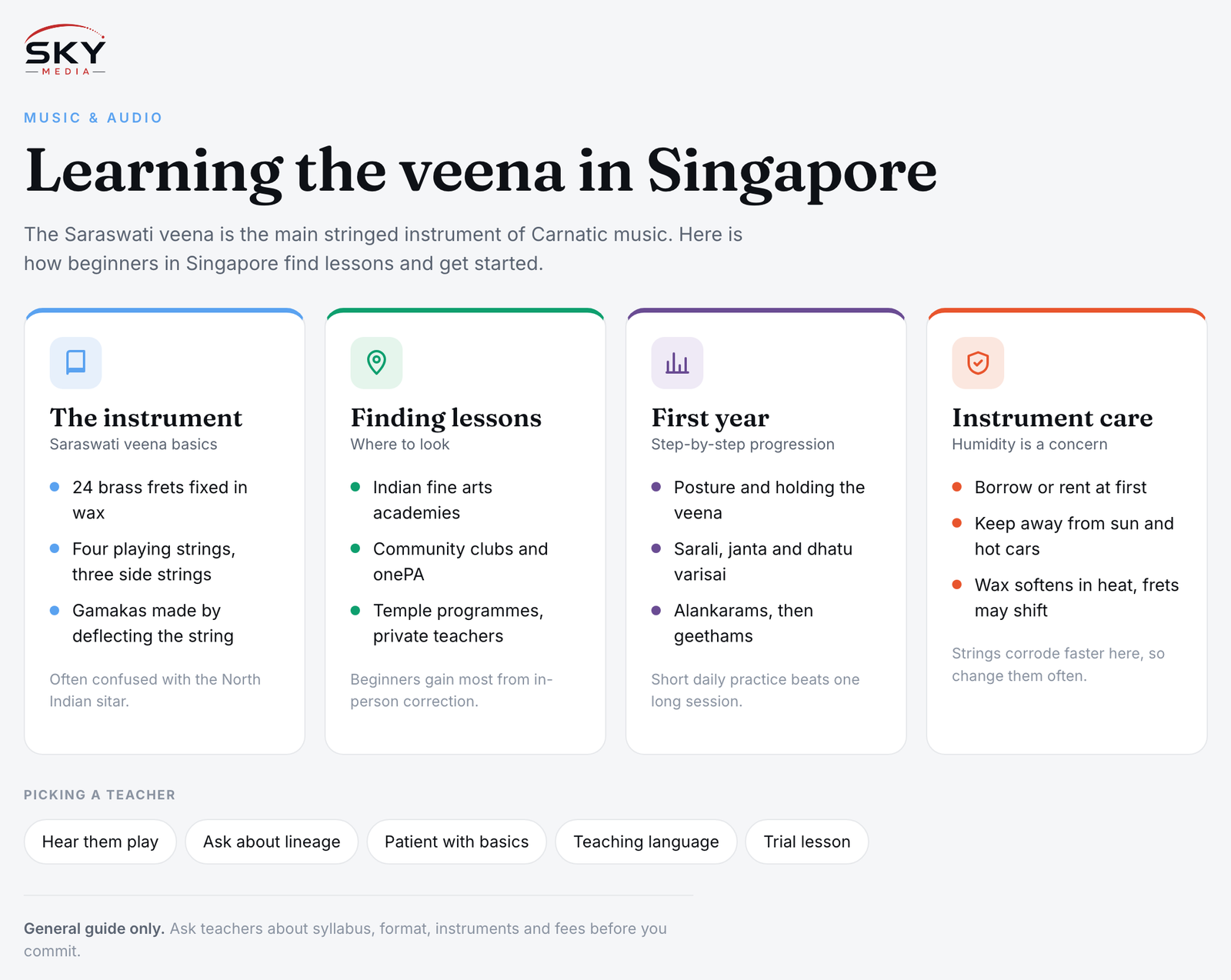
Key features of the Saraswati veena:
- A large resonator and a long neck. The main body is a big bowl, traditionally carved from jackwood, with a smaller gourd or resonator under the far end of the neck to help balance the instrument.
- Fixed frets set in wax. The veena has 24 brass frets fixed on a wax bed. Unlike the sitar, they are not moved to suit each raga.
- Four playing strings and three side strings. The main strings are plucked for melody, and the side strings are strummed with the little finger to keep rhythm and provide a drone.
- Gamakas by pulling the string. Much of the expression in Carnatic music comes from gamakas, the oscillations and slides between notes. On the veena these are produced by deflecting the string sideways across the frets, which is a skill that takes years to refine.
Players usually sit cross-legged on the floor, with the main resonator resting on the right thigh and the small resonator on the left side. The left hand stops the strings on the frets, while the right index and middle fingers pluck, often with wire picks worn on the fingertips.
Veena vs Sitar at a Glance
If you are still deciding between the two, this comparison helps.
| Feature | Saraswati veena | Sitar |
|---|---|---|
| Musical tradition | Carnatic (South Indian) | Hindustani (North Indian) |
| Frets | Fixed in wax | Movable, curved metal frets |
| Sympathetic strings | Usually none | Many, under the main strings |
| Main expressive technique | Deflecting the string for gamakas | Pulling the string (meend) on raised frets |
| Typical repertoire for beginners | Varisais, geethams, then varnams | Paltas, then simple compositions in a raga |
Neither is “easier”; choose the tradition whose music moves you.
Where to Find Veena Lessons in Singapore
Veena teachers are fewer than piano or guitar teachers, so it helps to know where to look. Common routes include:
- Indian fine arts academies and societies. Several long-running arts institutions in Singapore offer Carnatic music classes, and some include veena alongside vocal, violin and mridangam. Many follow a structured syllabus with graded exams or annual performances.
- Community and cultural centres. Some community clubs and Indian cultural groups run classes or can point you to a teacher. Check the People’s Association’s onePA portal and notices at your local community club.
- Temple-linked cultural programmes. Some temples host or support music classes, particularly for children, and their notice boards are a good place to hear about teachers.
- Private teachers. Many experienced veena players teach from home, one to one or in small groups. Word of mouth within the Indian classical music community is still the most common way to find them.
- Online lessons. Some students learn from teachers in India over video, which suits those past the basics; beginners gain most from in-person correction.
When you contact a teacher or school, ask about lesson length, group or individual format, the syllabus they follow, whether they lend or recommend instruments, and their policy on missed lessons and fees. Fees vary widely, so compare a few options.
What Your First Year Usually Covers
Carnatic music is traditionally taught step by step, and most veena teachers follow a familiar progression:
- Posture and holding the instrument. Learning to sit comfortably and balance the veena comes first.
- Sarali varisai. Simple scale exercises in the raga Mayamalavagowla, used to train the fingers and the ear.
- Janta varisai and dhatu varisai. Exercises with repeated and zigzag note patterns that build clarity and control.
- Alankarams. Exercises set to the different talas (rhythmic cycles), which teach you to keep time with the side strings.
- Geethams. Short, simple songs that introduce how a raga feels as music rather than as exercises.
Many students then move on to swarajathis and varnams, which are longer and more demanding pieces that develop gamakas properly. How fast you progress depends on regular practice more than on talent. Short daily practice tends to beat one long weekend session.
Choosing a Teacher Who Suits You
A good veena teacher is someone you will learn from for years, so it is worth taking time over the choice.
- Listen to them play. Ask if you can attend a student concert or hear a short demonstration.
- Ask about their lineage and training. Carnatic music places great value on the guru-shishya tradition, the passing of knowledge from teacher to student, and many teachers are happy to explain who they learned from.
- Check their approach with beginners. Patience with posture and basics matters more than an impressive performance record.
- Consider the language of teaching. Lessons may be in English, Tamil, Telugu or another language. Make sure you are comfortable.
- Try a trial lesson. Many teachers allow one before you commit.
Children often start around the age when they can sit still and manage a large instrument, but adults are welcome too. Adult learners frequently progress steadily because they practise with purpose. If you are an adult returning to learning, our guide on learning how to learn has useful ideas on spacing practice and staying motivated.
Getting an Instrument
Veenas are mostly handmade in South India, with Thanjavur particularly well known for veena making. In Singapore you can usually:
- Borrow or rent at first. Some schools and teachers have instruments for students to use in class, which lets you try before buying.
- Buy through your teacher. Teachers often know makers and can help you order one suited to your height and level.
- Buy second hand. Instruments occasionally change hands within the community. Have your teacher check it for cracks, warped frets and wax condition before you pay.
Singapore’s humidity is a real concern for a wooden instrument with frets set in wax. Keep the veena in an air-conditioned or well-ventilated room away from direct sunlight, store it in a padded cover, and avoid leaving it in a hot car. Wax can soften in heat and frets may shift, so ask your teacher how to check and care for them. Strings also corrode faster here, so expect to change them more often.
Staying Motivated Through the Long Middle Stretch
The veena rewards patience. There will be months where progress feels slow, especially while learning gamakas. A few habits help:
- Record yourself. Listening back reveals pitch and timing issues you cannot hear while playing.
- Ask for specific feedback. Instead of “Is this right?”, ask “Is my gamaka on this note too wide?” Our piece on how to learn from feedback explains how to turn corrections into improvement.
- Attend concerts. Carnatic concerts and festival performances take place in Singapore through the year, including during the Tamil month of Margazhi (around December and January) when many music events are held. Hearing experienced players is one of the best teachers.
- Play with others. Group classes and student recitals build confidence and keep you accountable.
Learning the veena is a long journey, but even the early stages are rewarding. Within a few months you will be playing simple songs, and with steady practice you will begin to hear the instrument’s distinctive voice in your own hands.
Further reading: Learning the Mridangam in Singapore · Learning the Koto in Singapore · Learning the Sitar