

The euphonium is the warm, singing voice of the brass section. It sits between the trombone and the tuba in pitch, it often carries the most lyrical melodies in a concert band, and it is one of the friendlier brass instruments for a beginner’s lungs and hands. If you want to learn euphonium in Singapore, you will find that most players start in a school band, but adults and late starters have good routes too.
This guide covers what the instrument actually is, how school band pathways work, how to get lessons outside school, and what to check if you are buying a used euphonium.
What the Euphonium Is (and How It Differs From Its Cousins)
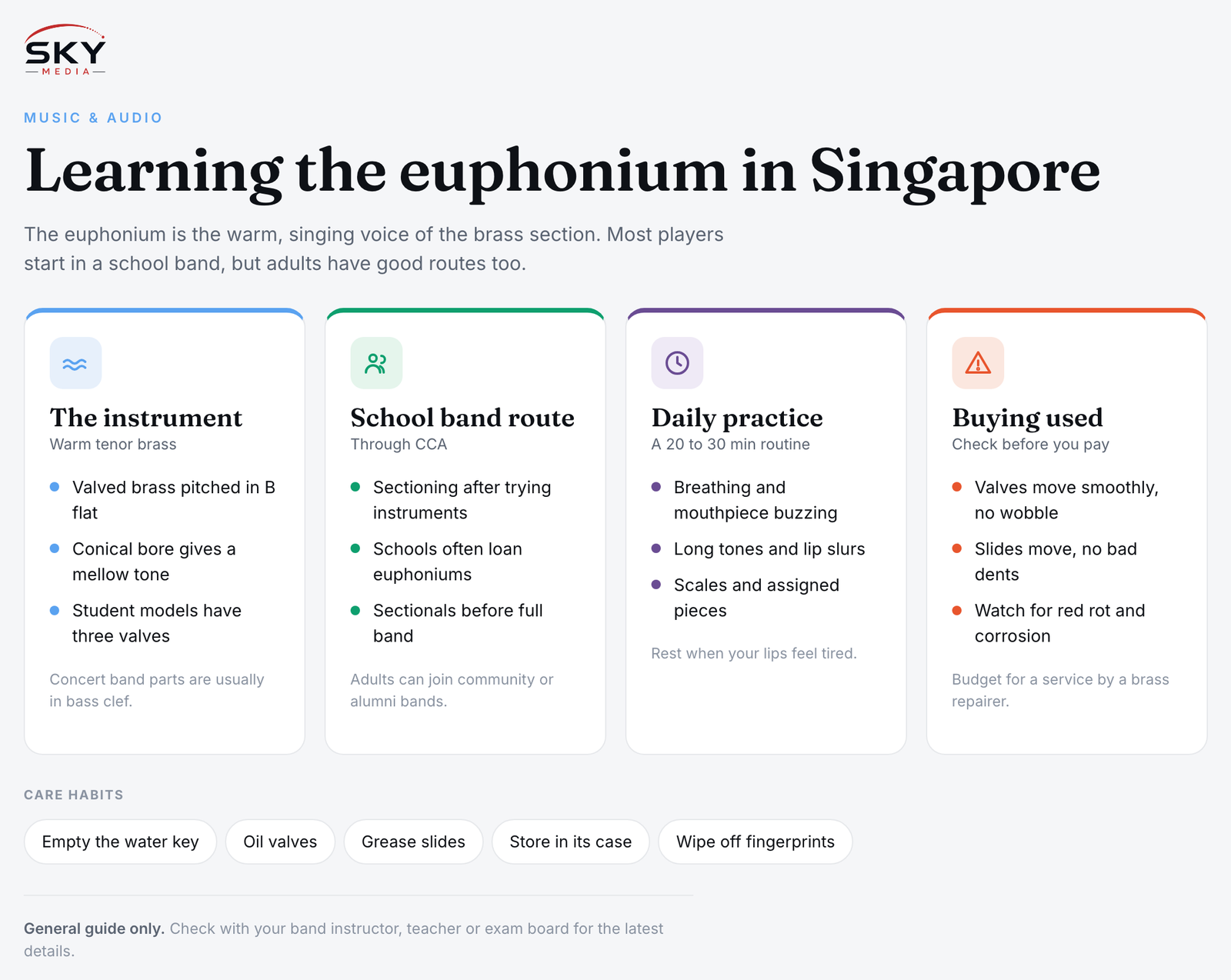
A euphonium is a valved brass instrument pitched in B flat, with a conical bore, meaning the tubing gradually widens from mouthpiece to bell. That shape gives it the mellow, round tone players love. Most student models have three valves played with the right hand. Intermediate and professional models usually add a fourth valve, often played with the left hand, which extends the low range and improves tuning on certain notes. Many higher-end instruments also use a “compensating” system, extra tubing that corrects the natural sharpness of some low notes.
Newcomers often confuse the euphonium with similar instruments. Here is how they compare.
| Instrument | Pitch and size | Tone | Where you usually hear it |
|---|---|---|---|
| Euphonium | B flat, tenor range, mid-sized | Warm, dark, singing | Concert bands, military bands, brass bands |
| Baritone horn | B flat, same range, smaller bore | Brighter, lighter | Mainly British-style brass bands |
| Trombone | B flat, similar range, slide not valves | Brighter, can be brassy | Concert bands, orchestras, jazz |
| Tuba | Lower (F, E flat, C or B flat), large | Deep, foundational | Concert bands, orchestras |
Reading Music: Bass Clef or Treble Clef?
One quirk worth knowing early: euphonium parts come in two forms. In concert bands, parts are usually written in bass clef at concert pitch, which is the same way trombone and bassoon parts are written. In brass band tradition, parts are often written in treble clef and transposed, so the written notes look like trumpet music.
Many Singapore school bands use bass clef, but some arrangements and teachers use treble clef. Ask your band instructor which one you will be reading. Learning both eventually is common and very useful if you ever join a community or brass band.
The School Band Pathway
For most young people in Singapore, the euphonium arrives through a school band. Concert or symphonic band is a popular CCA (co-curricular activity) in many primary and secondary schools, and in some junior colleges and polytechnics.
Here is how it usually works:
- Sectioning. New members often try several instruments during an introductory period. Instructors look at lip shape, arm length, interest and the band’s needs, then assign instruments. If you want the euphonium, say so politely and early, but be open to the band’s needs.
- School-owned instruments. Large brass instruments like the euphonium are commonly loaned by the school, so families do not have to buy one immediately. Check the school’s rules on taking instruments home, insurance and care.
- Sectional practices. Brass players often rehearse in sections with an instructor before full band practice.
- Performances and assessments. School bands take part in concerts and in the Singapore Youth Festival Arts Presentation, a regular showcase where bands are assessed. Check MOE and your school for current details, since formats change over time.
If your child joins a band and loves it, private lessons alongside CCA can speed up progress, especially with tone production and reading.
Starting as an Adult
Community bands, alumni bands and some community club interest groups accept adult learners, and many are happy to take keen beginners after some basic lessons. Search for community concert bands, ask at music shops, or look on the People’s Association OneCommunity platform for interest groups near you. Adults often progress quickly because they practise with purpose.
Lessons, Practice and Graded Exams
You can learn the euphonium through private teachers, music schools, or band instructors who also teach one-to-one. When choosing a teacher, look for:
- Experience teaching beginners on low brass specifically, not just brass in general.
- A clear plan covering breathing, buzzing, tone, lip slurs, scales and sight-reading.
- Willingness to work alongside your band’s repertoire.
- Honest communication about practice expectations and progress.
Prices vary widely by teacher experience and lesson length, so compare a few options and ask about trial lessons and cancellation terms.
Graded exams from bodies such as ABRSM and Trinity College London include euphonium or low brass syllabuses. Exams are optional, but they give structure and motivation. Check each board’s website for current syllabuses and exam sessions in Singapore.
A Simple Beginner Practice Routine
A beginner routine of 20 to 30 minutes might include:
- Breathing (2 to 3 minutes). Slow, deep breaths using the whole torso, without lifting the shoulders.
- Mouthpiece buzzing (2 minutes). Buzz simple pitches and slides on the mouthpiece alone.
- Long tones (5 minutes). Hold notes steadily, focusing on a full, even sound.
- Lip slurs (5 minutes). Move between notes on the same valve combination to build flexibility.
- Scales and pieces (10 minutes). Work on what your teacher or band assigned.
Rest when your lips feel tired. Pushing through fatigue often leads to a pinched, forced sound and bad habits.
Practising in an HDB Flat or Condo
The euphonium carries. Practise at reasonable hours, close windows, and consider a practice mute designed for euphonium, or book a music studio.
Buying a Used Euphonium: What to Check
Eventually many players want their own instrument. Euphoniums are expensive when new, so the second-hand market is popular, through online marketplaces, music shops that take trade-ins, and players upgrading.
Before buying, check these points, ideally with your teacher or an experienced player:
- Valves. Press each valve repeatedly. They should move smoothly and quietly without sticking, and should not wobble excessively. Worn valves leak air and are costly to fix.
- Slides. Every tuning slide should move with gentle pressure. Seized slides may need a repairer.
- Dents. Small dents on the bell are usually cosmetic. Dents in the narrow tubing near the mouthpiece or in the valve section can affect playing.
- Red rot and corrosion. Pinkish spotting or pitting on the brass can signal corrosion that may lead to leaks.
- Joints and solder. Look for loose braces or rattles.
- Mouthpiece receiver. The mouthpiece should fit snugly and the receiver should not be bent.
- Play test. Play through the full range. Notes should centre easily and the sound should be even.
Ask about valves, compensation, case and mouthpiece, and budget for a service by a brass repairer after purchase.
New vs Used
New student instruments come with warranties and no hidden wear, which suits families who want certainty. A good used intermediate instrument can sound better than a new student one, but carries more risk. If in doubt, rent first, or keep using the school instrument until you know the player is committed.
Looking After Your Euphonium
Singapore’s humidity is hard on instruments. A few habits help:
- Empty water through the water key after playing.
- Oil valves regularly with proper valve oil and grease slides as needed.
- Give it a gentle bath occasionally, following your teacher’s advice.
- Store it in its case, away from direct sun and damp corners.
- Wipe fingerprints off so sweat does not damage the finish.
Getting Started
Learning the euphonium is rewarding, social and surprisingly accessible. Start with your school band or a beginner-friendly teacher, build a short daily routine, and take your time before buying. If you enjoy exploring traditional instruments too, our guide to learning the veena in Singapore shows a very different path. And if you are an adult wondering how to practise efficiently, Learning How to Learn: A Practical Guide has techniques that apply directly to music.
Further reading: Learning the Bassoon in Singapore · Learning the Tuba in Singapore · Learning the French Horn · Learning the Trombone: A Friendly Beginner Guide for Singapore