

If you sell goods to consumers in Singapore, the lemon law applies to you whether you run a heartland shop, a car showroom or an online store. Understanding your lemon law retailer obligations helps you handle complaints fairly, avoid disputes escalating, and protect your reputation. This guide explains what the law expects from sellers, how the six-month rule works, and a practical process for handling claims.
This is general information, not legal advice. The rules sit in the Consumer Protection (Fair Trading) Act (CPFTA), which is administered by the Competition and Consumer Commission of Singapore (CCCS). For specific situations, check the official CCCS guidance or speak to a lawyer.
If you want to see the same rules from your customers’ side, our guide to your rights under the lemon law in Singapore is written for consumers.
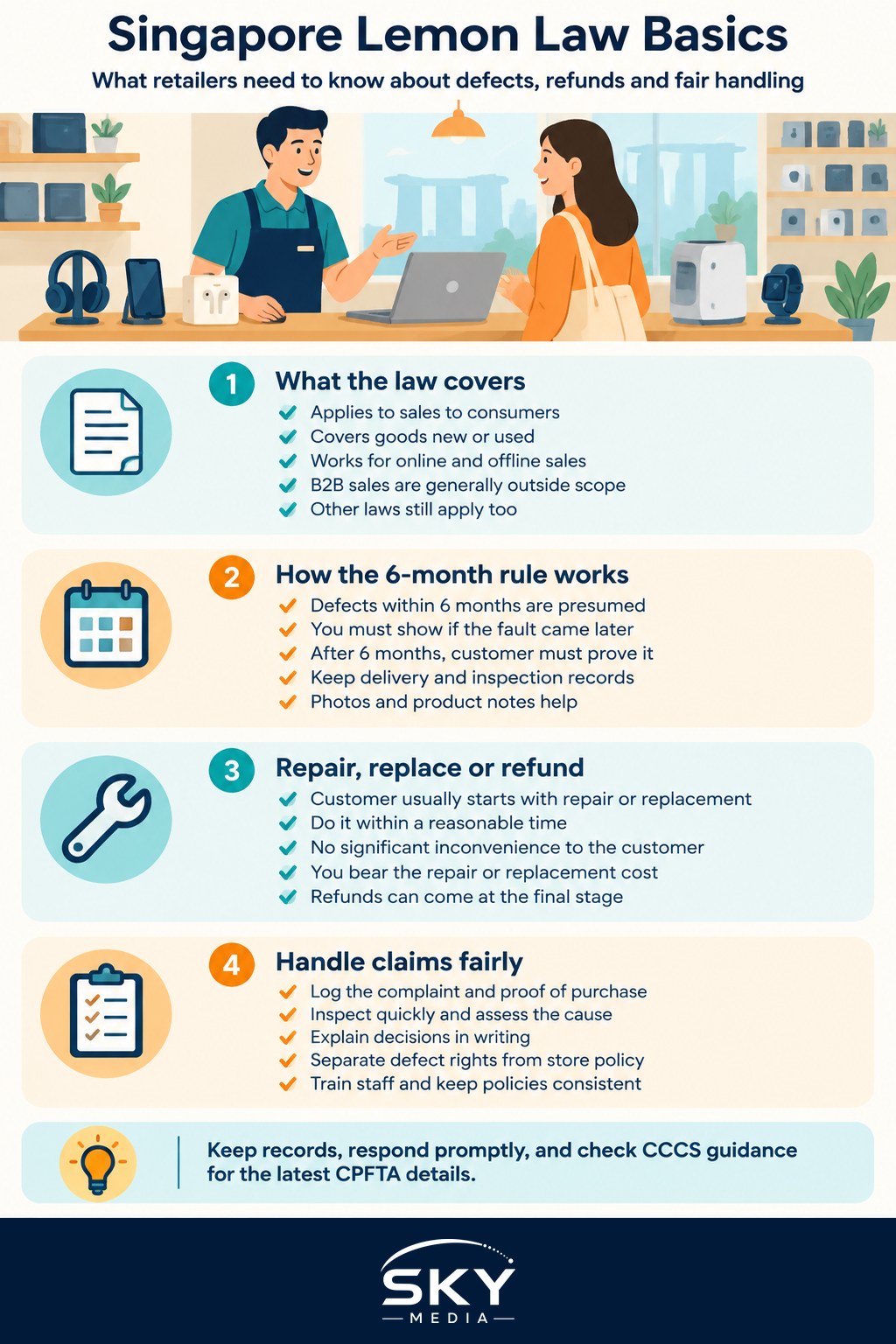
What the Lemon Law Covers
The lemon law is a set of provisions in the CPFTA that give consumers remedies when goods do not conform to the contract at the time of delivery. In plain terms, a product is “non-conforming” if it is defective, not of satisfactory quality, not fit for its purpose, or does not match its description or sample.
Key points for retailers:
- It covers sales to consumers. Business-to-business sales are generally outside its scope.
- It covers goods, new or used. This includes items like electronics, appliances, furniture and vehicles. Used goods are judged against what a reasonable buyer would expect given their age and price.
- It applies to online and offline sales. Selling through a website or marketplace does not change your duties as the seller.
- It sits alongside other laws. The Sale of Goods Act and general contract law still apply.
It does not cover everything. Retailers are generally not responsible for defects caused by the customer’s misuse, accidents, normal wear and tear, or defects that were specifically pointed out to the customer before the sale.
The Six-Month Presumption Explained
The rule that matters most day to day is the six-month presumption. If a defect shows up within six months of delivery, the law presumes it existed at the time of delivery. It is then up to you, the retailer, to show otherwise, for example by showing that the damage came from misuse.
After six months, consumers can still make a claim, but the burden shifts: they must show the defect existed when the goods were delivered.
This is why good records matter. Delivery dates, inspection notes, photos of condition at handover, and clear product descriptions can all help if a dispute arises.
Repair, Replace, Reduce or Refund: Your Duties in Order
The lemon law sets out remedies in two tiers. The customer starts with the first tier, and moves to the second only if the first does not work.
| Stage | What the customer can ask for | What you must do | When it moves on |
|---|---|---|---|
| First tier | Repair or replacement | Carry it out within a reasonable time and without significant inconvenience to the customer, at your cost | If repair or replacement is impossible, disproportionate, or not done within a reasonable time |
| Second tier | Price reduction | Agree a reduction that reflects the defect | If the customer prefers to keep the item with a reduced price |
| Second tier | Rescission (refund) | Take back the goods and refund, possibly taking the customer’s use of the item into account | Usually the final step when earlier remedies have failed |
A few practical notes:
- The customer generally chooses between repair and replacement, unless their choice is impossible or disproportionately costly compared with the other option.
- “Reasonable time” depends on the product. A phone and a car will naturally differ. Communicate timelines clearly.
- You bear the cost of the repair or replacement, including reasonable costs such as transporting the goods.
- Manufacturer warranties do not replace your duty. You can work with the manufacturer or distributor, but the customer’s legal relationship is with you as the seller.
“No Refund, No Exchange” Signs and Your Store Policy
Many shops display “no refund, no exchange” signs. These can apply to change-of-mind returns, which are a matter of your own store policy. They do not remove a customer’s legal rights when goods are defective.
When writing your returns policy:
- Separate change-of-mind returns from defects. Make it clear that statutory rights for defective goods are not affected.
- Avoid misleading wording. Telling customers they have no rights when they do could be an unfair practice under the CPFTA.
- Train staff on the difference. Front-line staff are the first people customers speak to. A dismissive “no refund” can turn a simple repair into a formal complaint.
- Be consistent online and offline. Put the same policy on receipts, your website and marketplace listings.
Our guide to consumer rights, returns and refunds in Singapore explains how customers usually understand these policies, which is useful when drafting your own wording.
A Practical Process for Handling Lemon Law Claims
Having a simple, written process keeps responses fair and consistent:
- Log the complaint. Record the date, the customer’s details, the item, proof of purchase and delivery date, and a description of the problem.
- Inspect promptly. Examine the item or arrange for the manufacturer’s service centre to do so. Note whether the defect is within the six-month window.
- Assess the cause. Check for signs of misuse or accidental damage, and document what you find with photos.
- Offer the first-tier remedy. If the claim is valid, offer repair or replacement and confirm a realistic timeframe in writing.
- Keep the customer updated. Silence is the fastest way to turn a claim into a dispute.
- Move to price reduction or refund if needed. If repair or replacement fails or takes too long, discuss the second-tier options.
- Close the file in writing. Confirm what was agreed and keep the records.
If you believe a claim is not valid, explain why in writing and share any evidence. Customers who remain unhappy may approach the Consumers Association of Singapore (CASE) for mediation, or file a claim at the Small Claims Tribunals. Responding calmly and with documents generally helps you at every stage.
Working With Suppliers and Manufacturers
You carry the legal duty to the customer, but you can manage the cost by setting clear terms with suppliers:
- Check supplier warranties and return terms before you list products.
- Agree who pays for repairs and replacements of defective stock in your supply contract.
- Know the authorised service centres for the brands you sell so you can route repairs quickly.
- Track recurring faults. If one product keeps failing, raise it with the supplier or stop selling it.
Staying Compliant as Your Business Grows
The lemon law rewards businesses that act fairly and keep good records. Review your policy wording once a year, refresh staff training, and keep an eye on CCCS announcements for any changes to the CPFTA. Rules and enforcement practices can change, so always check the latest details with CCCS directly.
Handled well, a lemon law claim is a chance to show customers you stand behind what you sell, which often earns more loyalty than the sale itself.
Frequently Asked Questions
Does the lemon law apply if I sell second-hand items online as a small seller? It can, if you are selling as a business or in the course of trade, since the law covers sales of goods to consumers, new or used. A casual one-off private sale is treated differently. Used goods are judged against what a reasonable buyer would expect given age and price. Check CCCS guidance for your case.
Does the lemon law cover services such as repairs or installation? No, it deals with goods that do not conform to the contract. Services such as repairs, installation or training are handled under other consumer protection rules and your service contract. If you sell both, keep the paperwork for each separate so you know which rules apply.
A customer wants a refund straight away for a faulty item. Must I give one? Not necessarily at the start. The first tier is repair or replacement at your cost, within a reasonable time and without significant inconvenience to the customer. A price reduction or refund comes in when that is impossible, disproportionate or fails. Explain the steps clearly and in writing.
What can happen if I refuse a claim that turns out to be valid? The dispute can escalate. The customer may approach CASE for mediation or file a claim at the Small Claims Tribunals, and CCCS can look into unfair practices. Handling it calmly, with documents and a written explanation, usually helps. For serious cases, speak to a lawyer.
Does the lemon law apply to items sold at a discount or on clearance? Yes, being on sale does not remove a customer’s rights if the goods are defective or not as described. What counts as satisfactory quality can reflect the price and any defects pointed out before the sale. Record those defects clearly on the receipt or listing.
Official sources: CASE (Consumers Association of Singapore)
Further reading: What the Consumer Protection (Fair Trading) Act Means for Singapore Retailers