
If you are selling health supplements in Singapore, the HSA (Health Sciences Authority, the national regulator for health products) is the body whose rules you need to understand. Supplements are not licensed product by product the way medicines are, but the responsibility for safety, labelling and honest claims sits squarely with you, the dealer, and HSA can act against you if a product on your shelf or in your online store breaks the rules.
This guide focuses on the product rules themselves: what cannot be in a supplement, what the label must show and what you may and may not say about it. If you are still at the stage of choosing premises, suppliers and a business structure, start with our guide on how to start a supplements and health store and come back here before you stock your first product.
This is general information, not legal advice. HSA’s guidelines are updated from time to time, so always check the current version on the HSA website before you buy stock or publish a listing.
How HSA Treats Health Supplements Compared With Medicines
Singapore regulates health products in different classes, and the class decides how much control applies before a product reaches the shelf.
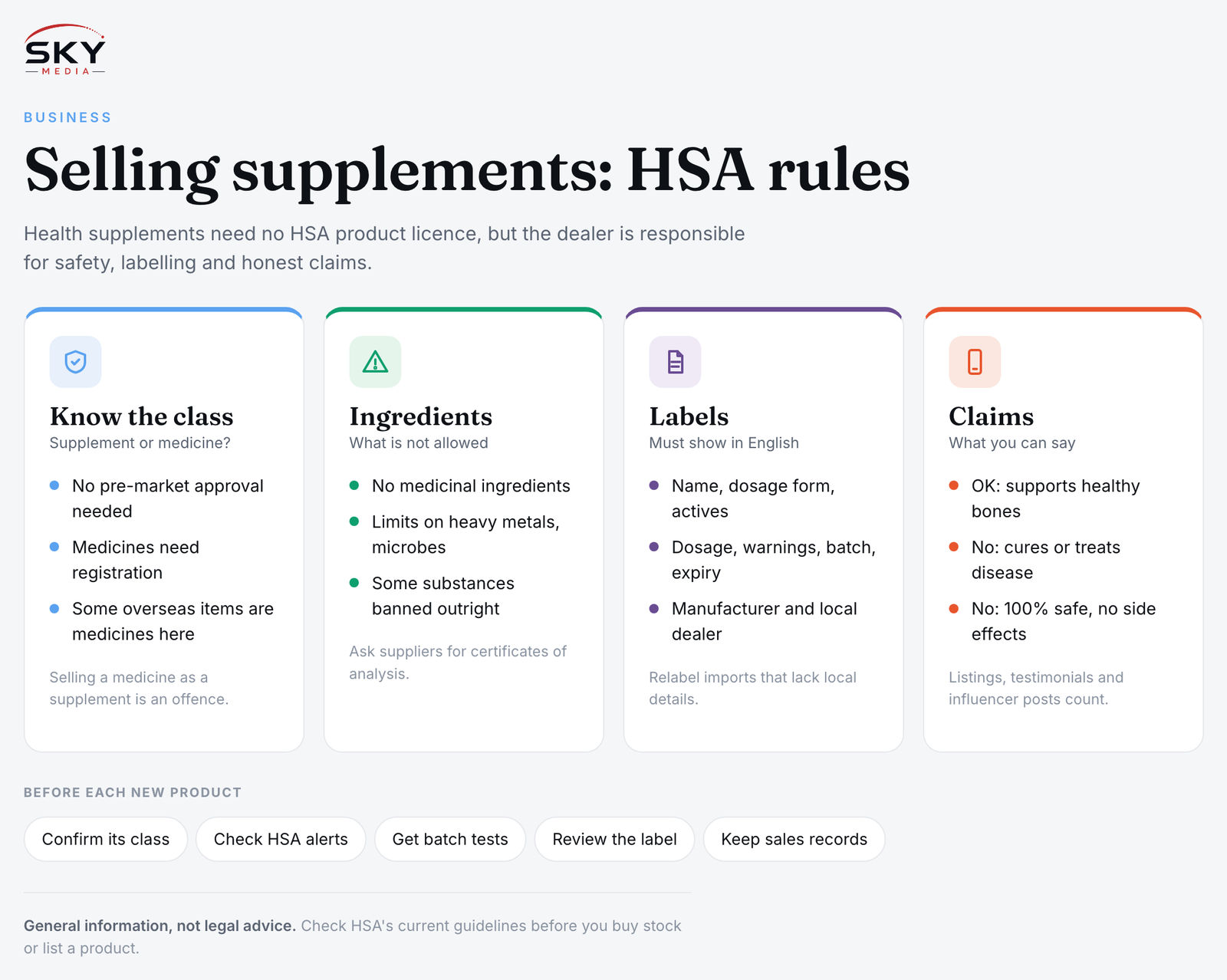
- Health supplements (vitamins, minerals, amino acids, fish oils, probiotics, plant extracts and similar products taken to support health) do not need pre-market approval or a product licence from HSA. Dealers must still make sure each product meets HSA’s guidelines on safety, quality and labelling.
- Medicines, including products intended to treat or prevent a disease, need product registration, and many can only be supplied by pharmacists or on prescription.
- Chinese proprietary medicines and other traditional medicines have their own framework, which differs from supplements.
- Medical devices and cosmetics have separate requirements again. If you plan to stock items such as blood pressure monitors or skincare, read about registering a medical device with HSA and notifying HSA before selling cosmetic products.
The same type of product can fall into a different class depending on what it contains and claims. Some ingredients sold freely as supplements overseas, such as certain hormones, are controlled as medicines in Singapore. If a product is really a medicine, selling it as a supplement is an offence even if it is legal in its country of origin.
Prohibited and Restricted Ingredients
The most serious risk for sellers is a product that contains something it should not. HSA’s guidelines set out what is not allowed in health supplements, and its public alerts over the years have repeatedly flagged products that contain hidden medicinal ingredients.
Key points to understand:
- No medicinal ingredients. Supplements must not contain substances that are regulated as medicines, such as prescription drugs. Products marketed for weight loss, sexual performance, joint pain or bodybuilding have historically been the most common categories found adulterated with undeclared drugs or steroids.
- Limits on contaminants. HSA sets limits for heavy metals and microbial contamination. Your supplier should be able to give you test results from a qualified laboratory for each batch.
- Controlled and banned substances. Some substances are prohibited outright under Singapore law, regardless of how the product is labelled. Check any unfamiliar botanical or “research” compound before stocking.
- Ingredients restricted by dose or form. Certain vitamins and minerals are permitted only within limits, and higher strengths may move a product into the medicine category.
Because supplements do not go through pre-market approval, HSA expects dealers to do their own checks. Ask suppliers for certificates of analysis, a full ingredient list with quantities, and evidence of good manufacturing practice. Keep these records, since you may be asked for them if HSA investigates a product you sold.
Labelling Requirements Sellers Must Check
A supplement label in Singapore needs to tell the buyer clearly what the product is and how to use it safely. HSA’s guidelines list the information required, and you should compare each product against the current list rather than relying on an overseas label. Typical requirements include:
- The product name and the dosage form (tablet, capsule, powder and so on)
- The names and quantities of active ingredients
- Recommended dosage and directions for use
- Any warnings or precautions relevant to the ingredients
- Batch number and expiry date
- The name and address of the manufacturer, and of the local dealer or importer responsible for the product in Singapore
- The labelling must be in English, even if other languages also appear
If you import products whose labels are only in another language, or which are missing local dealer details, you will need to relabel or overlabel them in line with HSA’s guidance before sale.
What Claims You Can and Cannot Make
Claims are where many retailers and online sellers get into trouble, often without realising it. A health supplement may make general claims about supporting or maintaining normal health. It may not claim to diagnose, treat, cure, mitigate or prevent a disease. Separately, Singapore law restricts advertising that refers to certain specified diseases and conditions, and HSA’s guidelines explain which claims are acceptable for supplements.
The table below shows the general difference in tone. Treat these as illustrations, not an approved wording list.
| Type of statement | Generally acceptable for a supplement? | Why |
|---|---|---|
| “Supports healthy bones” | Usually yes | A general health maintenance claim |
| “Helps maintain normal energy levels” | Usually yes | Describes normal body function |
| “Cures arthritis” | No | A claim to treat a disease makes it a medicinal claim |
| “Lowers blood sugar for diabetics” | No | Refers to managing a disease condition |
| “Clinically proven, 100% safe, no side effects” | No | Misleading absolute safety claims |
| “Lose 10 kg in two weeks” | No | Exaggerated and likely misleading |
Claims are not just what is printed on the box. HSA and the Advertising Standards Authority of Singapore (ASAS, which administers the industry advertising code) look at the whole impression you create, including:
- Product titles and descriptions on your website or marketplace listing
- Customer testimonials you choose to repost
- Before and after photos
- Influencer posts you pay for or supply products to
- Chat replies your staff send to customers asking whether a product will help their condition
If a customer asks whether a supplement will treat a medical problem, suggest they speak to a doctor or pharmacist.
Extra Points for Online and Marketplace Sellers
Selling online brings the same rules plus a few practical issues.
- Marketplace policies. Platforms have their own rules on health products and may remove listings that HSA flags. Read the platform’s restricted items policy before listing. See our guide to selling on online marketplaces in Singapore.
- Cross-border stock. Shipping products from overseas warehouses directly to Singapore buyers does not exempt you from local rules if you are the seller targeting Singapore customers. Imports for sale also go through Singapore Customs permit requirements.
- Monitoring. HSA monitors online sales of health products and publishes alerts on products found to contain undeclared ingredients. Checking these alerts regularly helps you avoid stocking a problem brand.
- Reseller and dropshipping risk. If you buy from parallel sources or unknown wholesalers, you carry the risk if the product turns out to be counterfeit or adulterated.
A Simple Compliance Routine Before Each New Product
Build a short checklist and use it every time you add a product:
- Confirm the product is genuinely a health supplement and not a medicine or traditional medicine.
- Check every ingredient against HSA’s current guidelines and alerts.
- Obtain batch test results and manufacturing information from the supplier.
- Review the label for all required information in English, with local dealer details.
- Rewrite listing copy to remove any disease, cure or absolute safety claims.
- Keep records of sources, batches and sales so you can trace and recall products if needed.
- Set up a way to receive and report adverse reactions customers tell you about.
If you are unsure where a product falls, HSA’s website has guidance documents and contact channels for industry enquiries.
Official sources: Health Sciences Authority (HSA)
Further reading: Consumer Product Safety Rules for Online Sellers in Singapore · Food Labelling Rules for Packaged Food Sold in Singapore