

Getting a library card in Singapore is one of the easiest and most rewarding settling-in tasks you can tick off in your first weeks. Public libraries here are bright, air-conditioned and well stocked, and they double as quiet study spaces, children’s reading corners and venues for free talks. This guide walks you through how membership works, how to sign up, and how to get real value out of your card once you have it.
How Public Library Membership Works in Singapore
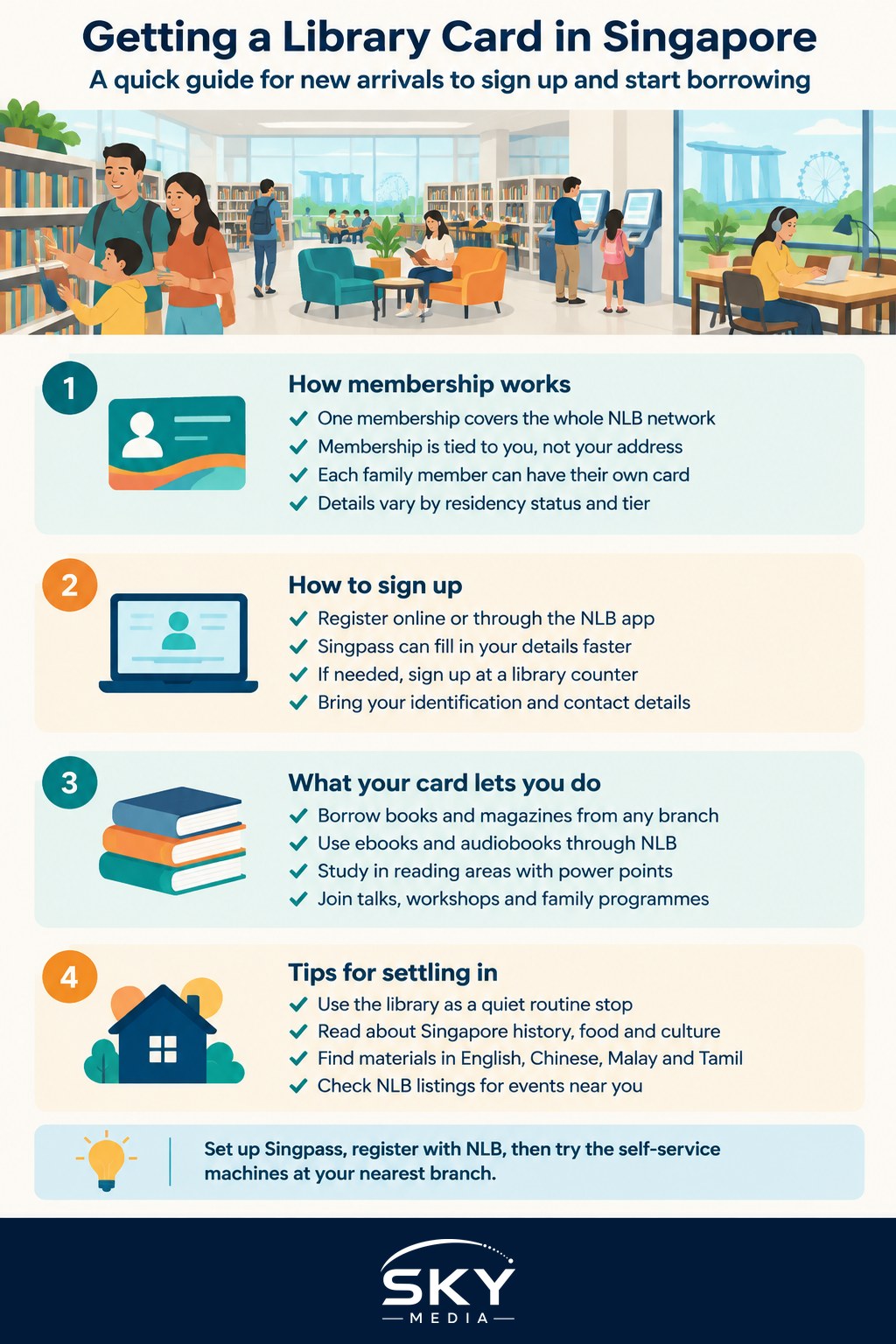
Singapore’s public libraries are run by the National Library Board, usually shortened to NLB. One membership covers the whole network, so you can borrow a book at the library near your office and return it at the one near your home. There is no separate card for each branch.
A few points that newcomers often find helpful:
- Membership is tied to your identity, not your address. You sign up as an individual, and each family member, including children, can have their own membership.
- Terms depend on your residency status. Membership tiers, borrowing limits and any fees differ between Singapore citizens, permanent residents and foreigners living here on a pass. Some tiers may involve a fee. Because these terms are reviewed from time to time, check the current details on the NLB website before you sign up.
- Your card is mostly digital. Many members never carry a physical card. The official NLB mobile app can show a digital membership card that you scan at the self-service machines.
If you have just arrived and your pass card has not been issued yet, it is worth waiting until you have it, as you will usually need your identification details to complete registration.
How to Sign Up for a Library Card
There are two main ways to register, and most people find the online route quickest.
Online or through the app. Singapore residents can typically register through the NLB website or app and verify their identity with Singpass, the national digital identity login used for government services. If you already have a Singpass account, your personal details can be filled in for you, which saves time. If you do not yet have Singpass, set it up first through the official Singpass website, as it will be useful for many other tasks too.
At a library counter. If you cannot register online, staff or service kiosks at a public library can help. Bring your original identification document, such as your pass card, and be prepared to provide contact details. Ask staff which documents are accepted for your residency status, as this can differ.
For children. Parents usually register children under their own account or help them sign up with their own identification. Check NLB’s current rules on how children’s memberships are created and whether a parent’s consent is needed.
Once you are registered, download the NLB app, log in, and check that your membership appears correctly. That is your library card from then on.
What You Can Do With Your Card
A library card in Singapore unlocks far more than physical books. Here is a quick comparison of the main ways newcomers use it.
| What you want | How the library helps | Good to know |
|---|---|---|
| Physical books and magazines | Borrow from any public library branch and return to any branch or book drop | Borrowing limits and loan periods depend on your membership tier |
| Ebooks and audiobooks | Borrow digital titles through NLB’s eResources and partner reading apps | Handy before your shipment of books arrives |
| A quiet place to study or work | Reading areas and seats with power points at many branches | Seats can fill up during exam periods and weekends |
| Family activities | Children’s sections, storytelling sessions and holiday programmes | Some programmes need advance registration through NLB’s events listings |
| Learning about Singapore | Local history, heritage and language collections | Reference collections may be for use in the library only |
Borrowing and returning are almost entirely self-service. You scan your digital card at a machine, place the books on the reader, and the loan is recorded. Returns go into book drops, many of which are available outside library opening hours. The app shows your loans and due dates and lets you renew items or place reservations on popular titles.
Using the Library to Settle In Faster
The library can quietly solve several early-days problems for people who have just moved.
Building a routine. Weekends can feel empty when you have not yet made friends. A regular library visit gives you somewhere pleasant to go, especially during hot or rainy afternoons.
Learning the local context. Singapore-themed shelves cover history, food, neighbourhoods and culture. Reading a few of these early helps you understand conversations at work and in the neighbourhood.
Language support. Libraries carry materials in English, Chinese, Malay and Tamil. Newcomers from mainland China will usually find a solid Chinese-language collection, which can be a comfort while settling in, while those working on their English can borrow graded readers and language learning books.
Free events. Libraries regularly host talks, workshops and reading programmes. Listings are published on NLB’s events platform, so check there for what is on near you.
A workspace between appointments. If you are flat hunting or waiting for documents to be processed, a library makes a calm, air-conditioned stop between appointments.
Tips for Families With Children
Libraries are a lifeline for parents who have just moved, particularly before school places and routines are settled. If you are bringing children over after arriving yourself, the guide on moving your family over after you settle covers the wider steps.
- Start with the children’s section. Picture books, early readers and bilingual titles are usually grouped by age, so younger children can browse independently.
- Build a weekly habit. A fixed library day gives children something familiar to look forward to in a new country.
- Use school holiday programmes. Many branches run activities during the school holidays. Popular sessions can fill quickly, so register early through the official listings.
- Teach good borrowing habits. Show children how to scan and return books themselves and how to treat borrowed items with care. Damaged or lost items may need to be paid for, according to NLB’s current policy.
While you are getting the family’s paperwork in order, also see catching up your child’s vaccinations after moving from China, which many parents tackle in the same first months.
Common Questions From Newcomers
Do I need to pay to join? It depends on your residency status and the membership tier you choose. Check the current fees, if any, on the NLB website, as these are set and updated by NLB.
What happens if I return a book late? Overdue items may attract charges. The app sends reminders and lets you renew items that nobody else has reserved, so turning on notifications is the easiest way to avoid this.
Can I borrow if my pass is about to change? If you renew or change your pass, check that your membership details are still valid. Updating your details early avoids problems when you next try to borrow.
What if I leave Singapore? Return all items before you go and settle any outstanding charges. You can then ask NLB about closing or leaving your membership inactive.
Can my children and elderly parents get their own library memberships? Yes, each family member can have their own membership, including children. Check NLB’s current rules on how children’s memberships are created and whether a parent’s consent is needed, and ask about requirements for your residency status.
What if I do not have Singpass yet when I want to join the library? You can still ask staff or service kiosks at a public library to help. Bring your original identification document, such as your pass card, and ask which documents are accepted for your residency status. Setting up Singpass later is still worthwhile.
Can I borrow Chinese-language books and ebooks from NLB? Yes, libraries carry materials in English, Chinese, Malay and Tamil, and many titles are available digitally through NLB’s eResources and partner reading apps. This is useful while your own books are still in a shipment.
Can I use the library as a quiet place to work or study? Yes, many branches have reading areas and seats with power points. Seats can fill up during exam periods and weekends, so weekday visits are easier. Keep calls outside and check each branch for its house rules.
How do I renew a loan or reserve a popular book? Use the NLB app, which shows your loans and due dates, lets you renew items nobody else has reserved and lets you place reservations. Turning on notifications is the easiest way to avoid overdue charges.
Getting Started This Week
To get your library card in Singapore sorted quickly, set up Singpass if you have not already, register through the NLB website or app, then visit your nearest branch to try the self-service machines. Borrow one book for yourself and, if you have children, let them pick a few of their own. Within a single visit, the library becomes a familiar place in a city that still feels new, and it costs very little to make it part of your weekly routine.
Explore more: How to Refill Long-Term Medicines After Moving to Singapore
Official sources: National Library Board
Further reading: How to Register Your Address After Moving to Singapore