

If you or a parent take medicine every day for blood pressure, diabetes, cholesterol, thyroid, heart or another chronic condition, moving countries raises a worrying question: what happens when the supply you brought runs out? This guide explains how to refill a prescription in Singapore as a newcomer, step by step, so there is no gap in treatment during the move.
This is general information, not medical advice. Never stop, change or swap a medicine without speaking to a doctor. Rules on bringing in and supplying medicines can change, so check current details with the Health Sciences Authority (HSA) and your doctor.
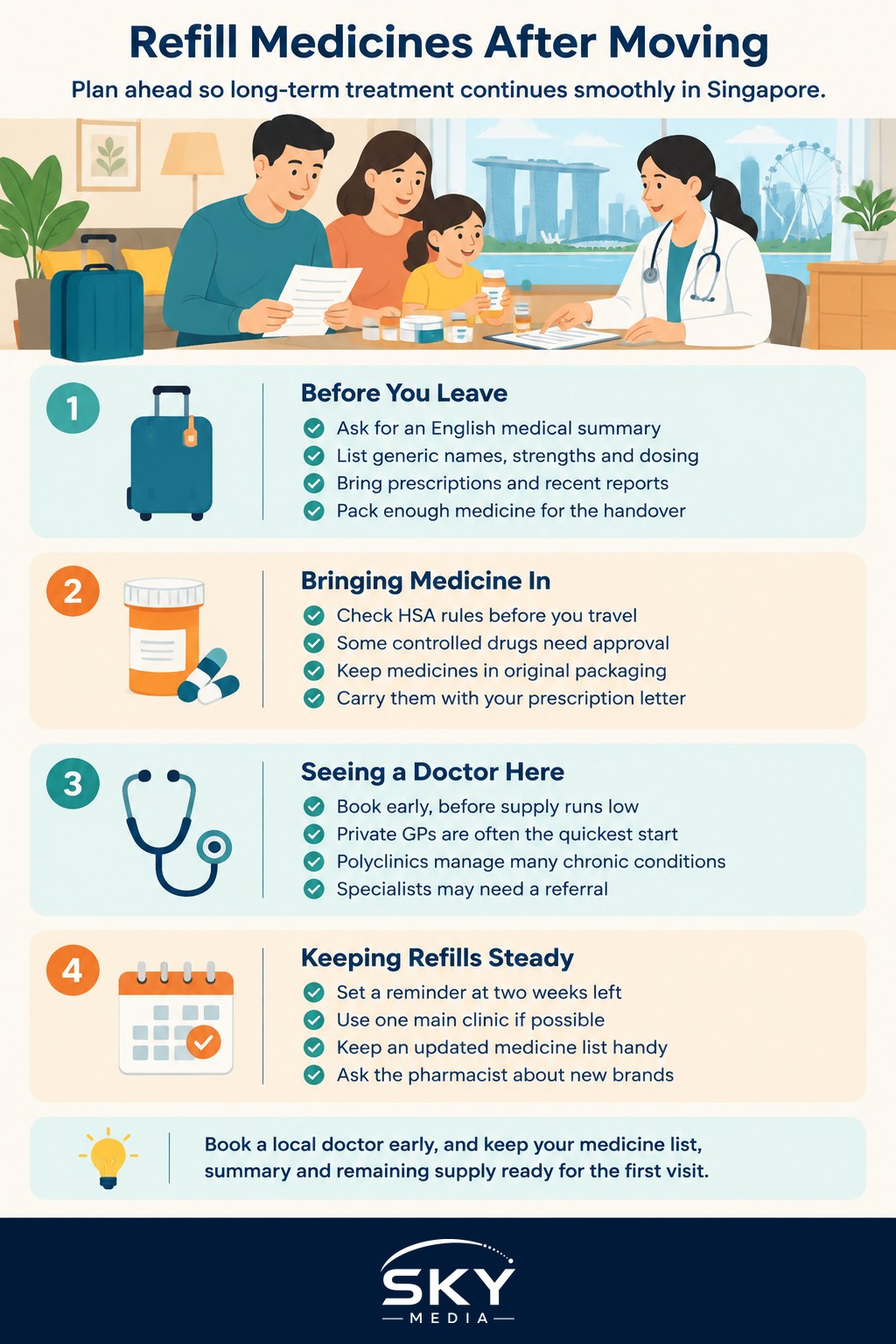
Why Continuity Is the Real Challenge
Most healthcare guides for newcomers explain clinics and insurance in general. The specific problem for people on long-term medication is continuity. A few things make it harder than expected:
- Overseas prescriptions are generally not filled as they are. Pharmacies in Singapore supply prescription-only medicines based on a prescription from a doctor practising here. In most cases you will need to see a local doctor, who assesses you and writes a new prescription.
- Brand names differ. The same active ingredient can be sold under a different brand, in a different strength or as a generic. Your doctor may need to switch you to the locally available version.
- First appointments take time. Registering with a clinic, getting a first slot and sometimes a referral can take longer than people plan for.
- Records may be in another language. A summary only your old doctor can read is of limited help.
The fix is to plan the handover before you leave, not after you land.
Before You Leave: Prepare a Medicine Handover
Ask your current doctor for help several weeks before your move. Try to leave with:
- A written medical summary in English listing your conditions, recent test results and any allergies.
- A list of each medicine with the active ingredient (generic name), strength, how often you take it and how long you have been on it. The generic name matters more than the brand.
- Copies of your prescriptions and, where relevant, recent lab reports or scans.
- Enough supply to bridge the gap until you can see a doctor in Singapore, within what the rules allow you to bring.
If you are moving from mainland China, ask the hospital for an English summary or arrange a certified translation. Singapore doctors may not be able to read Chinese-language records, and handwritten notes are especially hard to interpret.
Bringing medicine into Singapore
Travellers can usually bring personal medicines in limited quantities, but some medicines, such as certain sleeping pills, strong painkillers and other controlled drugs, need prior approval from HSA before you travel. Check the HSA website for the rules that apply to personal medication, including how much you may bring and which items need approval. Carry medicines in their original packaging with your prescription or doctor’s letter, and keep them in your hand luggage.
Your First Weeks in Singapore
Once you arrive, book a doctor’s appointment early, ideally well before your supply runs low. The main options compare like this:
| Option | What it is | Good to know for newcomers |
|---|---|---|
| Private GP clinic | A family doctor in your neighbourhood | Often the quickest first step for a review and new prescription; fees vary by clinic |
| Polyclinic | Government primary care centres run by public healthcare clusters | Manage many chronic conditions; foreigners are usually charged non-subsidised rates, so ask when booking |
| Specialist clinic | Hospital or private specialists | Usually needs a referral from a GP or polyclinic for complex conditions |
| Company or insurer panel clinic | Clinics on your employer’s or insurer’s list | Check whether chronic medication is covered under your plan before you go |
Bring your medical summary, medicine list and remaining medicine packs to the first visit. The doctor can then review your condition, confirm the equivalent local medicine and decide how much to prescribe at a time. Some doctors may want fresh blood tests before continuing treatment, which is normal.
Once your care is set up, ask the clinic how refills work. Many clinics let established patients book a follow-up for a repeat prescription, and some medicines can be dispensed directly at the clinic.
Paying for Long-Term Medicines
Costs depend on your pass, where you are treated and your insurance. A few points to check:
- Employer insurance. Many work pass holders have outpatient cover through their company. Read the policy wording or ask HR whether chronic conditions and long-term medication are included, and whether pre-existing conditions are excluded.
- Personal insurance. If you hold a private plan, check limits on outpatient and chronic medication claims with the insurer.
- Citizens and PRs. Singapore citizens and permanent residents may qualify for subsidies and schemes such as CHAS (Community Health Assist Scheme, which helps with costs at participating GP and dental clinics) and Healthier SG. Eligibility rules change, so check HealthHub or the Ministry of Health website.
- Foreigners on long-term passes. Parents on a Long-Term Visit Pass, and other pass holders who are not citizens or PRs, usually pay non-subsidised rates. Budget for regular clinic visits and medicines.
If you are planning for an older parent, our guides to bringing your parents to Singapore and the Long-Term Visit Pass explain the pass side, including any insurance requirements.
Keeping Your Supply Steady
Once you have a local doctor, build a simple routine so you never run out:
- Set a reminder when you reach roughly two weeks of supply left, so there is time to book a visit.
- Use one main clinic where possible, so your records and medicine history stay in one place.
- Keep an updated medicine list on your phone and a printed copy at home, especially for seniors who may see several doctors.
- Use HealthHub if you are eligible. The HealthHub app and website let many users view health records and some appointment details from public healthcare institutions.
- Plan ahead for trips. If you travel back home, ask your doctor in advance for enough supply to cover the trip and check the rules of the country you are visiting.
- Ask the pharmacist. Pharmacists can explain a new brand, how to take it and what to watch for when switching.
Support for Seniors on Multiple Medicines
Older family members often take several medicines at once, which makes moving riskier. A few extra steps help:
- Use a weekly pill organiser and refill it with a family member present at first.
- Ask the doctor or pharmacist to review all medicines together at the first visit, including supplements and traditional remedies, to check for interactions.
- Write down any side effects after a switch to a local brand and mention them at the next appointment.
- If a parent will need more support over time, look at long-term care options in Singapore early.
Moving countries does not have to interrupt treatment. With an English medical summary, the generic names of each medicine and an early appointment with a local doctor, you can refill a prescription in Singapore smoothly and keep long-term conditions well managed from the first month.
Frequently Asked Questions
What if my medicine runs out before I can see a doctor in Singapore? Do not skip doses or stretch them out. Walk in to a nearby GP clinic and explain your condition, bringing your medicine packs and doctor’s letter. A pharmacist can also advise on next steps, and for urgent symptoms an emergency department is the safest option.
Can I order my regular medicine online from my home country and post it here? This is risky and not recommended, because imported medicines are regulated and parcels can be held at the border. Quality and storage of online sellers cannot be checked either. Ask your Singapore doctor for a local supply, and check import rules with the Health Sciences Authority.
Is it safe to switch to a generic version of my usual tablets? Generics contain the same active ingredient as the brand, so many people switch without trouble, but the decision belongs to your doctor. Tell the doctor your exact medicine name and strength, and report any new side effects afterwards so the dose or choice can be reviewed.
What tests will a new doctor want before continuing my long-term medication? It depends on your condition. Doctors often ask for recent results or repeat blood tests to confirm your treatment is still suitable, for example kidney, sugar or cholesterol checks. Bringing your latest lab reports can reduce repeat testing, but the doctor decides what is needed.
Can the clinic or pharmacy deliver my repeat medicine to my home? Some clinics and pharmacies offer delivery for established patients, which suits elderly parents who find travelling hard. Services, fees and which medicines qualify vary, so ask your clinic when you collect your first prescription whether delivery is available for your regular items.