

Many people assume their life insurance premiums cut their tax bill. When tax filing season opens in March, some go looking for the claim box on myTax Portal, only to find it does not apply to them. That is because life insurance relief in Singapore is tightly linked to your CPF contributions, and most full-time employees already contribute too much CPF to qualify.
This guide explains why most CPF members are shut out, how the $5,000 cap works, which groups can still benefit, and how to claim. It is general information, not tax or financial advice. Relief rules can change with each Budget, so confirm the current conditions on the IRAS website before you file.
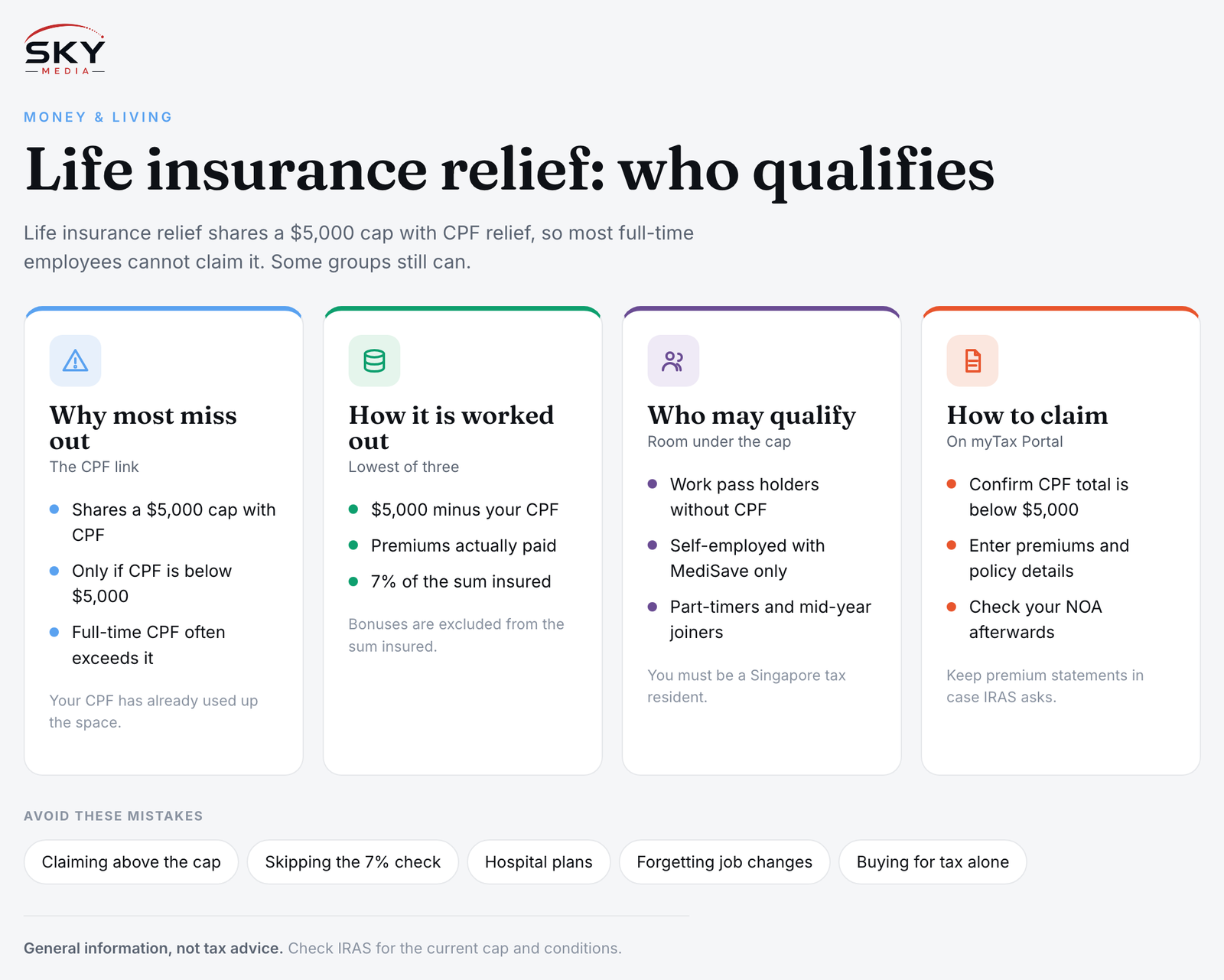
Why Most CPF Members Cannot Claim It
Life insurance relief and CPF relief share the same $5,000 ceiling. The idea is that both are forms of saving and protection, so the government sets a combined limit for them.
Here is the key rule: you can only claim life insurance relief if your total compulsory CPF contributions for the year are less than $5,000. If you are an employee earning a typical full-time salary, your own share of CPF contributions over 12 months will usually exceed $5,000 on its own. Once that happens, there is no room left for life insurance relief.
In other words, it is not that your insurance policy is unsuitable. It is that your CPF has already used up the space. This surprises many people because insurance agents sometimes mention tax relief in general terms without explaining the CPF link.
How the $5,000 Cap Works
If your CPF contributions are below $5,000, IRAS works out your life insurance relief as the lowest of three figures:
- The gap: $5,000 minus your compulsory CPF contributions for the year
- The premiums: the actual life insurance premiums you paid in the year for qualifying policies
- The 7% limit: 7% of the capital sum insured (the amount payable on death), excluding bonuses
So even if you pay large premiums, your relief is limited by both the gap and the 7% rule. A simple illustration: if your CPF contributions were $3,000, the gap is $2,000. If you paid $2,500 in premiums on a policy with a sum assured that makes 7% higher than $2,000, your relief would be $2,000, the smallest of the three.
The figures here reflect the rules IRAS has published in recent years. Check IRAS for the current cap and conditions, since these details can be adjusted.
Who Still Qualifies
The relief is narrow, but several groups can still benefit. The table compares typical situations.
| Your situation | CPF contributions in the year | Likely to qualify? |
|---|---|---|
| Full-time employee on a typical salary | Usually above $5,000 | Unlikely, CPF uses up the cap |
| Foreigner on a work pass who does not contribute to CPF | None | Possibly, if a tax resident with qualifying policies |
| Self-employed person with only MediSave contributions | Often below $5,000 | Possibly, depending on contributions |
| Part-time or lower-income employee | Often below $5,000 | Possibly, with room left under the cap |
| Employee who joined or left work part-way through the year | Lower than a full year | Possibly, if contributions stayed below $5,000 |
Foreign professionals. Employment Pass and S Pass holders generally do not contribute to CPF. If they are Singapore tax residents and hold qualifying life policies, they may have the full gap available, subject to the 7% and premium limits.
Self-employed people. Many self-employed persons contribute only to MediSave, which counts towards the CPF total. If those contributions are below $5,000, there may be room for life insurance relief.
Part-timers and lower-wage workers. Lower salaries mean lower CPF contributions, which can leave space under the cap.
Mid-year joiners and leavers. Someone who started their first job in the second half of the year, or took a long career break, may have contributed less than $5,000 in that year.
You must also be a Singapore tax resident. Non-residents do not get personal reliefs.
Which Policies and Premiums Count
Not every insurance product qualifies. In general terms, the relief covers premiums on:
- Life insurance policies insuring your own life, and in some cases your spouse’s life, as allowed under IRAS rules
- Policies issued by insurers that meet IRAS requirements, typically those operating in Singapore
- Certain deferred annuity premiums, which IRAS treats separately and with their own conditions
Products that are commonly excluded or need checking include pure health or hospitalisation plans, investment-linked components where only part of the premium is for protection, and policies on the lives of children or parents. The rules on whose life can be insured have been updated over the years, so check IRAS for the current position rather than relying on an older article or an agent’s memory.
Ask your insurer for an annual premium statement. It shows the premiums paid in the year and the sum assured, which you need to work out the 7% limit.
How to Claim It on myTax Portal
Life insurance relief is not always automatic. Steps generally look like this:
- Log in to myTax Portal with Singpass during the filing period.
- Check your CPF contributions. If your employer is on the Auto-Inclusion Scheme, your CPF figures are usually pre-filled. Confirm the total is below $5,000.
- Find the life insurance relief section in the reliefs part of your form and enter the premiums paid, along with the policy details requested.
- Keep records. Store your premium statements and policy documents. IRAS may ask for them, and the guidance is generally to keep supporting records for several years.
- Check your Notice of Assessment after filing to confirm the relief was granted at the amount you expected.
If you claimed the relief before, IRAS may carry the claim forward in later years. Check your form each year, because your CPF contributions or policies may have changed, and you should update or remove a claim that no longer applies.
Common Mistakes to Avoid
- Claiming when CPF is already above $5,000. The relief will be disallowed. It is better to leave it blank than to file an incorrect claim.
- Using the full premium without the 7% check. For policies with high premiums relative to the sum assured, the 7% rule often limits the relief.
- Including non-qualifying policies. Hospitalisation plans and policies on other family members may not count.
- Forgetting it after a job change. If you moved from a CPF-contributing job to a non-CPF role, or vice versa, your eligibility may flip.
- Buying insurance for the tax benefit alone. Even for those who qualify, the relief is modest. Choose cover based on your protection needs first.
Keep the Bigger Picture in Mind
For most Singaporeans, the tax angle of life insurance is minor. The real question is whether your cover fits your needs. If you are reviewing your policies this filing season, our guides on life insurance in Singapore and term vs whole life insurance help you weigh the options. Older readers may also find buying insurance after 60 useful.
When in doubt about whether you qualify, check the IRAS life insurance relief page or contact IRAS directly. For questions about what your policy covers, speak to your insurer and refer to your policy wording.
Official sources: IRAS
Further reading: Spouse Relief in Singapore: Who Can Claim It