

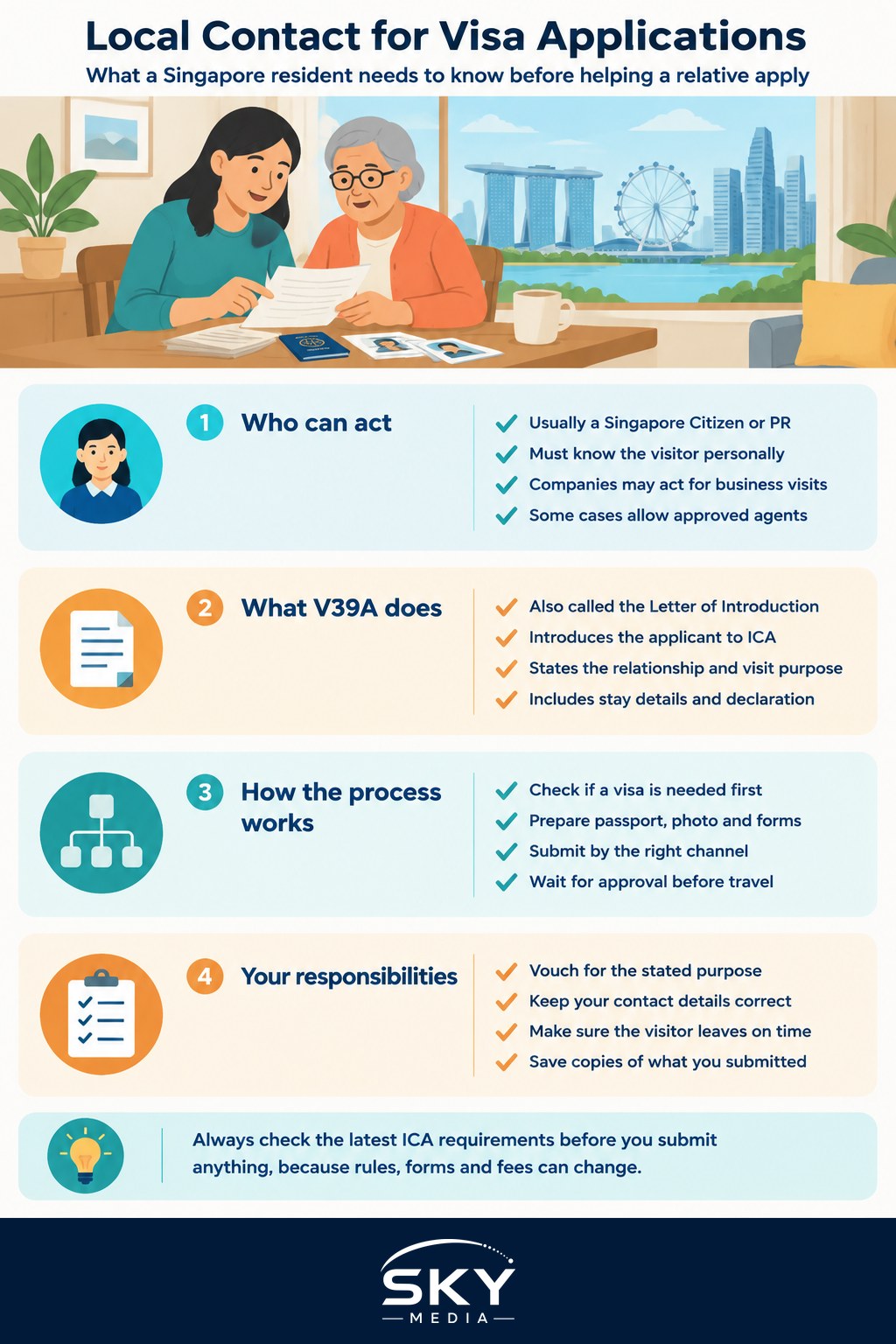
When a parent, sibling or in-law from a visa-required country wants to visit you in Singapore, they usually cannot simply book a flight. Their visa application normally needs someone in Singapore to vouch for them, known as the Singapore visa local contact. If you are a Singapore Citizen or Permanent Resident, that person is often you.
This guide explains who can act as a local contact, what the role involves, what Form V39A is for, and how the process generally works with the Immigration & Checkpoints Authority (ICA), the government agency that handles entry into Singapore. It is general information, not legal or immigration advice. Visa rules, forms and eligibility can change, so always confirm the current requirements on the ICA website before you submit anything.
First, Check Whether Your Relative Needs a Visa at All
Many nationalities can enter Singapore for short visits without a visa. Others, known as visa-required nationals, must have an entry visa approved before they travel. ICA publishes the list of countries whose nationals need a visa, and it is updated from time to time.
It is worth checking carefully before you start, because arrangements change. For example, Singapore and China have had a mutual visa exemption arrangement for short visits by ordinary passport holders since 2024, so many relatives travelling on a Chinese ordinary passport may not need to apply for a visa for a short stay. Conditions such as the permitted length of stay and purpose of visit apply, so read ICA’s current page for your relative’s nationality and passport type.
Also note the difference between this guide and extending a stay. Applying for an entry visa happens before your relative travels. Asking to extend a Short-Term Visit Pass happens after they have arrived, and is a separate process with its own rules.
Who Can Be a Local Contact
ICA’s requirements set out who may act as a local contact. In general, a local contact is:
- A Singapore Citizen or Permanent Resident of the required minimum age, or
- A Singapore-registered company or organisation, typically for business or work-related visits, or
- In some cases, an authorised party such as a strategic partner or authorised visa agent appointed by ICA, usually for applicants abroad.
Work pass holders and other foreigners living in Singapore are generally not able to act as the local contact for a family visit in the same way as a citizen or PR, though rules for specific categories can differ. If you hold a pass, check ICA’s guidance or ask a citizen or PR relative or friend who knows your visitor well.
The local contact should genuinely know the visitor and be able to stand behind the purpose of the trip. Acting as a local contact for someone you do not know, or for a fee, is not a good idea and could have serious consequences.
What Form V39A Is For
Form V39A is commonly referred to as the Letter of Introduction. It is the document in which the local contact introduces the applicant to ICA, states their relationship, and confirms the purpose and details of the visit.
In practice, the form usually covers:
- The local contact’s own particulars and contact details
- The applicant’s particulars and their relationship to the local contact
- The purpose of the visit and intended length of stay
- Where the visitor will stay in Singapore
- A declaration by the local contact
By signing, the local contact gives an undertaking about the visitor. ICA’s wording sets out exactly what you are agreeing to, and it typically includes responsibilities around the visitor’s stay, conduct and departure. Read the declaration in full before signing. Whether V39A is needed, and in what format, depends on the applicant’s nationality and the channel used to apply, so check ICA’s current instructions rather than relying on an old copy.
How the Application Process Generally Works
The exact route depends on the applicant’s nationality and circumstances. ICA describes the available channels on its website. A typical family-visit application looks like this:
- Confirm the visa requirement on ICA’s website for your relative’s nationality and passport type.
- Gather the applicant’s documents, which commonly include a passport valid for the required period, a recent photograph meeting ICA’s specifications, and ICA’s application form for the visitor.
- Complete the local contact documents, including Form V39A where required, with your particulars and declaration.
- Submit through the correct channel. Depending on the case, this may be an online submission by the local contact, or a submission through a Singapore overseas mission or an authorised visa agent in the applicant’s country.
- Pay the applicable fee through the stated method. Fees are set by ICA and may change, so check the current amount on the website.
- Track the outcome and, if approved, make sure your relative prints or saves the visa as instructed and carries it when travelling.
Processing time varies. Apply well ahead of the planned trip, especially around festive periods and school holidays, and avoid buying non-refundable tickets before approval.
The table below summarises who does what at each stage.
| Stage | Local contact (you) | Visiting relative |
|---|---|---|
| Before applying | Check ICA eligibility and visa list, confirm your own eligibility | Check passport validity, gather personal documents |
| Preparing documents | Complete and sign Form V39A where required | Complete the applicant form, provide photo and passport copy |
| Submission | Submit online or provide documents to the relative or agent | Submit via overseas mission or authorised agent where required |
| After approval | Keep records, stay contactable, help with arrival plans | Carry the visa and supporting documents when travelling |
| During the visit | Ensure the visit stays within its stated purpose | Follow the conditions of the pass and leave on time |
Your Responsibilities as a Local Contact
Acting as a local contact is more than a signature. Before agreeing, consider the following.
You vouch for the purpose. If you state the visit is a family holiday, it should be exactly that. A Short-Term Visit Pass does not allow the holder to work in Singapore. If your relative intends to work, study or stay long term, a different pass with its own application process applies.
You may be contacted. ICA may reach out to you during or after the application. Make sure your contact details are correct.
Departure matters. Your relative must leave by the date on their visit pass unless an extension is approved. Overstaying is an offence in Singapore and can affect both the visitor and, depending on the undertaking given, the local contact.
Accuracy is essential. Giving false information in an immigration application is an offence. Double-check names, passport numbers and dates against the passport itself.
Keep copies. Save a copy of everything you submitted and any approval documents, in case questions come up later.
If the Application Is Refused
ICA does not always give reasons for refusing a visa. If an application is unsuccessful, review whether the documents were complete and consistent, and read ICA’s guidance on reapplying or appealing. Some families find that a clearer statement of purpose, accurate supporting documents, or applying through the correct channel helps. Avoid any agent or online service promising a guaranteed approval; no legitimate party can do that.
Planning a Good Visit
Once the visa is approved, the rest is the fun part. Help your relative check their passport validity, arrange travel insurance, and agree on where they will stay. If they are coming to meet grandchildren for the first time, prepare a few simple Chinese family terms together; our guide on what to call your relatives is handy for mixed-language families. And if your own family plans a trip abroad afterwards, see our guide to applying for travel visas from Singapore and the list of visa-free countries for Singaporeans.
For forms, eligibility, fees and processing details, the ICA website is the authoritative source. Check it each time you apply, as requirements are updated.
Frequently Asked Questions
Do I need to be in Singapore while my relative is visiting? Not necessarily for the visit itself, but you should stay contactable because ICA may reach out during or after the application, and your declaration covers the visitor’s stay and departure. Make sure the contact details you gave are correct and that someone can host or assist your relative.
Can my relative stay at a hotel instead of with me? Yes, visitors can stay in a hotel, although the application usually asks where they will stay, so give accurate details. The local contact’s undertaking still concerns the visit and the visitor’s departure. Check ICA’s current form for how accommodation should be stated.
If my relative does not need a visa, do I still need to submit anything? Usually no entry visa or local contact form is needed for visa-exempt nationalities on short visits, but entry conditions such as permitted stay and purpose still apply. Check ICA’s page for your relative’s nationality and passport type, and carry proof of return travel and accommodation.
What if my parents want to stay longer than a short visit? A Short-Term Visit Pass is for short stays, so a longer stay needs a different arrangement. Extending after arrival is a separate process, and long-term options have their own eligibility rules. Check with ICA before booking tickets and avoid any agent promising guaranteed approval.
Can I be the local contact for a friend or fiance, not only family? Eligible Singapore Citizens and PRs can generally act as a local contact only for someone they genuinely know and can vouch for. The purpose of the trip must match what you declare. Never act for a stranger or in exchange for payment. Confirm current rules on the ICA website.
Official sources: ICA
Further reading: The Visa-Free Transit Facility for Travellers Passing Through Singapore