

Most people picture Singapore’s nature as rainforest trails and reservoir loops, but some of the calmest walks on the island run through mangroves. A mangrove walk in Singapore is usually short, mostly flat and built on a raised boardwalk, which makes it one of the easiest ways to see wildlife up close without a long hike.
This guide focuses on the mangrove habitat itself: what makes it special, which kinds of short walks suit different people, what to look for, and how tides and timing shape what you see.
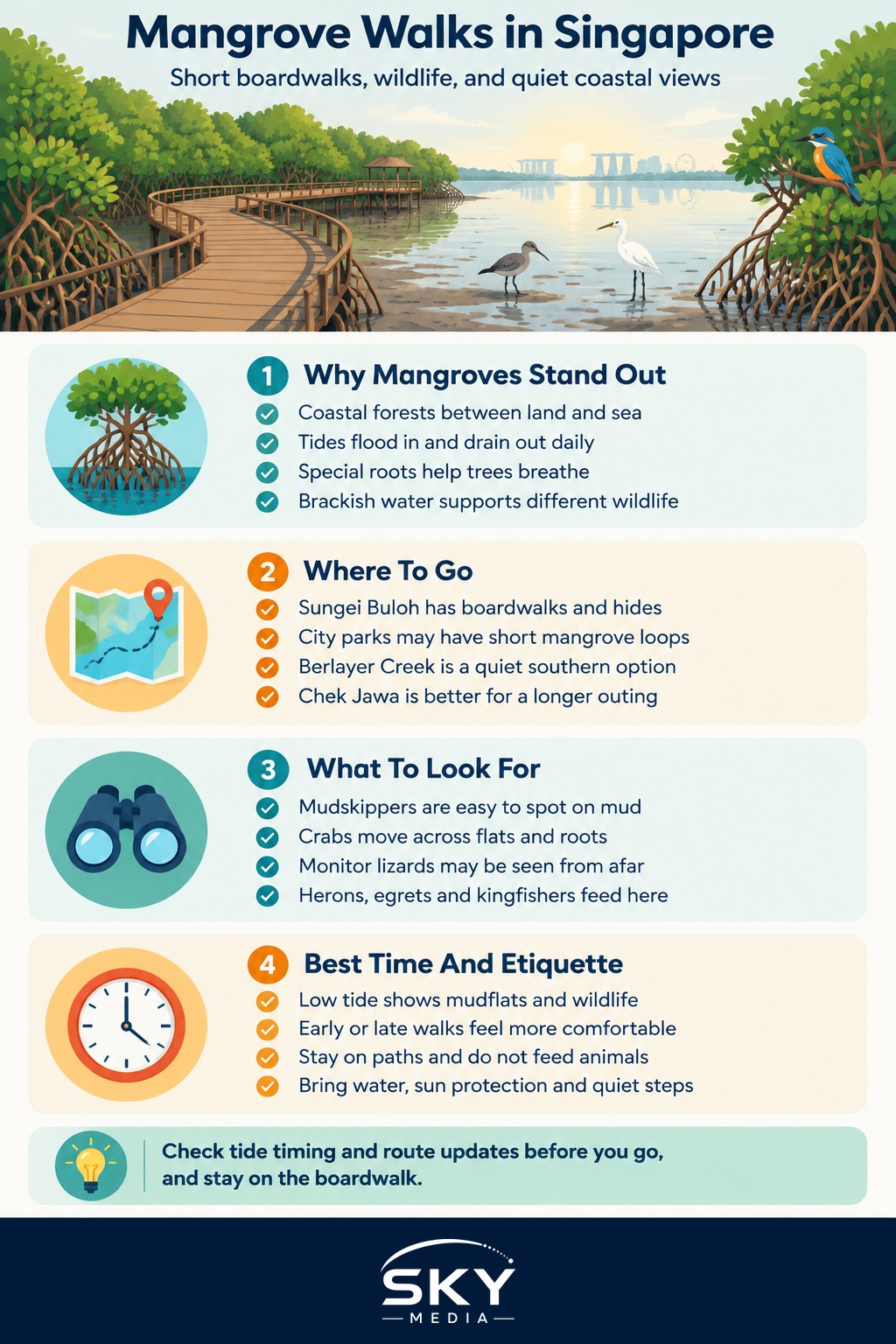
What Makes a Mangrove Different From Other Nature Spots
Mangroves are coastal forests that grow in the zone between land and sea. Twice a day, the tide floods in and drains out, so the plants and animals here have adapted to salt water, soft mud and constant change.
A few features you will notice on almost any mangrove boardwalk:
- Unusual roots. Some trees send up pencil-like breathing roots (pneumatophores) through the mud. Others prop themselves up on arching stilt roots. These are not decoration: they help the trees take in air in waterlogged ground.
- Mudflats. At low tide, wide stretches of grey mud appear. This is where much of the visible wildlife activity happens.
- Brackish water. The water is a mix of fresh and salt, so the creatures you see are different from those in a reservoir or a forest stream.
Singapore once had far more mangrove cover along its coasts. What remains is protected and managed, largely by NParks (National Parks Board), and it plays a role in shoreline protection and carbon storage. If you want the bigger picture on why these patches matter, our guide to coastal and mangrove conservation in Singapore explains the background.
Short, Accessible Mangrove Walks to Try
You do not need hiking gear for most mangrove walks. Many are boardwalk loops attached to larger parks, with toilets and shelters nearby. Here are the main types of places you can visit, described generally so you can choose the right one for your group.
Wetland reserves in the northwest. Sungei Buloh Wetland Reserve is the best-known mangrove destination in Singapore. It has boardwalks through mangrove forest, hides overlooking mudflats and a visitor centre. Check the NParks website for current opening arrangements, any visitor registration requirements and which routes are open.
Mangrove boardwalks inside city parks. Some regular parks include a stretch of mangrove with a short boardwalk, so you can combine a family picnic or cycle with a short nature loop. Our Pasir Ris Park visitor guide covers one of the easiest examples in the east, where the mangrove section sits alongside the beach and playgrounds.
Mangrove creeks in the south. Berlayer Creek, linked to Labrador Nature Reserve, is one of the few remaining mangrove areas along the southern coast. It suits a quick, quiet walk near the city.
Island boardwalks. Chek Jawa on Pulau Ubin has boardwalks that pass through mangroves and out over the shore. Getting there takes more planning because you need to cross to the island first, so treat it as a half-day or full-day outing rather than a quick walk.
Routes, facilities and access can change because of maintenance or habitat works, so always check the NParks website or the park’s notice boards before you set out.
Choosing the Right Mangrove Walk for Your Group
The best mangrove walk depends on who is coming and how much time you have. This comparison can help you narrow it down.
| Type of walk | Best for | What to expect | Plan ahead for |
|---|---|---|---|
| Wetland reserve boardwalks | Wildlife lovers, photographers, curious kids | Longer network of boardwalks, hides and lookout points | Current opening arrangements and any registration on the NParks site |
| Mangrove section in a city park | Families, casual walkers, first-timers | A short loop next to playgrounds, picnic areas and toilets | Weekend crowds and finding shade after the walk |
| Southern mangrove creek | Office workers, quick weekday visits | A compact, quiet trail close to the city | Combining it with nearby nature reserve paths |
| Island boardwalk | Adventurous walkers, older kids, day-trippers | Mangroves plus open shoreline, more remote feel | Travel time to the island, tide timing and return transport |
If someone in your group uses a wheelchair or pushes a pram, look for parks that describe their boardwalks as accessible and ask NParks if you are unsure. Some boardwalks have steps or narrow sections.
What Wildlife to Look For on a Mangrove Walk
Part of the fun is that mangrove wildlife is often active right in front of you. Walk slowly, stop often and look down as much as up.
- Mudskippers. These fish spend much of their time out of water, hopping across the mud on their fins. They are one of the easiest mangrove animals to spot.
- Crabs. Fiddler crabs, with one oversized claw on the males, wave across the mudflats. Tree-climbing crabs may be seen on roots and trunks.
- Monitor lizards. Large lizards are common in some mangroves. Admire them from a distance and do not approach.
- Waterbirds. Herons, egrets and kingfishers hunt along the water’s edge. In certain months, migratory shorebirds also use Singapore’s mudflats as a resting point.
Timing Your Visit: Tides, Heat and Light
Mangroves look different depending on the tide.
- Low tide exposes the mudflats, which is when mudskippers and crabs are most visible and birds come to feed.
- High tide fills the channels, so you see more water, reflections and possibly fish, but less of the mud life.
You can check tide information from official sources such as the Maritime and Port Authority of Singapore (MPA) before you go.
Heat matters too. Mangroves can feel humid and still, especially in the afternoon. Early morning or late afternoon walks are usually more comfortable, and the softer light is better for photos and views across the water.
Safety and Etiquette on the Boardwalk
Mangroves are delicate habitats, and the rules are there to protect both you and the wildlife.
- Stay on the boardwalk and marked paths. The mud can be deep and slippery, and stepping off damages roots and burrows.
- Do not feed or touch animals. This includes monkeys, monitor lizards and crabs. Feeding wildlife is against NParks rules and harms their natural behaviour.
- Bring water and sun protection. A hat, a light long-sleeved top and insect repellent make the walk much more pleasant.
- Keep noise down. Quiet walkers see far more wildlife than loud groups.
- Watch children near railings and edges, especially on raised sections over water.
- Take your litter home.
- Follow any closures. If a section is closed for repairs or habitat recovery, respect the signs.
If thunder or lightning starts, leave the open boardwalk and head for shelter. Exposed coastal areas are not a safe place to wait out a storm.
Making the Most of the Quiet Views
What many people remember from a mangrove walk is not one animal but the stillness. Bring a small pair of binoculars if you have them, pause at lookout points and give your eyes time to adjust to movement in the roots. If you bring a camera, our guide to wildlife photography in Singapore covers ethics such as keeping your distance.
A mangrove walk is a simple, low-cost way to slow down, and because most routes are short, it is easy to fit one into a weekend morning. Start with a park boardwalk near you, check the tide, and see how much life you can spot in half an hour.
Frequently Asked Questions
What is the easiest mangrove walk for a family with a pram? A mangrove section inside a city park is usually easiest, as it is a short loop next to playgrounds, picnic areas and toilets. Look for parks that describe their boardwalks as accessible and ask NParks if unsure, since some boardwalks have steps or narrow sections.
What are the strange roots sticking out of the mud? They are breathing roots, called pneumatophores, and arching stilt roots. They help mangrove trees take in air in waterlogged ground, so they are not decoration. Do not step off the boardwalk to touch them, as that damages roots and burrows.
Is it safe to approach a monitor lizard on the boardwalk? No. Large lizards are common in some mangroves, so admire them from a distance and do not approach, feed or touch them. Feeding wildlife is against NParks rules and harms natural behaviour. If one is on the path, wait quietly or turn back.
Where can I check the tide before a mangrove walk? Tide information is available from official sources such as the Maritime and Port Authority of Singapore (MPA). Low tide exposes mudflats, when mudskippers and crabs are easiest to spot, while high tide fills the channels with water and reflections.
How much time should I plan for a mangrove walk? Most boardwalk routes are short, so a park mangrove can fit into half an hour or a weekend morning. Wetland reserves have longer networks, and an island site such as Chek Jawa needs a half-day or full-day outing because you must cross to the island first.
Further reading: Berlayer Creek Mangrove Trail: A Visitor Guide · Singapore Lighthouse Walks and Coastal Spots to Explore