

If you are a Singapore Citizen or Permanent Resident (PR) planning to marry work permit holder Singapore partner, there is one step many couples do not know about until late in their planning: approval from the Ministry of Manpower (MOM). A Work Permit carries conditions, and one of them concerns marriage to a Singaporean or PR. Getting this step right protects your partner’s job and their ability to stay and work in Singapore.
This guide explains why approval is needed, what the process generally involves and how it fits around your Registry of Marriages (ROM) plans. It is general information, not legal advice. Rules can change, so always confirm current requirements on the MOM website before you act.
Why MOM Approval Is Needed Before the Wedding
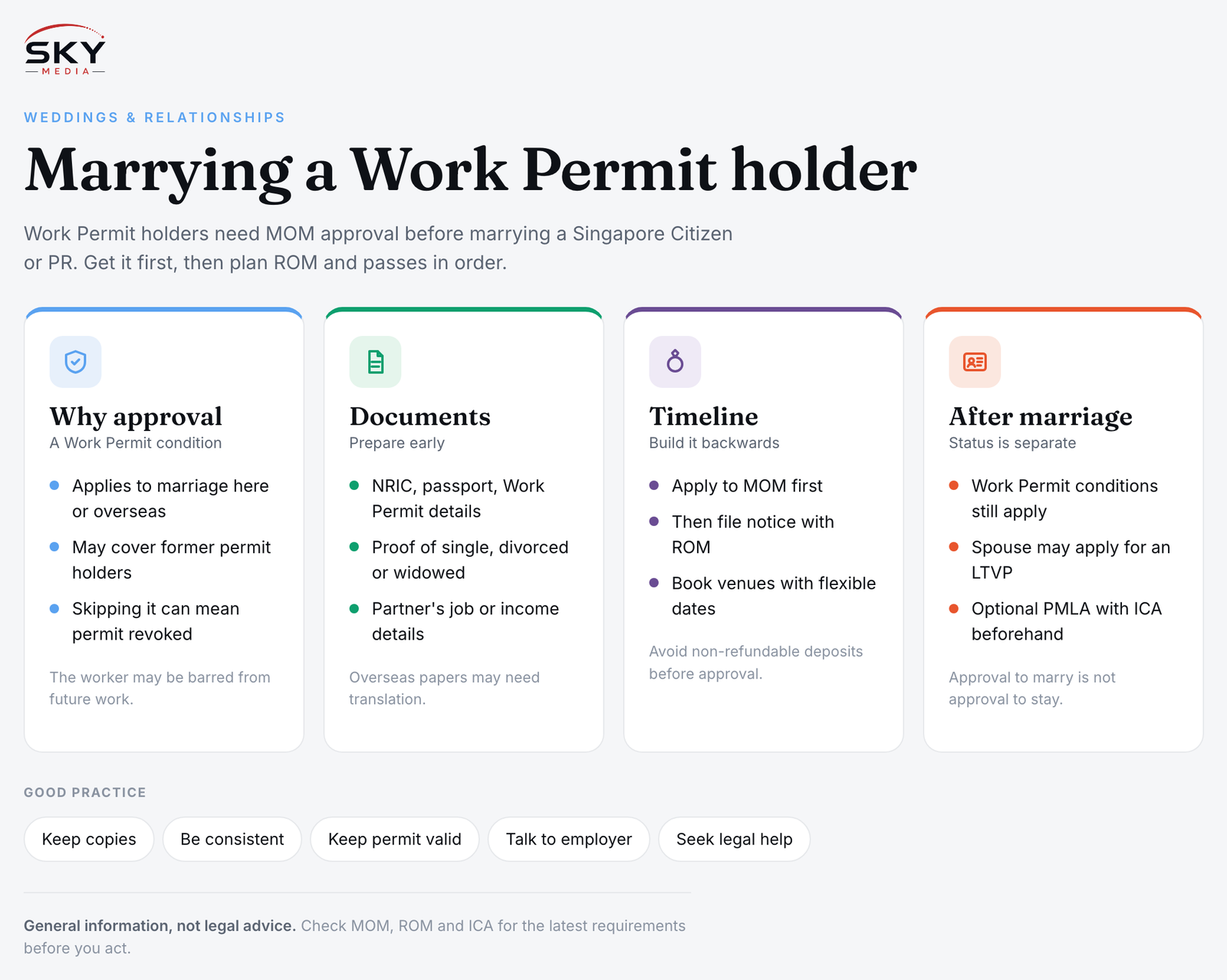
Work Permit holders, including migrant domestic workers, are subject to conditions set by MOM. These conditions include a requirement to obtain MOM’s approval before marrying a Singapore Citizen or PR. According to MOM, this applies whether the marriage takes place in Singapore or overseas, and it can also apply to people who previously held a Work Permit. Check MOM’s page on this topic to see exactly who it covers in your situation.
The consequences of skipping the step are serious. MOM states that marrying without approval breaches the Work Permit conditions, and the worker may have their permit revoked and may be barred from working in Singapore in future. For a couple building a life together, that is a risk worth avoiding entirely by applying first.
It helps to see this as a checkpoint, not a judgement on your relationship. The approval process lets the authorities consider the application in line with their policies, and it gives you a clear, documented path before you commit to wedding dates and deposits.
Who Applies and How the Process Generally Works
MOM publishes an application process for Work Permit holders who wish to marry a Singapore Citizen or PR. In broad terms, couples should expect the following flow, though the exact steps, forms and channels are set by MOM and may change.
- Read MOM’s current guidance. Start on the MOM website and search for marriage approval for Work Permit holders. Note who submits the application and how it is submitted.
- Inform the employer as needed. The employer may need to be aware or involved, depending on MOM’s current process. Ask MOM or check the guidance if you are unsure.
- Gather documents for both partners (see the next section).
- Submit the application through the channel MOM specifies and keep a copy of everything you send.
- Wait for the outcome. Do not book ROM or a wedding venue on a non-refundable basis until you have a decision. MOM’s site will indicate expected processing information, which can vary.
- Proceed with marriage registration only after approval, keeping the approval letter safe for later use.
Here is how the main stages compare and what each involves.
| Stage | Who is involved | What usually happens |
|---|---|---|
| MOM marriage approval | Work Permit holder, Singaporean or PR partner, MOM | Application with documents, MOM assesses and issues an outcome |
| ICA Pre-Marriage LTVP Assessment (optional) | Couple, ICA | Assessment of the foreign partner’s eligibility for a Long-Term Visit Pass |
| Marriage registration at ROM | Couple, witnesses, ROM | Notice of marriage filed online, then solemnisation |
| Post-marriage pass application | Couple, sponsor, ICA or MOM | Apply for the appropriate pass for the foreign spouse |
Documents You Are Likely to Need
MOM sets the document list, so treat this as a preparation checklist rather than an official list. Couples are commonly asked for:
- Identity documents for both partners, such as the Singaporean’s NRIC and the Work Permit holder’s passport and Work Permit card details.
- Proof of marital status, for example a document showing the foreign partner is single, divorced or widowed. Documents from overseas may need certification or translation.
- Divorce or death certificates if either partner was previously married.
- Information about the relationship, such as how and when you met.
- Details of the Singaporean or PR partner’s circumstances, such as employment or income, which help show the household’s ability to support itself.
If any document is not in English, plan for an official translation. Getting foreign certificates issued, legalised or translated can take longer than expected, so start early. If you are unsure whether a document is acceptable, ask MOM before submitting rather than risking a delay.
Fitting It Around ROM and Your Wedding Plans
Couples often have an ideal date in mind, sometimes timed around Chinese New Year or another auspicious period. Because the MOM approval must come first, build your timeline backwards.
- Apply to MOM first. Allow a generous buffer for processing and for any requests for more documents.
- Then file your notice of marriage with ROM. ROM has its own rules on notice periods and documents, and it may ask to see evidence of approval where a party is a Work Permit holder. Check the ROM website for current requirements.
- Book venues flexibly. If you must put down deposits early, ask about date-change terms.
- Plan for the customary side too. If you are holding a tea ceremony or banquet, the legal marriage date and the celebration date can be different. Many couples register first and celebrate later, or the other way around.
If your partner is also Malaysian or you are considering registering overseas, MOM’s approval requirement can still apply. See our guide on marrying a Malaysian partner for how ROM in Singapore compares with registration in Malaysia, and our broader guide to marrying a foreigner in Singapore.
Thinking Ahead: Your Partner’s Status After Marriage
Approval to marry is not the same as approval to stay. After the wedding, your spouse’s immigration and employment status depends on separate rules.
- Their Work Permit. Marriage does not automatically change your partner’s Work Permit. They remain bound by its conditions, including working only for the employer and in the occupation stated. Check with MOM whether any update is needed after marriage.
- Long-Term Visit Pass (LTVP). Foreign spouses of Singaporeans may apply for an LTVP through the Immigration & Checkpoints Authority (ICA). Eligibility is assessed case by case.
- Pre-Marriage Long-Term Visit Pass Assessment (PMLA). ICA offers this optional assessment so couples can get an indication of the foreign partner’s LTVP eligibility before marrying. Many couples find it useful for planning. Check ICA’s website for the current process.
- Working on an LTVP. Spouses on certain passes may need separate permission or a work pass to work. Requirements are set by MOM and can change, so check before your partner changes jobs or status.
Practical Tips for Couples
- Keep copies of everything, including the submission confirmation and approval letter.
- Be truthful and consistent. Inconsistent information across MOM, ROM and ICA applications can cause delays or worse.
- Look after the Work Permit essentials. Your partner’s permit must stay valid throughout. Our guide to Work Permit eligibility and conditions explains the main rules.
- Talk openly with the employer. Good communication avoids surprises, especially if documents or time off are needed.
- Seek proper help if your case is complex. Previous marriages abroad, children from earlier relationships or past immigration issues may benefit from advice from a qualified lawyer. MOM and ICA can also clarify their own procedures.
Marrying someone you love should feel joyful, not uncertain. By getting MOM approval first, then handling ROM and the pass applications in order, you give your marriage the strongest possible start in Singapore.
Official sources: Ministry of Manpower (MOM)
Further reading: Getting Married Under 21 in Singapore: Consent and Requirements