

If you have browsed HDB listings or a BTO launch, you have probably seen towns sorted into two groups. The mature vs non-mature estate singapore distinction used to shape where flats were launched, how they were priced, and how strong the competition was. It is a useful lens for understanding a neighbourhood, even as HDB moves towards its newer classification of Standard, Plus and Prime flats. Knowing what each label really means helps you weigh convenience against cost and pick a home that fits your life rather than just a postcode.
What the terms actually mean
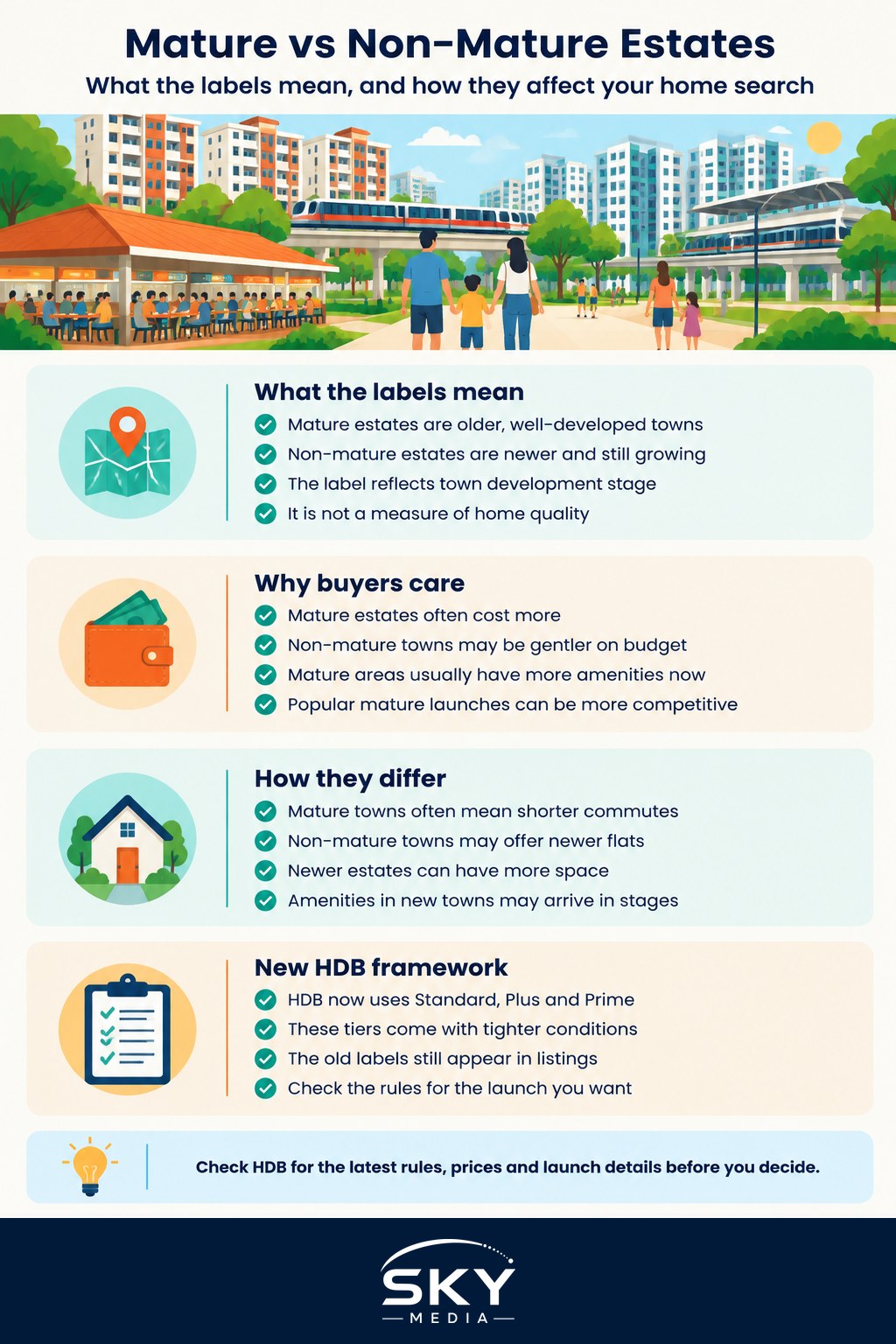
A mature estate is simply a town that has been developed for longer, roughly two decades or more. Over the years it has filled in with amenities: MRT stations, bus interchanges, hawker centres, wet markets, malls, clinics, schools, parks and libraries. Places like Bishan, Toa Payoh, Queenstown, Bedok and Ang Mo Kio are commonly thought of as mature. Everything you need tends to be within a short walk or a couple of stops away, and the trees are tall.
A non-mature estate is a newer town still growing into itself. Punggol, Sengkang, Tengah, Sembawang and parts of Woodlands and Jurong have been developed more recently. Amenities are arriving in stages, so you may live near a brand-new flat while the promised mall, MRT extension or school is still a few years from opening. The trade-off is space, newer infrastructure, and often a more affordable entry price.
It helps to remember this was never a rule about quality. Both categories contain excellent flats and lovely surroundings. The label describes the stage of a town’s development, not how good a home there will be.
Why it matters for buyers
The practical differences show up in a few places:
- Price. Mature estates usually command higher resale prices and BTO prices because demand is strong and land is central. Non-mature towns tend to be gentler on the budget. Actual prices move constantly, so check current transactions rather than relying on old figures.
- Amenities and commute. In a mature estate, the convenience is here today. In a non-mature one, you may be buying into a plan, so read up on what is confirmed and when it is due.
- Competition for BTO flats. Popular mature-town launches have historically drawn heavier application rates, which affects your chances at ballot. If you are weighing this, our guide on how HDB BTO balloting works explains the odds and how queue numbers are drawn.
- Space and layout. Newer developments sometimes offer different unit mixes and greener masterplanning, which can appeal to young families.
None of these should be read as a simple better-or-worse verdict. A shorter commute in a mature town has real value; so does a larger, newer flat in a growing one. What matters is which trade-off suits your household.
How this fits the new BTO framework
From 2024, HDB began classifying new flats as Standard, Plus or Prime instead of only mature or non-mature, with tighter conditions such as longer minimum occupation periods and resale restrictions on the Plus and Prime tiers. The old mature and non-mature language still appears widely in resale listings and everyday conversation, so it remains worth understanding, but for new launches the newer tiers are what determine the rules you will live with. Our explainer on the new BTO Standard, Plus and Prime framework walks through what each tier means for eligibility and future selling.
If you are still deciding on an area more broadly, choosing the right neighbourhood can help you rank what matters most, from schools to green space to your daily journey to work.
Making your decision
Start with your non-negotiables. If you rely on a short commute, care for elderly parents nearby, or want your children in a settled school catchment, a mature estate may earn its premium. If you value a newer flat, more room, and a lower entry price, and you can be patient while amenities arrive, a non-mature town can be excellent value. Visit at different times of day, test the actual journey to work, and look past the label to the specific block and unit.
For the most current details on eligibility, launch locations, pricing and the Standard, Plus and Prime conditions, check HDB directly, since schemes and figures are updated over time. This article is general information to help you frame the choice, not financial advice, so speak with a qualified professional before committing to a purchase that stretches your budget.
Frequently Asked Questions
Is a mature estate flat a better investment than one in a new town? Not automatically. Mature estates often hold strong demand because of established amenities, but a newer town can offer a lower entry price and room to grow as facilities arrive. Past trends do not guarantee future prices, so check recent transactions and speak to a licensed adviser.
Can I still find a reasonably priced flat in a mature estate? Yes, it is possible, especially in resale where older and smaller units may cost less than newer ones nearby. Remaining lease, floor level and condition all affect price. Compare recent transactions for the specific block rather than assuming the whole town is expensive.
How do I check what amenities are really coming to a newer town? Look at official sources rather than agent promises. HDB’s launch information and the Urban Redevelopment Authority’s plans show what is confirmed, and timelines can shift. Visit the site, and check how far the nearest working MRT station, shops and school are today.
Does the estate label affect my CPF housing grant or loan? The label itself is not what decides your grant or loan. Eligibility depends on your household, income and the flat type, and for new launches HDB’s newer flat classification also sets conditions. Confirm the current grant rules and your loan limit with HDB and your bank.
What should young families weigh most when choosing between the two? Think about daily life first: commute, childcare and school access, and whether grandparents live nearby. A mature estate offers convenience now, while a newer town may offer more space for the money and more greenery. Visiting at different times of day shows what living there is really like.
Official sources: HDB