

Good memory techniques for studying are not about being born with a sharp memory. They are habits and methods that make information stick, so you spend less time rereading and more time actually remembering. Most students in Singapore lose marks not because they never saw the material, but because they only met it once and hoped it would stay. The methods below help you learn things properly the first few times, then hold on to them right through to the exam.
None of this asks for extra hours. In many cases it asks for fewer, because remembering well the first time saves you from relearning the same chapter three times. Take the ideas that fit your subjects and build them into your normal revision.
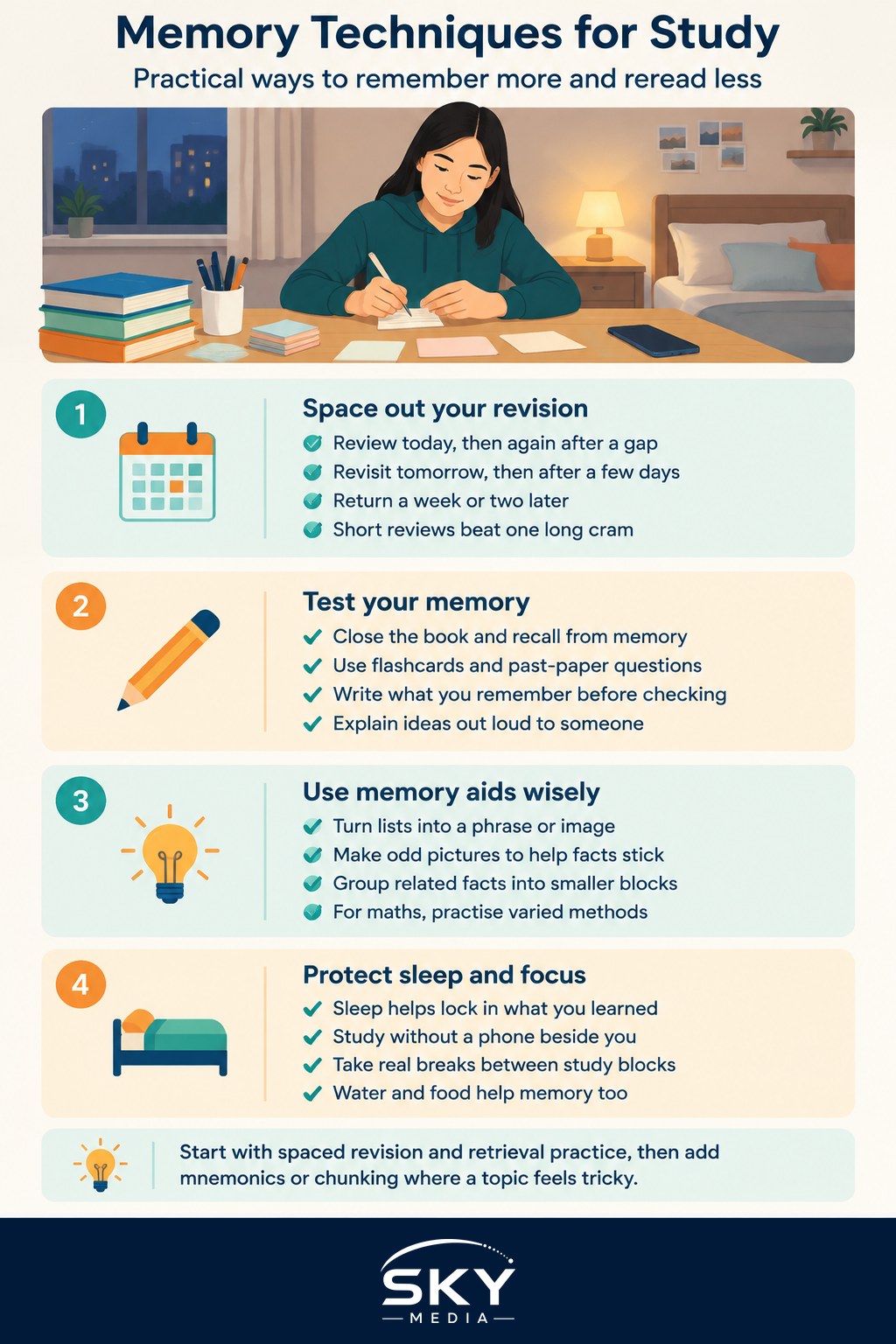
Space Your Revision Instead of Cramming
Your brain treats information you revisit as important, and lets go of what it meets only once. Cramming the night before an exam works against this. You force a lot in quickly, then most of it fades within days because your brain never got the signal that it mattered.
Spaced repetition flips this around. You review a topic, then come back to it after a gap, then again after a longer gap. Each return, just as the memory starts to fade, tells your brain to keep it. A simple pattern looks like this:
- Learn a topic properly today.
- Revisit it briefly tomorrow.
- Come back to it after a few days.
- Review it again a week or two later.
The reviews get shorter each time, so this is not more work overall. You might spend ten minutes on a topic you learned last week rather than an hour relearning it in a panic later. For a long syllabus, a small stack of topics revisited on rotation keeps everything warm without any single marathon session. This is why steady weekly revision beats a frantic finish, and it protects your sleep in the run-up to the O levels or A levels, when late nights hurt more than they help.
Test Yourself With Retrieval Practice
Rereading your notes feels productive because the words look familiar. That familiarity fools you into thinking you know the material when you can only recognise it, not recall it. In the exam, nobody shows you the notes and asks if they look familiar. You have to pull the answer out of an empty page.
Retrieval practice trains exactly that skill. Instead of rereading, you close the book and try to recall the material from memory. The struggle to remember is the part that strengthens the memory, so a slightly hard recall is doing more good than a comfortable reread.
Practical ways to build it in:
- Cover your notes and write down everything you remember about a topic, then check what you missed.
- Make simple question-and-answer flashcards and test yourself, keeping the ones you get wrong for another round.
- Do past-paper questions from memory before checking the mark scheme.
- Explain a concept out loud to a family member or an empty room, as if teaching it.
The gaps you find are the point, not a failure. Every blank you notice now is a mark you protect later. Combine this with spacing, and you have the two most reliable memory techniques for studying that exist: recall a topic from memory, leave a gap, then recall it again.
Use Mnemonics and Chunking for Tricky Lists
Some material is just awkward to hold, like a list of steps, a set of dates, or the parts of a process. Here, memory tricks earn their keep. They do not replace understanding, but they give slippery facts a handle to grip.
Mnemonics turn information into something more memorable. A silly sentence where each word starts with the first letter of an item, a made-up word from initials, or a vivid mental picture all work because your brain remembers the strange and the visual far better than a plain list. The odder the image, the better it sticks.
Chunking groups small pieces into larger, meaningful blocks. A long string of separate facts is hard to hold, but broken into three or four themed groups it becomes manageable. You already do this with phone numbers, reading them in blocks rather than as eight loose digits. Apply the same idea to a science process by grouping the stages, or to an essay plan by clustering points under a few main headings.
For subjects like maths, the memory work is slightly different. You are remembering methods and patterns, not lines of text, so the best approach is working through varied problems until the steps feel automatic. Understanding why a method works also makes it far easier to recall than a rule you only memorised.
Let Sleep and Focus Do the Heavy Lifting
Memory is not only built at the desk. A large part of it is settled while you sleep, when your brain sorts through the day and moves what you practised into longer-term storage. A student who revises well but sleeps badly is quietly undoing the work. Late-night cramming that costs you rest often removes more than it adds, especially in the final week before a paper.
Focus matters just as much as hours. An hour of real attention beats three hours with a phone buzzing beside you. Every time a notification pulls you away, your brain has to reload the topic, and the memory you form is weaker for it. Put the phone in another room, work in reasonable stretches, then take a proper break to move and rest your eyes.
A few conditions help memory form well:
- Enough sleep, especially in the nights around learning something new.
- Focused sessions without a phone within reach.
- Real breaks between stretches of study, not a slide into a screen.
- Water and food, since a tired, hungry brain remembers poorly.
None of this is dramatic, but together it decides whether your revision actually lands.
Match the Method to the Task
Different material rewards different techniques, so it helps to be deliberate rather than using one habit for everything. Here is how the main methods compare, so you can pick the right tool for what you are trying to remember.
| Method | Best for | How you use it | Why it works |
|---|---|---|---|
| Spaced repetition | Any topic across a long syllabus | Review, leave a gap, review again | Signals the memory is worth keeping |
| Retrieval practice | Facts, definitions, exam answers | Recall from a blank page, then check | Trains true recall, not recognition |
| Mnemonics | Lists, steps, sequences, dates | Turn items into a phrase or image | Gives dry facts a memorable hook |
| Chunking | Large sets of related facts | Group items into a few themed blocks | Fewer, bigger pieces are easier to hold |
| Sleep and focus | Locking in everything you learn | Rest well, study without distraction | Memory is consolidated during rest |
Start with spacing and retrieval as your backbone, since they do the most for the least effort. Add mnemonics and chunking where a topic is genuinely fiddly. Protect sleep and focus throughout, because they quietly decide how much of your effort survives. Build these into ordinary weeks rather than saving them for the exam season, and remembering slowly stops feeling like luck and starts feeling like a skill you own.
Explore more
These methods work best alongside a solid overall routine, so pair them with our guide to effective study techniques for students. Sharper notes make revision easier too, so see note-taking methods that work. When the big papers loom, our advice on how to study for the O levels puts these habits into a full revision plan.
Frequently Asked Questions
How often should I review a topic to remember it for the exam? Review it soon after learning, then again after a few days, and a week or two later. The reviews get shorter each time, so it is not extra work overall. Steady weekly revision beats a frantic finish and protects your sleep before the O levels or A levels.
Why does rereading my notes not help me remember? Rereading makes the words look familiar, so you feel you know the material when you can only recognise it. In the exam you must recall it from a blank page. Closing the book and trying to retrieve it from memory trains the skill that actually counts.
What is the best way to memorise a long list or a set of steps? Use mnemonics and chunking. Turn the items into a silly sentence, a word made from initials or a vivid picture, and group them into three or four themed blocks. The odder the image, the better it tends to stick.
How do I memorise maths methods and formulae? Work through varied problems until the steps feel automatic, since maths is about remembering methods and patterns rather than lines of text. Understanding why a method works makes it far easier to recall than a rule you only memorised.
Does sleep really affect how well I remember what I studied? Yes, a large part of memory is settled during sleep, when your brain moves what you practised into longer-term storage. Late-night cramming that costs you rest often removes more than it adds. Aim for enough sleep around the time you learn something new.
Further reading: Microlearning: Studying in Small Chunks · How to Improve Your Memory: Techniques You Can Actually Use