
Most of us know the basics of physical first aid, or at least where the nearest AED is. Far fewer people know what to do when a friend, colleague or family member is quietly falling apart. A mental health first aid course fills that gap. It teaches ordinary people, not professionals, how to notice when someone is struggling, how to start a conversation without making things worse, and how to guide them towards proper help.
World Mental Health Day on 10 October is a good prompt to sign up, but the skills are useful all year. This guide explains what these courses usually cover, the different types you will find in Singapore, how to judge a provider, and how to check whether SkillsFuture Credit can help with the cost.
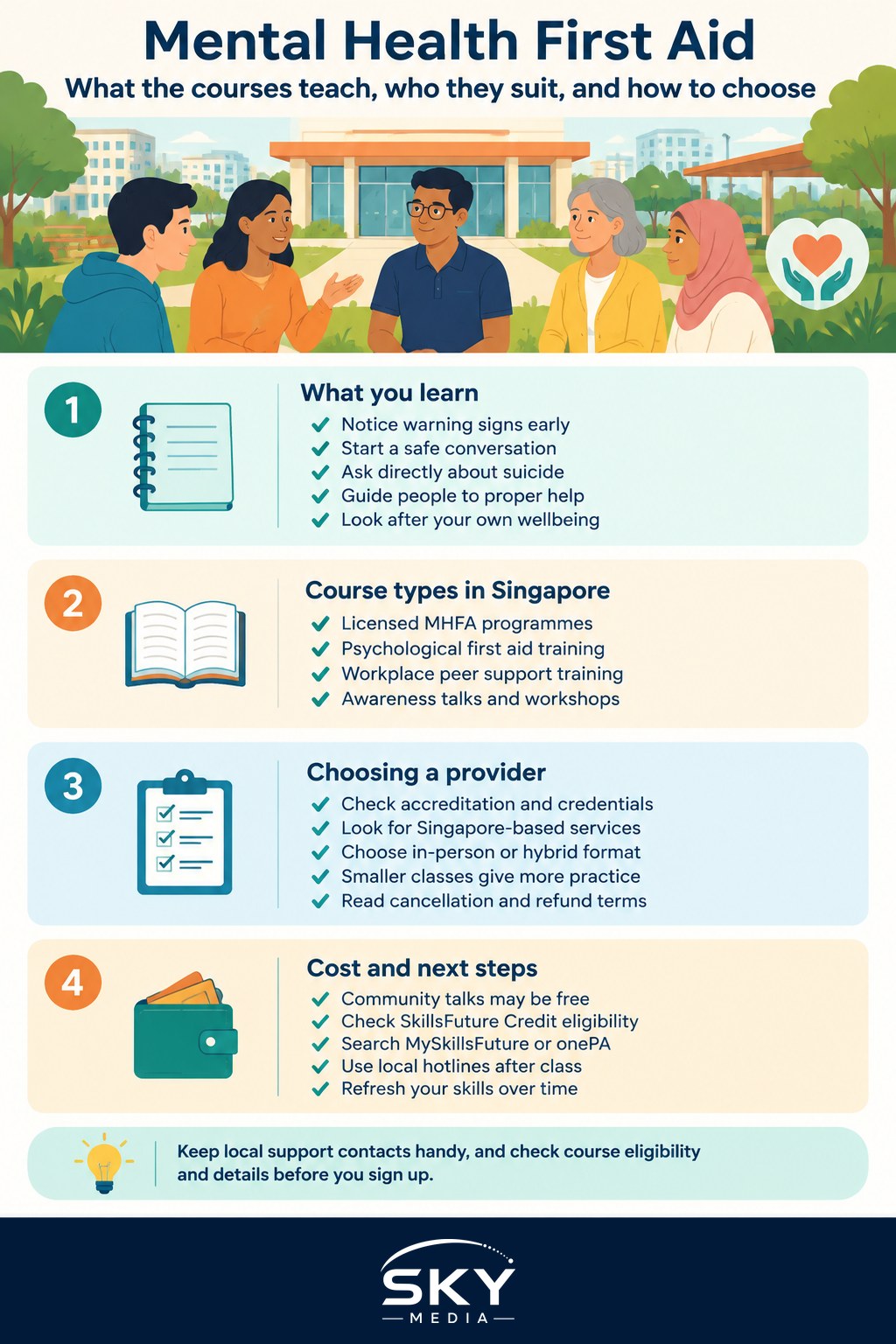
What a Mental Health First Aid Course Actually Teaches
The name borrows from physical first aid on purpose. Just as a CPR course does not turn you into a doctor, a mental health first aid course does not make you a counsellor. The goal is to help you hold the line until the right support is in place.
Most courses, whatever the brand, cover a similar core:
- Mental health literacy. Plain explanations of common conditions such as depression, anxiety, psychosis and substance use problems, and how they can show up in everyday behaviour.
- Recognising warning signs. Changes in mood, sleep, appetite, work performance, social withdrawal, or comments about feeling hopeless or being a burden.
- Starting the conversation. How to choose a private moment, ask open questions, and listen without rushing to fix or judge.
- Asking directly about suicide. Many courses teach you to ask clearly and calmly if you are worried. Trainers explain that asking does not plant the idea, and that a direct question often brings relief.
- Crisis responses. What to do in situations such as a panic attack, someone in acute distress, or someone at immediate risk, including when to call emergency services.
- Signposting. How to encourage professional help and connect the person to suitable services, from a family doctor to a hotline.
- Looking after yourself. Boundaries, debriefing and recognising when supporting someone is taking a toll on you.
Courses typically use role-play and case scenarios, so expect to practise saying the words out loud.
Types of Courses You Will Find in Singapore
Training on offer in Singapore broadly falls into a few groups.
Licensed Mental Health First Aid (MHFA) programmes. MHFA is an internationally recognised programme that started in Australia and is now delivered in many countries through licensed instructors. Accredited versions follow a set curriculum and usually award a certificate valid for a fixed period, after which a refresher is recommended.
Psychological first aid (PFA) training. PFA focuses on supporting people right after a distressing event, such as an accident, sudden loss or community crisis. It is often run by social service and humanitarian organisations and suits volunteers and community leaders.
Workplace mental health courses. Some employers bring in trainers to equip managers or appointed “wellbeing champions” with peer support skills. These are sometimes tailored to a company’s own Employee Assistance Programme (EAP) and HR processes.
Short awareness talks and workshops. Community clubs, libraries, schools and religious organisations sometimes run free or low-cost sessions of a couple of hours. These raise awareness but are not full certification courses.
| Course type | Typical length | Best for | What you get |
|---|---|---|---|
| Licensed MHFA programme | One to two full days, or several shorter sessions | Anyone wanting structured, recognised training | Certificate, set curriculum, refresher recommended |
| Psychological first aid | Half a day to a full day | Volunteers, community leaders, crisis responders | Skills for the hours and days after a distressing event |
| Workplace peer support training | Varies, often tailored | Managers, HR staff, wellbeing champions | Skills linked to company policies and EAP |
| Awareness talk or workshop | One to three hours | Curious beginners, parents, students | Basic literacy, no formal certification |
Lengths are typical patterns only, so check each course page.
Who Runs These Courses and How to Choose
In Singapore, mental health training is offered by a mix of social service agencies, hospital and community health training arms, voluntary welfare organisations, and private training providers. Rather than recommending a single provider, here is what to check before you pay:
- Accreditation. If a course calls itself MHFA, ask whether the trainer is a licensed instructor and whether the certificate is recognised. For other courses, look for a clear syllabus and trainer credentials, such as backgrounds in psychology, counselling, social work or nursing.
- Local context. Good courses refer to Singapore services, such as polyclinics, family service centres and local hotlines, so you know where to point people here, not overseas.
- Format. In-person classes allow better role-play. Online or hybrid options suit busy schedules but check they still include practice.
- Class size. Smaller classes mean more chance to practise and ask questions.
- Language. Some providers run sessions in Mandarin or other languages, useful if the people you support are more comfortable outside English.
- Cancellation and refund terms. Read these before you register, especially for multi-day courses.
You can search for courses on the MySkillsFuture portal, on community club listings through the onePA platform, and on the websites of mental health organisations. The national mental health resource site mindline.sg is also a useful starting point for understanding local services.
Costs and Using SkillsFuture Credit
Fees vary widely by provider, length and whether the course is subsidised, so we will not quote numbers here. Short community talks are often free. Full certification courses usually cost more.
If you are a Singapore Citizen aged 25 and above, you may be able to use your SkillsFuture Credit, but only for courses that are listed as eligible on the MySkillsFuture portal. To check:
- Log in to MySkillsFuture with Singpass.
- Search for the course name or keywords such as “mental health first aid” or “psychological first aid”.
- Confirm the listing shows the course is claimable with SkillsFuture Credit.
- Submit your claim through the portal before the course starts, following the current instructions shown.
Rules, eligibility and course listings change, so confirm the current details on the SkillsFuture website run by the Skills and Workforce Development Agency (SWDA, formed in 2026 from Workforce Singapore and SkillsFuture Singapore). If you are a Permanent Resident or foreigner, ask the provider about other subsidies or employer sponsorship. Many companies will fund this training as part of staff wellbeing or development budgets, especially for supervisors.
After the Course: Using Your Skills Well
A certificate on its own does not help anyone. The real test is the first time you notice a friend or colleague is not okay. A few habits help:
- Keep a short list of local contacts on your phone. For example, the Samaritans of Singapore (SOS) 24-hour hotline at 1767 and the Institute of Mental Health (IMH) Mental Health Helpline at 6389 2222. In an emergency, call 995 or go to the nearest A&E.
- Remember your role. You are a bridge to help, not the help itself. Encouraging someone to see a doctor or counsellor is a success, not a failure.
- Refresh your skills. Many certificates recommend a refresher after a few years.
- Look after yourself. Supporting someone can be heavy. Talk to someone you trust, without sharing private details, if a conversation stays with you.
For workplace situations, our guide on protecting your mental health at work covers the bigger picture, and Mental Health Resources in Singapore lists where to point people for professional help. If the people you care for prefer Mandarin, see Mental Health Support in Mandarin.
Is It Worth Your Time?
For most people, yes. A mental health first aid course takes a day or two, and the confidence it gives you lasts much longer. Parents, teachers, managers, coaches, grassroots volunteers and anyone who is “the friend people talk to” will find it especially useful. You do not need any background in psychology to attend.
This article is general information, not medical advice. If you or someone you know is in crisis, contact SOS at 1767, call 995 in an emergency, or speak to a doctor or polyclinic.
Further reading: CHAT Mental Health Checks for Young People in Singapore · How to Check In on a Colleague Who Seems to Be Struggling