

Almost everyone has a graveyard of half-finished online courses. You sign up full of good intentions, watch the first few lessons with real enthusiasm, and then life gets busy, the momentum fades, and the course quietly joins the pile. Finishing online courses is one of the most common struggles for anyone trying to learn on their own time. The good news is that it is rarely a willpower problem. More often it is a design problem, and design is something you can fix.
Why we start but do not finish
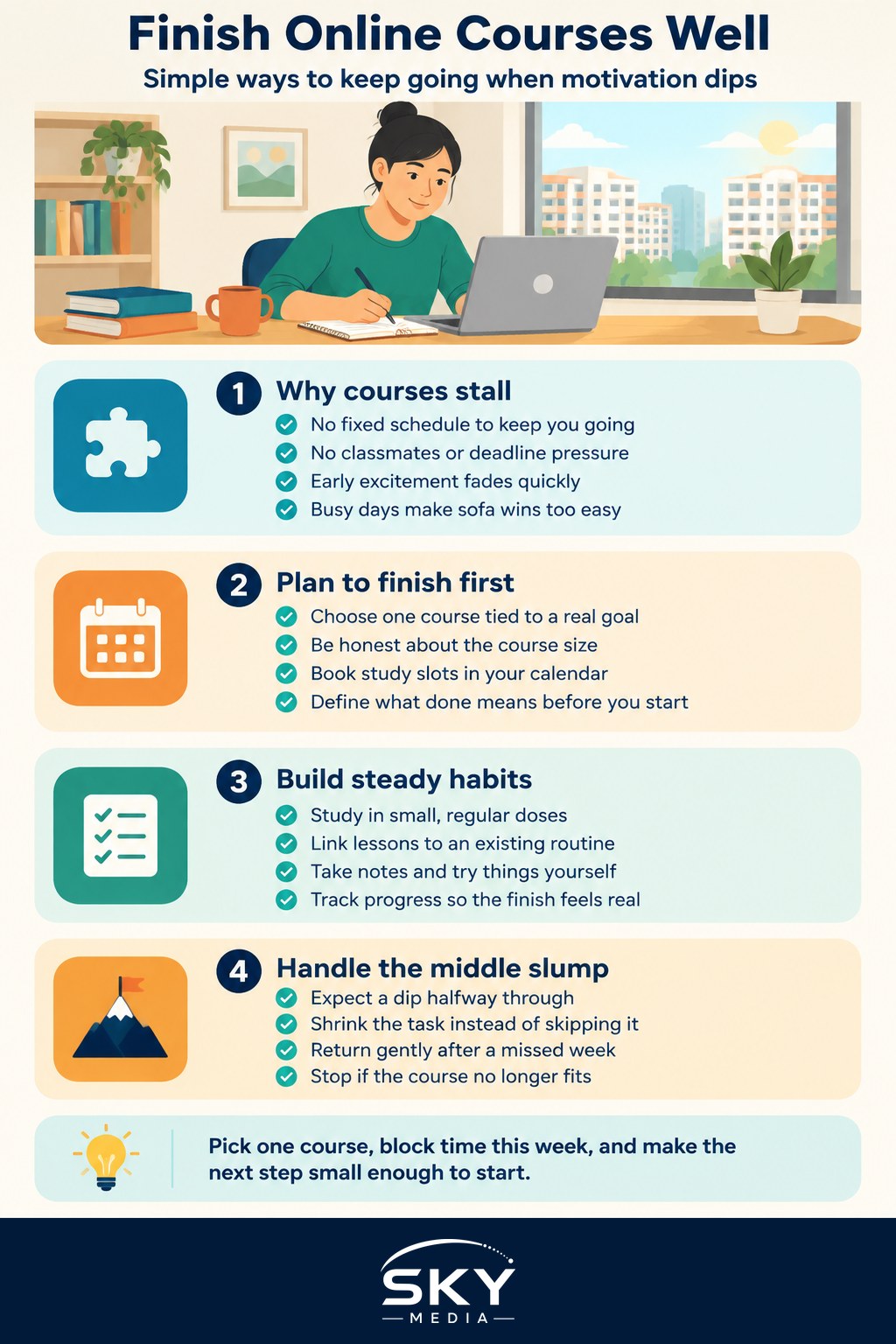
It helps to understand what actually derails us, because the reasons are surprisingly predictable. Online courses ask a lot of you that a classroom does not. There is no fixed schedule forcing you to show up, no classmates noticing your absence, and no real deadline. All the structure that normally carries you along is missing, and you are asked to supply it yourself.
On top of that, the early excitement is deceptive. Signing up feels like progress, so we get a little hit of satisfaction just from buying the course or watching lesson one. That feeling fades fast, and what remains is the ordinary, unglamorous work of showing up on a tired Tuesday night. Add our Singapore reality of long hours, commuting, and a dozen other commitments, and it is no wonder the course loses to the sofa. Knowing this is not an excuse, but it does tell you where to aim your effort: at building the structure the course does not give you.
Set up finishing before you start
The best time to plan for finishing online courses is before you dive in, while your motivation is high. A little setup now saves a lot of struggle later.
- Pick with intention. Choose one course that connects to a real goal, and resist enrolling in three at once. Finishing one beats abandoning many.
- Check the size honestly. Look at the total length and be realistic about your week. A shorter course you complete is worth more than an epic one you never finish.
- Book the time. Put specific slots in your calendar, for example two evenings a week, rather than hoping to find time. This is the heart of how to plan your day applied to learning.
- Decide your “done.” Define what finishing means: all lessons watched, the final project built, or the key skill practised. A clear finish line pulls you forward.
Doing this turns a vague wish into a concrete plan, which is far more likely to survive a hectic month.
Habits that carry you to the finish
Once you have started, small, repeatable habits matter more than bursts of motivation. Aim for consistency over intensity.
Show up in small, regular doses. One focused lesson a few times a week beats a rare three-hour marathon that leaves you drained and unlikely to return. Attaching your study to an existing routine helps enormously, a technique known as habit stacking: watch one lesson right after dinner, or review notes on the morning commute.
Make it active, not passive. It is easy to let videos play while your mind wanders. Instead, take notes, pause to try things yourself, and teach the idea back in your own words. Learning that involves doing sticks far better, and it keeps you engaged enough to keep going. For more on this, how to learn anything faster is a useful companion.
Track your progress visibly. Ticking off completed lessons gives you a small, satisfying sense of momentum, which is exactly what how to celebrate small wins is about. Seeing the bar fill up makes the finish feel real and reachable.
Handling the messy middle
Every course has a slump, usually somewhere in the middle, where the novelty is gone but the end is not yet in sight. This is where most people quit, so expect it and plan for it rather than being surprised.
When motivation dips, shrink the task instead of skipping it. Tell yourself you only need to watch one short lesson, not power through a whole module. Starting small is often enough to get you moving again. If you fall behind, resist the urge to declare the whole thing a failure. Missing a week is normal; the skill is simply returning, gently, without drama. Reconnect with why you signed up in the first place, whether it was a career goal or genuine curiosity, and let that pull you the last stretch.
Be honest, too, about courses that no longer serve you. If your goals have genuinely changed, or the course turned out to be a poor fit, choosing to stop can be a wise decision rather than a defeat. The aim is not to finish everything you ever start out of guilt. It is to finish the things that still matter to you, and to do it without shame when they do.
Finishing online courses comes down to treating learning like any other worthwhile habit: plan the time, keep the doses small and regular, make the learning active, and expect a slump you can walk through. Do that, and the graveyard of abandoned courses slowly turns into a shelf of real skills you actually earned. Pick one course, block the time this week, and take the first small, doable step.