
With mid-year exams over and the June school holidays starting, many Singapore families head overseas. Amid the packing lists, flight check-ins and hotel bookings, one small step often gets skipped: registering the trip with MFA eRegister. It takes a few minutes, it is free, and it helps Singapore’s Ministry of Foreign Affairs (MFA) find and reach you if something serious happens where you are travelling.
This guide explains what MFA eRegister is, why it is worth doing even for short holidays, what information you will be asked for and what it can and cannot do for you. Always check the official MFA website for the current details, as the system and its features can be updated.
What MFA eRegister Is
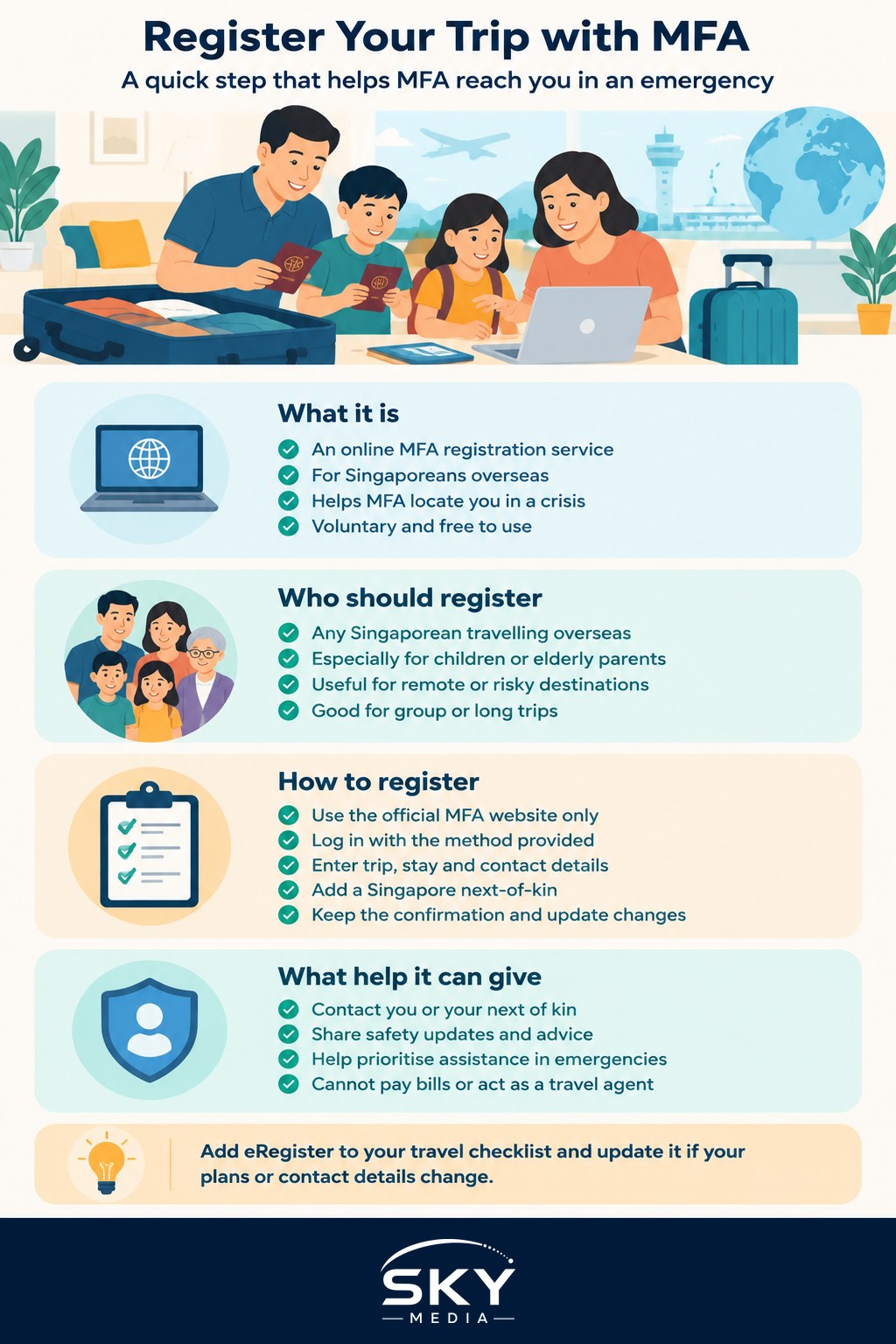
MFA eRegister is an online registration service run by the Ministry of Foreign Affairs. Singaporeans travelling or living overseas can log their trip details and contact information so that MFA and Singapore’s overseas missions (embassies, high commissions and consulates) know who may be in an affected area during an emergency.
It is voluntary. Nobody checks for it at immigration and there is no penalty for not registering. But in a crisis, such as an earthquake, flood, terror attack, political unrest or a major transport disruption, the information helps consular officers:
- Work out which Singaporeans are likely to be in the affected area
- Contact you, or your listed next of kin, to check that you are safe
- Send you important updates and advice
- Prioritise assistance if evacuation or other help is needed
Without registration, officers may have to rely on worried relatives calling in, which is slower and less reliable.
Who Should Register
MFA encourages Singaporeans to eRegister whenever they travel overseas. It is especially worthwhile if you are:
- Travelling with young children or elderly parents, where help could be needed quickly. Our guide to multi-generational family trips has more planning tips for these journeys.
- Going somewhere with a current MFA travel advisory, or to an area prone to natural disasters.
- Heading to remote areas, such as trekking routes, islands or rural regions with patchy phone coverage.
- Travelling in a group, such as a school trip, company outing or extended family holiday. See planning group trips from Singapore for the wider logistics.
- Staying overseas for a long period, for work, study or an extended stay.
If you are a permanent resident or a foreign national living in Singapore, check the MFA website for whether the service applies to you, and also look into what your own country’s embassy offers. Many governments run similar registration schemes for their citizens abroad.
How to Register: Step by Step
The exact screens may change, but the process generally looks like this:
- Go to the official MFA eRegister page through the MFA website. Be wary of look-alike sites and only use the official government address.
- Log in using the method offered on the page, such as Singpass.
- Enter your trip details, including destination countries and cities, travel dates and where you are staying.
- Add your contact details overseas, such as your mobile number and email address, and whether you will use roaming or a local SIM.
- Add a next-of-kin contact in Singapore who can be reached if you cannot.
- Include travel companions if the system allows, such as family members on the same trip.
- Submit and keep any confirmation. Update your registration if your plans change.
Registering a week or so before departure is ideal, once your accommodation is confirmed, but registering even on the day is better than not at all.
eRegister and Other Travel Safety Steps Compared
eRegister works best as part of a wider routine. Here is how it sits alongside other common steps:
| Step | What it does | When to do it |
|---|---|---|
| MFA eRegister | Lets MFA find and contact you in an overseas emergency | Before departure, updated if plans change |
| Check MFA travel advisories | Warns you about risks in your destination | When planning, and again just before you fly |
| Travel insurance | Covers medical bills, delays, losses and evacuation as per policy | When booking, so cancellation cover applies |
| Note your nearest Singapore mission | Gives you a place to turn if you lose your passport or need help | Before departure, saved offline |
| Share itinerary with family | Lets someone at home know where you should be | Before departure |
What Consular Help Can and Cannot Do
It helps to have realistic expectations. Singapore’s overseas missions can typically help in situations such as:
- Replacing a lost or stolen passport with an emergency travel document
- Giving information on local doctors, hospitals and lawyers
- Contacting your family if you are seriously ill, injured or detained
- Coordinating help and advice during major crises
Consular officers generally cannot pay your hotel or medical bills, get you out of jail, interfere in another country’s legal process or act as a travel agent. That is why travel insurance and your own preparation matter just as much. The MFA website explains the scope of consular assistance in more detail.
MFA also runs a 24-hour duty office for Singaporeans needing urgent consular help overseas. Save its contact details and the details of the Singapore mission nearest your destination from the MFA website before you leave, and keep a copy offline in case you lose data access.
Practical Tips for Families and Frequent Travellers
- Make it part of your checklist. Add eRegister next to “check passport validity” and “buy insurance” so it becomes routine.
- Keep phone numbers working. If you switch to a local SIM, update your registration or make sure your next of kin knows the new number.
- Register each trip separately. A trip to Japan in June and another to Malaysia in December are separate registrations.
- Teach older children the basics. Make sure teenagers travelling on school or overseas exchange trips know how to contact the group leader and, in an emergency, the nearest Singapore mission.
- Carry copies of documents. Keep a photo of your passport data page and insurance details somewhere secure, separate from the originals.
- Check health requirements too. Some destinations need vaccinations or health precautions; our guide on travel vaccinations for trips to China shows the kind of planning involved.
Why It Is Worth Five Minutes
Most trips go smoothly and eRegister is never needed. But when disasters do strike, families in Singapore often spend anxious hours trying to find out if loved ones are safe. A quick MFA eRegister entry means officers already know you may be there and how to reach you. For the time it takes to choose an in-flight movie, it is one of the simplest safety steps you can take before any overseas trip.
Frequently Asked Questions
Is MFA eRegister compulsory for Singaporeans travelling overseas? No, it is voluntary. Nobody checks for it at immigration and there is no penalty for not registering. In a crisis, though, the information helps consular officers contact you or your next of kin, so MFA encourages Singaporeans to register whenever they travel.
How early should I register my trip on eRegister? A week or so before departure is ideal, once your accommodation is confirmed. Registering even on the day is better than not at all. Update your entry if your plans change, and register each trip separately.
Can Singapore consular officers pay my hospital bill overseas? No. Consular officers generally cannot pay hotel or medical bills, get you out of jail or interfere in another country’s legal process. They can help with emergency travel documents, local doctor and lawyer information and contacting family, so travel insurance still matters.
What should I do if I lose my passport on holiday? Contact the Singapore mission nearest your destination, which can typically replace it with an emergency travel document. Save its contact details offline before you leave, and keep a photo of your passport data page stored separately from the original.
Does a permanent resident or foreigner living in Singapore use eRegister? Check the MFA website for whether the service applies to you. You should also look into what your own country’s embassy offers, since many governments run similar registration schemes for their citizens abroad.